Berlin Seeds Alfalfa Sprouting Seed Recall: Check the Bag Size and Lot Code
Berlin Seeds is recalling about 950 pounds of its alfalfa sprouting seed because it may be contaminated with Shiga toxin-producing E. coli (STEC) and/or Salmonella. The FDA-posted company announcement is dated September 23, 2026; it does not give a specific posting time. Check the package details below. Importantly, the ¼-, ½-, and 1-pound bags have no lot code, so a missing code does not by itself rule out those packages.
Updated October 18, 2026: We rechecked the FDA notice and its product photos. The recall scope, package sizes, lot-code rules, and consumer instructions remain unchanged.
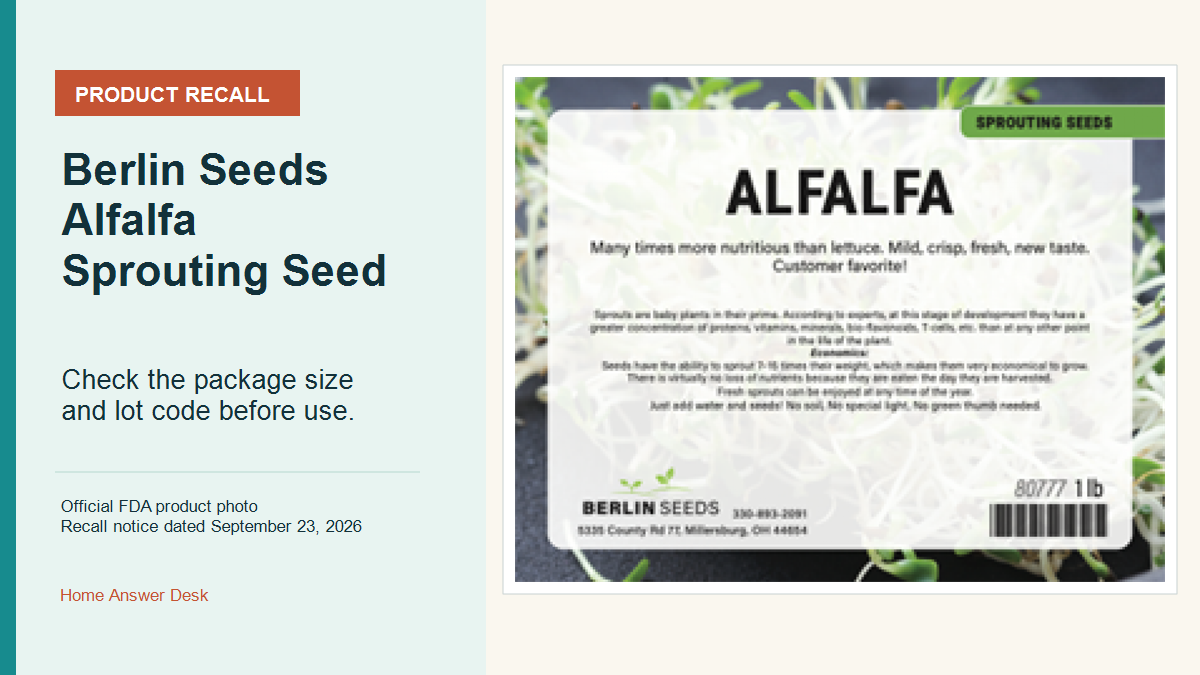
Quick check: is your seed included?
| What to check | Recalled product details |
|---|---|
| Brand and product | Berlin Seeds Alfalfa Sprouting Seed |
| Package sizes | ¼ lb, ½ lb, 1 lb, 5 lb, or 50 lb |
| Lot code on 5-lb and 50-lb packages | SAL2-24JB, at the bottom-right of the label |
| Lot code on ¼-lb, ½-lb, and 1-lb packages | No lot code is printed; check the other product and purchase details and compare with the FDA photos |
| Sold | February 13 through August 23, 2026 |
| Sales channels | Berlin Seeds’ Millersburg, Ohio retail store and its website |
The product was sold to customers in these states: Alaska, Alabama, Arkansas, Arizona, California, Colorado, Connecticut, Delaware, Florida, Iowa, Idaho, Illinois, Indiana, Kansas, Kentucky, Massachusetts, Maryland, Maine, Michigan, Minnesota, Missouri, Mississippi, Montana, North Carolina, North Dakota, Nebraska, New Hampshire, New Mexico, New York, Ohio, Oklahoma, Oregon, Pennsylvania, South Carolina, South Dakota, Tennessee, Texas, Utah, Virginia, Vermont, Washington, Wisconsin, West Virginia, and Wyoming.
For package photos and the exact official notice, see the FDA recall announcement. The FDA page describes this as a company announcement posted as a public service; FDA says it does not endorse the company or product.
If you have a matching package
- Stop using it. Do not eat, sprout, plant, or give away the seed.
- Do not eat sprouts already grown from this seed. Throw those sprouts away.
- Discard the seed in a sealed bag in the trash.
- Clean and sanitize items it may have touched. This includes jars, trays, sprouters, and contacted surfaces.
- If you ate the recalled product and feel ill, contact a health care provider. The FDA notice does not offer individual diagnosis or treatment advice.
Berlin Seeds lists 877-464-0892 for consumer questions and replacement arrangements, Monday through Friday, 8 a.m.–4 p.m. Eastern Time. The company also lists order@berlinseeds.life; it says email replies are handled during those business hours.
Why was the seed recalled?
The company says its supplier notified it that the seed had been identified through traceback as seed used by a sprout grower whose finished sprouts were part of an FDA investigation involving several STEC strains and Salmonella Agona. The supplier also told the company that a spent irrigation-water sample from one of its alfalfa seed lots tested positive for E. coli.
That context explains the recall, but it should not be overstated: the announcement describes a potential contamination risk. It does not say that this specific recalled seed package was confirmed to contain a pathogen or that it was proven to cause an illness. The company says one illness had been reported directly to Berlin Seeds in connection with the seed. The notice also says no other Berlin Seeds sprouting seeds, including other alfalfa sprouting seed, are included in this recall.