How to Clean a Leather Couch Without Stripping the Finish
Quick answer: Find the manufacturer label and identify the upholstery before applying any liquid. For routine care, remove loose grit with the soft attachment or dry-cloth method the maker permits. For a fresh spill, blot with a clean, dry white cloth—do not rub. Only wet-clean protected leather when the couch instructions allow it, using the exact cleaner and method approved for that finish. Keep aniline, artisan, nubuck, suede, unknown, peeling, or damaged surfaces out of a generic soap-and-water routine.
“Leather couch” can mean protected real leather, absorbent aniline leather, nubuck, a mix of leather and vinyl, bonded material, or fully synthetic upholstery. Those surfaces can look similar and react differently. The useful first question is not Which homemade cleaner works? It is What surface do I have, and is this still a cleaning problem?
If the upholstery is fabric rather than leather, start with our complete couch-cleaning guide.
At a glance
| Job | Active time | What you need | Risk level |
|---|---|---|---|
| Dry dust and crumb removal | About 10–20 minutes | Maker-approved soft attachment or clean dry cloth | Low after checking the attachment in a hidden area |
| Fresh-spill control | Start immediately | Several clean dry white cloths | Low if you blot only and stop before adding an unapproved product |
| Approved cleaning of protected leather | Often 20–45 minutes plus drying | The product and cloths named by the couch maker | Moderate; the wrong product can change color or finish |
| Aniline, nubuck, suede, unknown material, large stain, or damage | Do not guess | Label/model information and a qualified cleaner if needed | High for DIY wet cleaning |
Times are practical estimates, not manufacturer specifications. Drying time depends on the product, room, upholstery, and maker directions.
Find the material and care instructions first
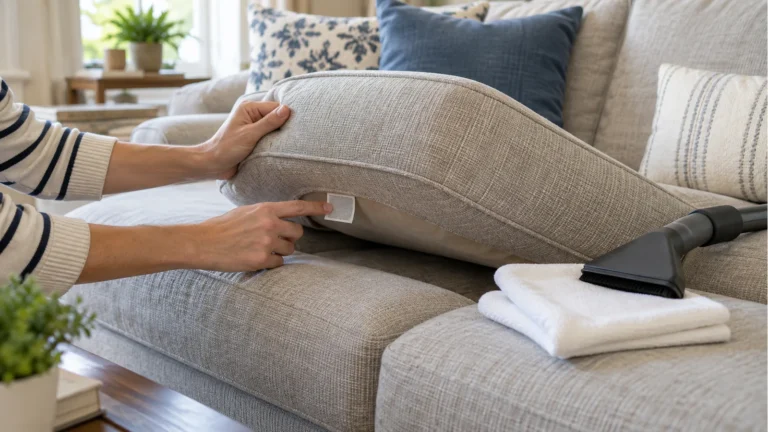
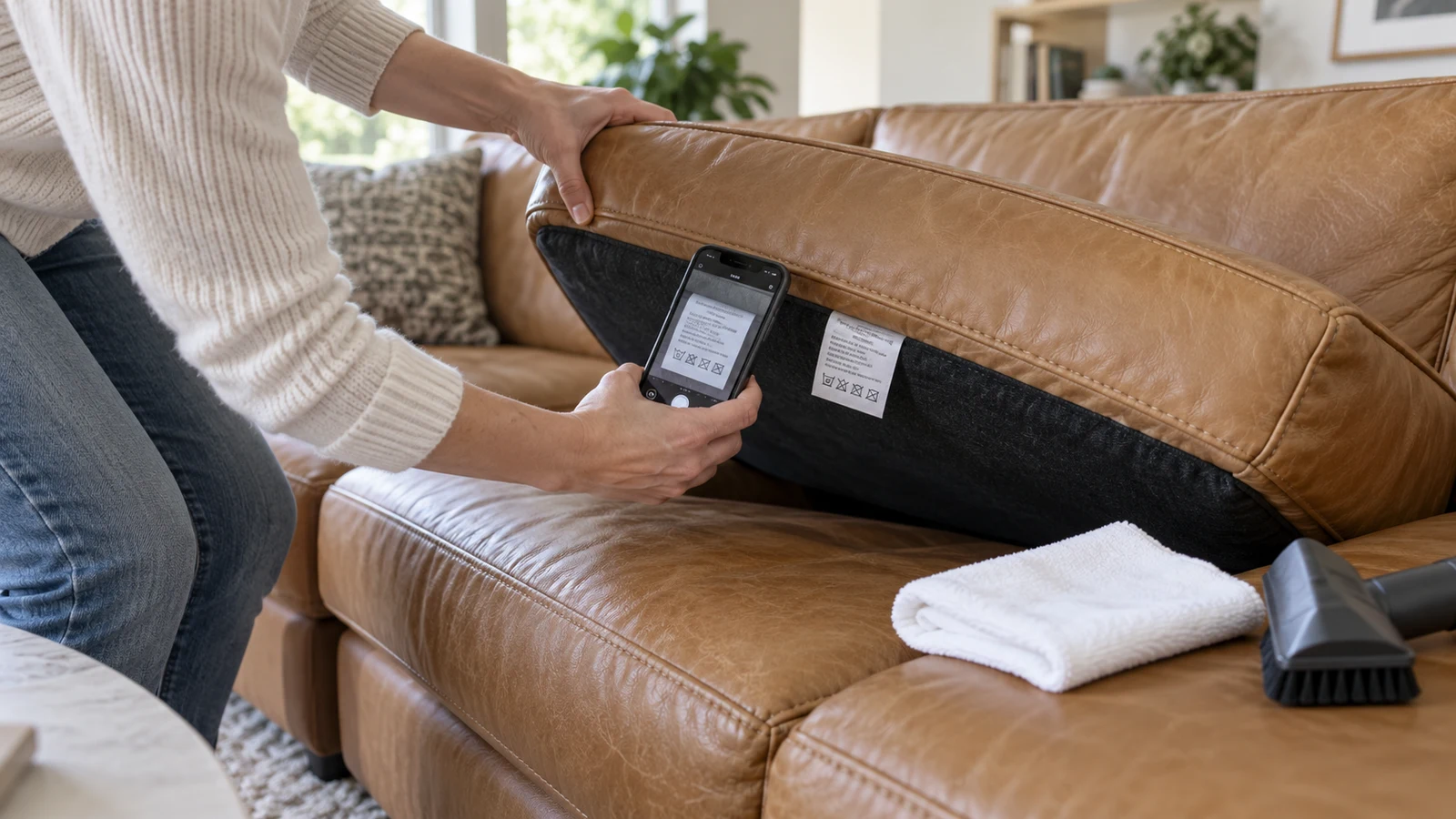
Look beneath removable cushions, under the seating deck, or along the frame. Photograph the complete label and note the manufacturer, model, upholstery name, and any material or care wording. A zipper does not prove a cover is removable or washable.
Use the couch maker’s current instructions when you can find them. Furniture companies do not give one shared leather recipe. La-Z-Boy allows a slightly distilled-water-damp cloth for routine care, while Ethan Allen tells owners to keep its natural and artisan leathers dry. Herman Miller permits a mild-soap route for its leather but explicitly rejects saddle soap, solvents, oils, furniture polish, abrasives, detergents, and ammonia.
That variation is the reason to treat the label as the decision point—not as a formality after choosing a cleaner.
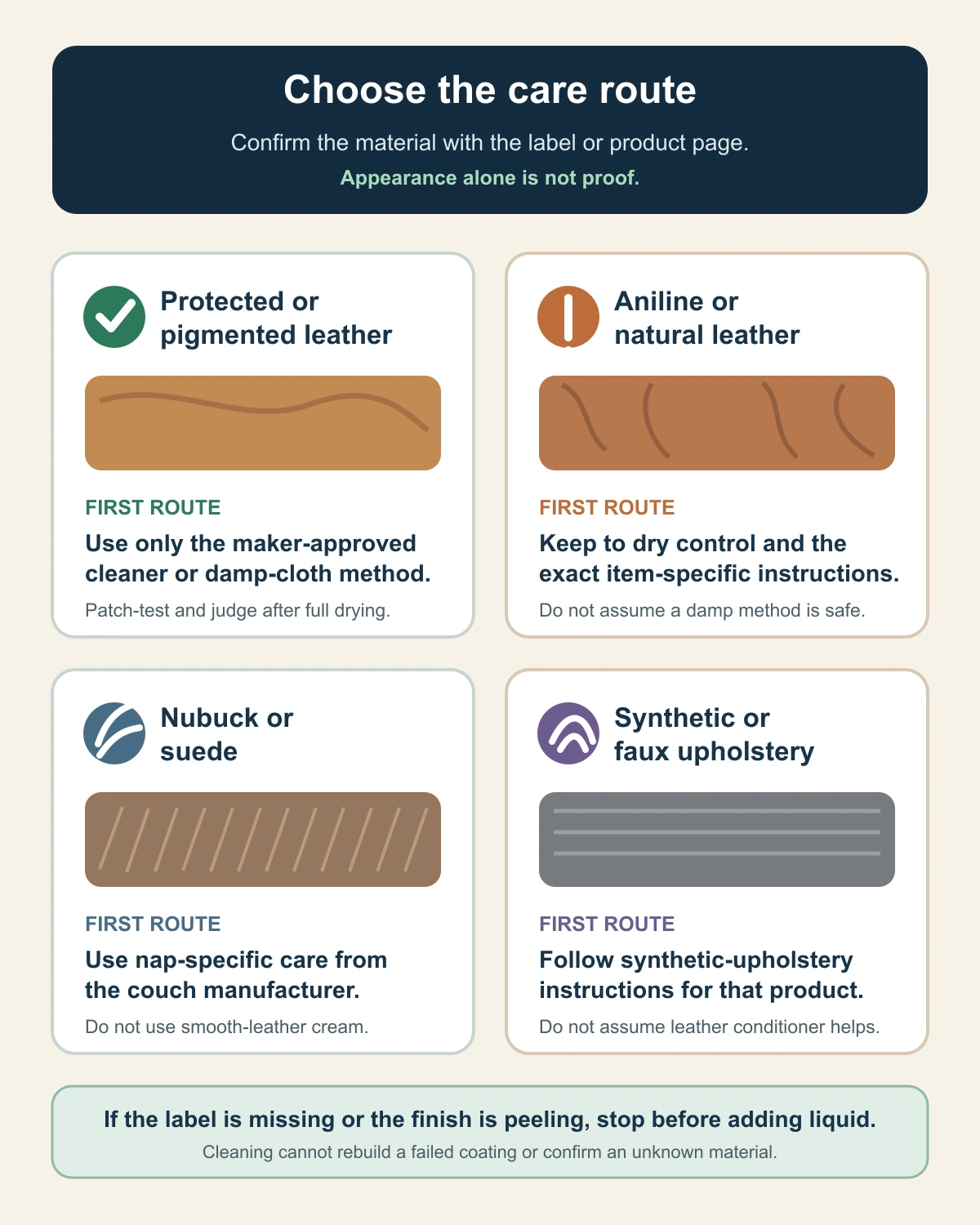
| What the label or product page says | Safe next move | Do not assume |
|---|---|---|
| Protected, corrected, or pigmented real leather, with a named home-cleaning method | Follow that exact method and product directions after a hidden test | That vinegar, dish soap, alcohol, saddle soap, or any “leather cleaner” is approved |
| Full-aniline, natural, artisan, unfinished, pull-up, or other absorbent specialty leather | Use only the item-specific instructions; dry spill control may be the only safe immediate action | That a barely damp cloth is harmless because the couch is real leather |
| Nubuck or suede | Use the separate nap-leather instructions from the maker | That a smooth-leather cleaner or conditioner is compatible |
| Synthetic, faux, PU, or vinyl upholstery | Use the synthetic-upholstery route given for that product | That real-leather conditioner will help or that peeling can be cleaned away |
| “Leather match” or mixed materials | Identify which panels are leather and which are synthetic before treating either | That every visible panel has the same coating |
| Unknown, missing label, vintage, or previously treated | Remove loose dry soil only while you identify the couch or arrange assessment | That appearance, softness, or a water-drop test proves the finish |
If your couch has a nap or suede-like surface, use our suede-couch identification and cleaning guide instead of continuing with a smooth-leather method.
Safety boundary: Never layer a new cleaner over unknown residue, and never mix cleaning products. Do not use bleach, ammonia, peroxide, acetone, nail-polish remover, rubbing alcohol, disinfecting wipes, vinegar, kitchen oil, furniture polish, steam, or a hair dryer unless the current instructions for that exact couch and product explicitly allow the use. A hidden test can reveal a problem; it cannot make a prohibited method safe.
Diagnose what you see before cleaning
A dark patch may be wet leather, absorbed body oil, dye transfer, finish loss, or normal patina. A shiny patch may be residue or abrasion. Peeling is usually a failing surface layer, not dirt. Use the visible condition to decide whether cleaning is likely to help.
| What you see | First low-risk action | Stop DIY cleaning when |
|---|---|---|
| Dust, crumbs, pet hair, or grit | Test the permitted soft attachment on a hidden seam, then lift debris from seams and surfaces without a rotating brush | The tool leaves a mark, catches, or transfers color |
| A fresh water-based spill | Blot from the outer edge toward the center with a dry white cloth; change to a dry section as it absorbs | Liquid reached a seam or cushion interior, or color transfers |
| Fresh oil or grease | Lift any excess without spreading it; follow the maker’s oil-stain route | The maker gives no route, the area is large, or the leather is absorbent |
| Ink, denim dye, makeup, adhesive, or paint | Photograph it and check the exact maker guidance before applying anything | The method would require alcohol, solvent, abrasion, or an unapproved remover |
| Dark, sticky headrest or arm area | Treat it as body-oil buildup until the maker or cleaner identifies it | The surface is tacky, color is lifting, or previous products are unknown |
| Water ring or uneven color | Let the area dry fully and compare it in daylight before deciding it is residue | The boundary grows, remains fixed, or the leather changes texture |
| Cracks, exposed backing, flaking, peeling, bald color, or rough finish | Stop and document the area for repair assessment | Always—cleaning cannot replace a missing coating or repair a tear |
| Urine, vomit, smoke, or another odor that reached seams or foam | Blot accessible liquid and isolate the couch from use; for urine, use the couch urine-odor depth guide | Odor or moisture is inside cushioning; surface wiping cannot decontaminate the interior |
Routine dry cleaning for an identified couch
Dry soil removal is the safest useful starting point when the maker permits it.
- Clear the couch without dismantling it. Remove only cushions designed to be removable. If a zipper is present, use our couch-cushion care-label guide before opening or washing anything.
- Inspect the attachment. Use a clean upholstery or soft-brush attachment only when the maker permits vacuuming. Do not let a rotating brush roll touch the upholstery.
- Test a hidden seam. Make one gentle pass where a new mark would not be visible. Stop if the finish looks glossier, rougher, lighter, or darker.
- Lift grit before wiping. Work through cushion gaps, seams, piping, and the seating deck. Grit left under a cloth can abrade the surface.
- Finish with the approved dry method. This may be a clean, dry, lint-free cloth or the same soft attachment. Do not polish harder to chase an uneven sheen.
Dry cleaning removes loose debris. It does not remove a fixed stain, body-oil saturation, finish damage, or contamination in the cushion.
What to do with a fresh spill
1. Blot before choosing a cleaner
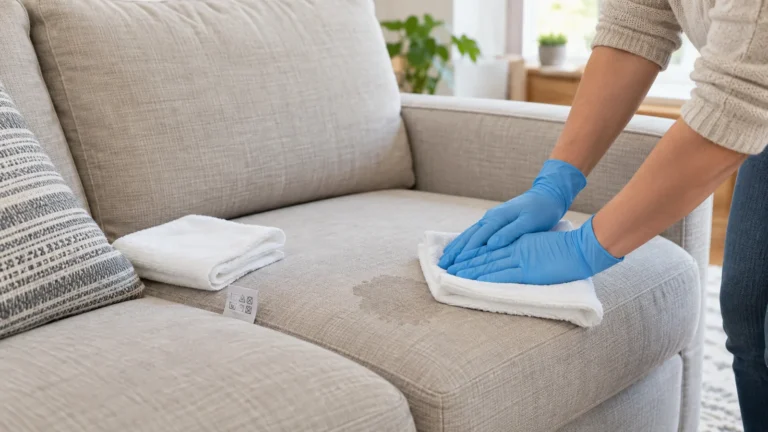
Use a clean, dry white cloth. Press straight down, lift, and move to a dry section. Work from the outside toward the center so you do not spread the spill. Do not scrub or push liquid toward a seam.
Check beneath a removable cushion and along nearby seams. If liquid has entered the cushion or deck, surface cleaning alone cannot reach the full problem.
2. Match the route to the exact upholstery
- Protected/corrected/pigmented leather: use the cleaner or damp-cloth route named by the manufacturer. If the instructions do not permit home wet cleaning, stop.
- Aniline/natural/artisan leather: use the item-specific route. IKEA’s current STOCKHOLM SEGLORA product page identifies its cover as aniline leather and permits a soft-brush vacuum; if needed, wipe it with a slightly damp cloth. Ethan Allen gives its natural and artisan leathers a different, dry-only care route. These product-specific instructions are not one method for all aniline leather.
- Nubuck/suede: use nap-specific instructions; do not apply a smooth-leather cream.
- Synthetic/faux upholstery: follow the synthetic route. Room & Board, for example, separates synthetic cleaning from top-grain leather and warns against soap, harsh detergent, and excess water on its synthetic upholstery.
- Unknown or mixed material: continue dry blotting while you identify the model. Do not gamble on a visible panel.
3. Run a full-dry hidden test
Only test a product the manufacturer already permits. Use the amount and location specified by the product, then wait for the stated drying time. Judge the test after it is completely dry.
Record four results:
- Did color transfer to the white cloth?
- Did the test area become darker, lighter, glossier, or duller?
- Did the surface become tacky, stiff, rough, or swollen?
- Is there a hard boundary after full drying?
Any “yes” is a stop signal. Do not dilute the product differently and try again on a visible cushion.
4. Clean a panel only as directed
Some manufacturers, including Herman Miller for its leather, say not to spot clean and instead treat the entire seat, back, or arm surface. Other products may give a different boundary. Follow the couch instructions exactly; do not turn “clean the whole panel” into permission to soak a cushion or treat the entire couch.
Apply cleaner to the cloth or applicator as directed—never by improvising a spray pattern. Use light pressure, control moisture around seams, and remove residue only as the product instructs.
5. Air-dry without heat
Let the surface dry naturally with ordinary room airflow. Keep people and pets off the area while it dries. Do not aim a hair dryer, space heater, iron, or steamer at the leather. Herman Miller specifically directs air drying without a hair dryer or other heat source, and La-Z-Boy warns that intense heat can dry and crack leather.
Do not judge final color while the leather is damp. Moisture can temporarily darken an area.
Should you condition after cleaning?
Only when the couch maker recommends a conditioner for the exact leather.
Conditioner is not a universal final step. It may be appropriate for a named top-grain product and inappropriate for natural/artisan leather, nubuck, synthetic upholstery, a peeling coating, or a couch already loaded with oil or polish. Room & Board recommends different products by material type; Ethan Allen tells owners of some leather to avoid unapproved oil and cleaner entirely.
If conditioning is approved:
- wait until the cleaned surface is fully dry;
- patch-test the exact conditioner for the complete label time;
- apply only the stated amount and method;
- stop if the test darkens, streaks, softens unevenly, or becomes tacky; and
- do not use olive oil, coconut oil, petroleum jelly, or furniture polish as substitutes.
Conditioner cannot rebuild a peeling coating, close a crack, replace lost color, or remove contamination from inside a cushion.
Why common online recipes can fail
Vinegar and dish soap
Some editorial guides recommend them broadly. Furniture-maker instructions are not consistent enough to treat either as universally safe. Ethan Allen rejects soap on its natural and artisan leather, while Herman Miller allows a mild-soap lather on its products but rejects detergents. Use the couch instructions, not a generic dilution ratio.
Rubbing alcohol for ink
Alcohol can alter dye or finish. If the maker names a leather ink remover, use only that route after testing. Otherwise, a small professional repair is safer than enlarging a pen mark into a pale patch.
Baking soda or cornstarch for oil
Powder advice is common online, but it is not universal manufacturer guidance. Herman Miller’s oil route is dry blotting and allowing the remaining oil to dissipate; Ethan Allen also gives a dry-blot route for some leather. Do not grind powder into an unidentified, absorbent, or napped surface.
Saddle soap, kitchen oils, and furniture polish
These products sound leather-friendly because they are associated with other leather goods. Upholstered furniture finishes are not interchangeable with saddles, shoes, or unfinished hides. Current Herman Miller and Ethan Allen instructions expressly reject several of these products.
Steam or extraction
Leather and synthetic coatings can react badly to heat, excess moisture, and aggressive extraction. Do not use a carpet/upholstery machine or garment steamer unless the exact couch instructions permit it.
Cleaning or repair? Use this boundary
Cleaning can remove compatible surface soil. It cannot reverse every visual change.
Choose repair or professional assessment when:
- the surface is peeling, flaking, cracked through, torn, or showing backing;
- a fixed pale or dark area is color/finish loss rather than removable residue;
- the material is unknown, vintage, natural/artisan, aniline, nubuck, or suede and the mark needs liquid treatment;
- ink, dye transfer, adhesive, paint, or makeup needs a solvent the maker has not approved;
- a large area is sticky, oily, or uneven from body oils or previous products;
- liquid or odor has reached foam, batting, seams, or the couch deck;
- a hidden test transfers color or changes gloss, texture, or tackiness;
- the couch is under warranty and the proposed method is not authorized; or
- the manufacturer recommends professional cleaning.
Ask the cleaner or repairer what leather type they believe it is, whether they plan to clean or recolor/refinish, what panel boundary they will treat, and what change in color or sheen to expect. A professional service is an escalation route—not a guarantee that every stain or failed coating is reversible.
Save a one-panel test record
Before treating a visible area, take one minute to record:
| Record this | Why it matters |
|---|---|
| Maker, model, upholstery name, and a photo of the care label | Prevents a smooth-leather recipe from being used on a different finish |
| Exact product name and the maker instruction that permits it | Separates permission from a generic “leather safe” claim |
| Hidden test location and application time | Makes the result repeatable |
| Full drying time | Prevents temporary darkening from being mistaken for a permanent stain |
| Color transfer, boundary, gloss, texture, and tackiness after drying | Gives a clear stop/go result before a whole panel is exposed |
Keep this note with a photo of the test. If you later call the manufacturer or a cleaner, it is more useful than saying the couch was treated with “a gentle product.”
The method that protects the finish
The safest way to clean a leather couch is to identify the exact upholstery, remove loose grit, control fresh spills with dry blotting, and then use only the maker-approved route. Protected leather may allow a careful damp-cleaning process. Aniline, artisan, nubuck, suede, mixed, synthetic, or unidentified upholstery may require a different method—or no DIY liquid at all.
If the surface is peeling, losing color, deeply saturated, or changing during a hidden test, stop. That is no longer a routine-cleaning problem, and another household recipe is more likely to enlarge the damage than solve it.