How to Remove Rust From a Cast-Iron Pan and Rebuild the Seasoning
Quick answer: On confirmed non-enameled cast iron, remove visible rust with a maker-approved tool, wash, rinse, dry promptly, and apply a very thin oil layer. Small spots may need only the maker’s local treatment; widespread rust or substantial seasoning loss calls for its full reseasoning method. Do not scour an unknown finish: black matte enamel can resemble seasoned iron. Stop using a cracked or structurally weakened pan.
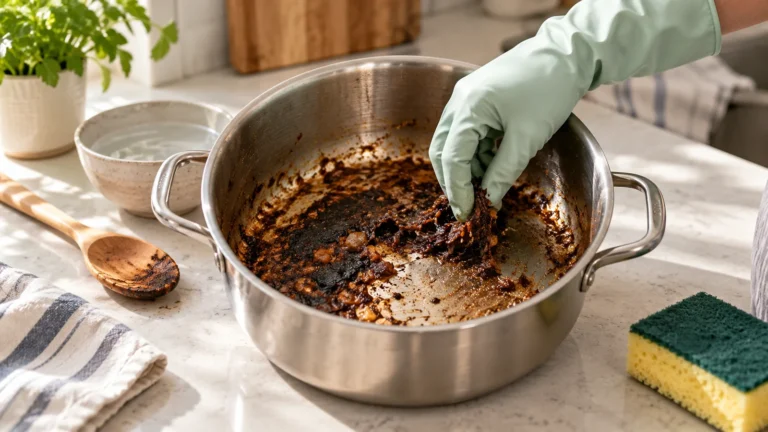
Use the rust-removal steps below only on confirmed non-enameled cast iron. Seasoning is a protective oil-based layer, not enamel. For stuck food without rust, start with our burnt-pot cleaning guide; cleaning food residue and restoring rusted iron are different jobs.
Updated October 22, 2026: clarified black matte enamel, small-spot versus full reseasoning routes, complete oven preparation, and the checks for rust, sticky oil, or structural damage. The decision map now has a separate phone layout.
Identify the finish · Start rust removal · Check the result
At a glance
| Time | Difficulty | Tools | Main risk |
|---|---|---|---|
| Varies with rust; oven seasoning also needs preparation and cooling | Moderate | Maker-approved rust tool, dish soap, lint-free towels, cooking oil, oven mitts | Hot metal and smoke; ventilate and follow the pan maker’s temperature |
Choose the right route before you clean
Identify the brand and product line from its markings, care sheet, or maker—not a scratch test. A dark, textured interior can be enamel: STAUB describes its interior as black matte enamel, and Lodge confirms that even its black enamel interiors do not need seasoning. If you cannot confirm the finish, pause before scouring or heating an empty pan. Do not pick at an edge to find out.
| What you have or see | Best first move | Why it matters |
|---|---|---|
| A few orange spots on bare cast iron | Use the maker’s small-spot route; wash, rinse, dry, and oil | Check what seasoning remains after the rust is gone; spot size alone does not prove the layer is intact |
| Rust covers much of the cooking surface | Remove visible rust, wash, rinse, dry, then follow the maker’s full reseasoning method | Oil wiped over remaining rust or loose material is not a finished restoration |
| Enameled cast iron or an unidentified finish | Identify the exact finish and use its care instructions; no bare-iron scouring or oven-seasoning recipe | Steel wool can permanently scratch the glass-like coating |
| Crack, movement at a handle, or deep structural pitting | Stop using the pan and replace or seek specialist advice | Cleaning cannot restore structural strength |

Safety boundary: Start washing and inspection with a cool pan. Heating steps are only for a confirmed, sound, non-enameled pan used according to its care instructions. Use dry oven mitts for hot iron, stay nearby while heating, and let it cool naturally; do not put hot iron into cold water. Do not scour enamel or an unidentified finish. Stop cooking and contact the maker if there is a crack, a moving integral handle, severe metal loss, or chipped food-contact enamel.
Remove rust, then restore the protective layer
1. Remove visible rust without chasing a polished surface
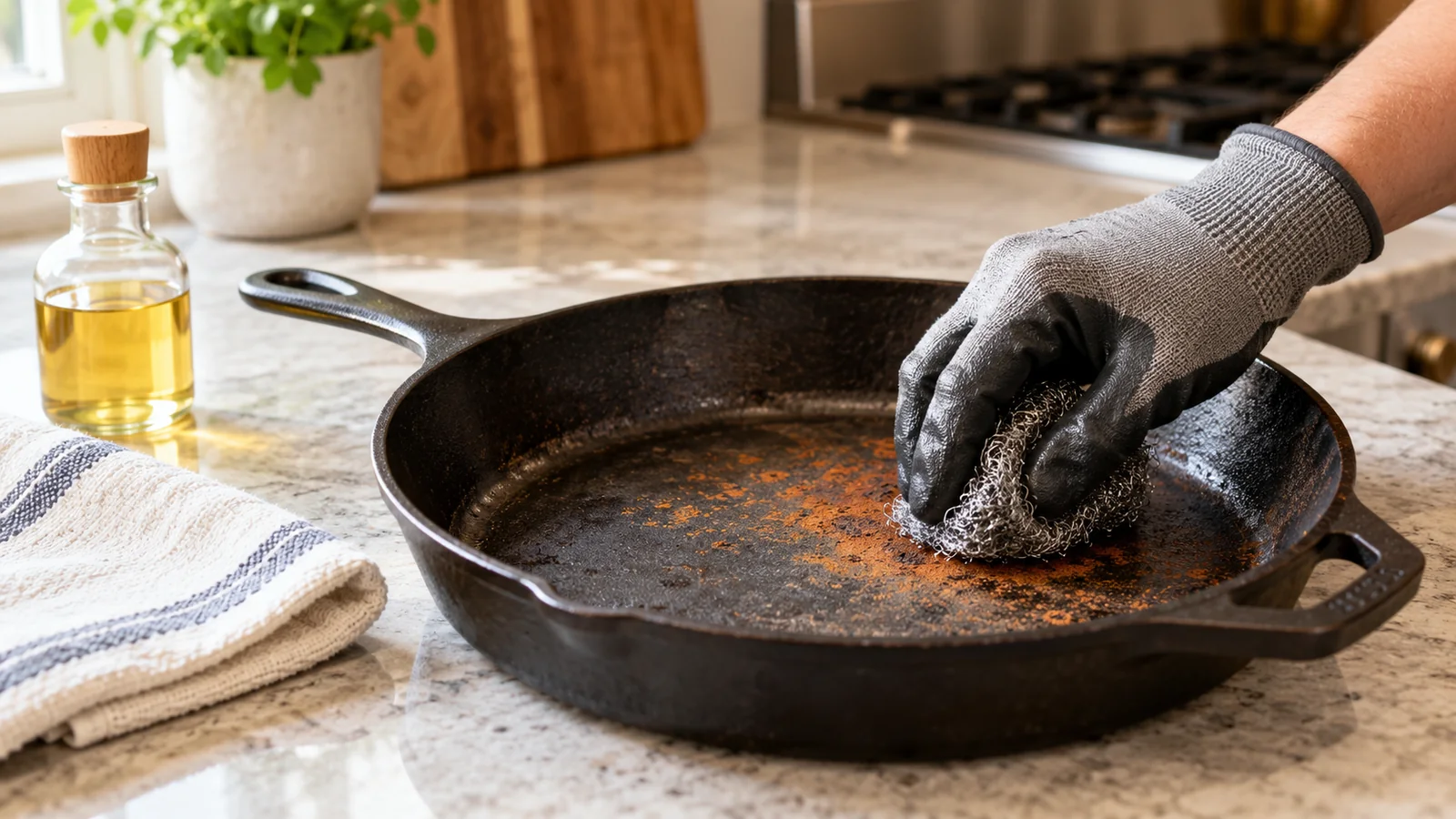
On confirmed non-enameled iron, use the rust-removal tool and washing method its maker permits. Lodge’s restoration route uses steel wool or its rust eraser, then warm soapy water. Field favors a brush or finer scouring pad for rust and cautions against excessive abrasion of the iron itself. These are product-specific options, not permission to use steel wool on every pan.
Work on the rusted areas, wash away loosened material, and rinse thoroughly until the rinse water runs clean. Smithey’s rust-removal instructions also require visible rust removal and a thorough rinse. Do not paint oil over orange residue or keep sanding simply to make the metal uniformly silver. If rust remains after the permitted treatment, ask the maker about the next restoration step rather than escalating to a power tool or an improvised chemical soak.
2. Dry promptly, including the underside and handle
Towel-dry immediately; do not leave the pan on a draining board. For its sound, non-enameled skillet, Lodge also permits a few minutes on low stovetop heat to remove remaining moisture. Follow the exact pan’s heat instructions, stay with it, and turn the burner off when dry. Do not transfer this empty-pan drying step to enamel or an unknown coating. Handle the warmed pan with dry mitts and keep it on a heat-safe surface.
3. Apply a thin film, not a layer that runs
Use the cooking oil the maker recommends. Spread a very thin layer over the non-enameled iron, then wipe off excess so there are no pools or drips. Keep the pan stable and use a folded cloth or suitable tool without touching hot metal. Oiling protects dry iron during storage; it does not remove rust or automatically replace a stripped seasoning layer.
4. Decide whether oven reseasoning is needed
Do not use the size of the original orange patch as the only test. After cleaning, check how much seasoning was removed and which tool you used. Lodge’s troubleshooting guide says a small rust-erased spot may need washing, drying, and oiling without a full oven cycle; its metal-pad route prepares the pan for reseasoning. Field likewise separates a few treated spots from widespread rust. Follow the branch for your own pan rather than mixing one maker’s abrasive step with another’s shortcut.
Lodge oven example, not a universal temperature: Its restoration page specifies 450–500°F for one hour after oiling, with the skillet upside down on the center rack, then the heat off and cooling in the oven. First confirm the entire pan and any attached parts are rated for that method. Remove accessories only as the product instructions direct; never assume a wooden handle, silicone grip, lid, or knob can take the same heat. Prepare the rack and any permitted drip-catching setup while the oven is cool. Lodge describes foil on a lower rack; also check the oven manual before using foil, and never line the oven floor or obstruct vents.
Ventilate during the seasoning cycle and use dry mitts when handling the pan. Do not treat heavy smoke as a reason to add heat or more time; stop the attempt and follow the oven’s safety guidance. Let the pan cool as directed before touching, inspecting, or storing it. A longer or hotter improvised cycle is not a substitute for the maker’s method.
5. Store only after drying and cooling
Keep the pan dry and lightly protected as its maker directs. Do not soak bare cast iron, put it in a dishwasher, or store it against damp cookware. If orange spots return, recheck retained moisture and the condition of the protective layer; repeated rust is not a reason to keep adding oil over it.
Methods to avoid
- Do not use the bare-iron method on enamel.
- Do not leave vinegar or another acid on the pan without exact maker instructions.
- Do not bake on a thick, wet coat of oil.
- Do not cook with a pan that is cracked or has a loose integral handle.
Check the cooled pan before cooking
Judge the result after the pan has cooled, not by touching hot iron. A thin protective film and an even jet-black appearance are not the same thing: color alone does not prove success or failure.
| What remains | Next action |
|---|---|
| No visible rust or loose residue; pan is dry, sound, and the maker’s required seasoning is complete | Return to normal cooking and care. Uneven seasoning color alone is not a reason to sand more. |
| Visible orange rust or loosened grit remains | Keep it out of cooking use. Repeat only the permitted cleaning route or ask the maker; do not cover residue with oil. |
| Sticky pools, drips, or a raised gummy oil layer after cooling | Do not add another coat. Use the maker’s excess-oil troubleshooting route; do not improvise a hotter or longer bake. |
| Crack, moving integral handle, severe metal loss, or chipped food-contact enamel | Stop using it. Send the maker the product marking and clear photos; cleaning or reseasoning cannot certify structural safety. |
For an enameled pan with rust only at its rim, do not automatically strip the whole vessel. Lodge has a separate rim-care route using gentle cleaning, thorough drying, and localized oil. Follow the exact enamel maker’s instructions, and distinguish a rust deposit from a chip exposing metal. If you cannot tell, leave it out of cooking use until the maker advises.
Frequently asked questions
Can I use soap on cast iron?
Yes. Lodge and Smithey allow a small amount of dish soap in their cast-iron care. Rinse it away, dry promptly, and restore the protective layer as the maker directs; soap permission is not permission to soak the pan.
Sources
- Lodge Cast Iron — Restore and Season Rusty Cast Iron
- Lodge — Enameled Cast Iron Cleaning and Care
- Field Company — How to Remove Rust From a Cast-Iron Skillet
- Lodge — Cast Iron Troubleshooting
- STAUB — Black Matte Enamel Use and Care
- Smithey — Cleaning and Rust Removal
Updated October 20, 2026: replaced generic completion wording with cast-iron-specific drying, thin-oil, reseasoning, and damage checks. Follow the current care instructions for your exact pan and finish.