Toilet Not Flushing? Safe Checks for the Handle, Tank, and Bowl
Quick answer: Watch what happens when you press the handle or button. If the bowl rises or drains slowly, stop flushing because the toilet may be clogged. If nothing happens, check whether the tank has water and whether the handle, chain, cable, or push-button linkage lifts the flapper or canister. If the tank releases water but the flush is weak, check the tank waterline, refill tube, flush-valve movement, and visible rim flow before replacing parts.
A toilet that does not flush is not always clogged. The problem may begin before water ever reaches the bowl: the tank may be empty, the handle may be disconnected, or the flush valve may not open far enough. The safest diagnosis starts by observing the bowl and tank separately.
Prevent an overflow: Do not flush again if the bowl water is already high, rising, or draining slowly. Turn the toilet’s supply valve clockwise only if needed and if it moves without force. Keep children and pets away from wastewater, wear gloves, and disinfect contaminated surfaces after the problem is controlled.
Match the symptom before opening the tank
| What happens | Likely area | First move |
|---|---|---|
| Bowl rises or drains slowly | Toilet trap or drain blockage | Stop flushing and follow the clog guide |
| Handle or button moves but nothing happens | Disconnected chain, cable, rod, or lever | Inspect the linkage inside the tank |
| Tank is empty or filling very slowly | Supply valve, fill valve, or supply line | Confirm the supply is open and listen for filling |
| Tank is full but little water enters the bowl | Flapper, canister, chain, or button travel | Watch whether the flush valve opens fully |
| Water enters the bowl but the flush is weak | Low tank level, early valve closure, rim jets, or partial clog | Compare the waterline and observe the bowl flow |
| One dual-flush button works and the other does not | Button rods, cable, or valve adjustment | Use the exact toilet model’s instructions |
Safe checks for a toilet that is not flushing
1. Check whether the bowl is blocked
Press the handle once while watching the bowl. If water rises toward the rim, stop immediately. If it swirls but drains slowly, leaves waste behind, or backs up into another fixture, the drain path may be restricted. Use our toilet-clogged guide for overflow control, plunging, and service limits.
Continue with the tank checks only when the bowl remains at a normal level and the symptom points to the flushing mechanism.
2. Lift the tank lid carefully
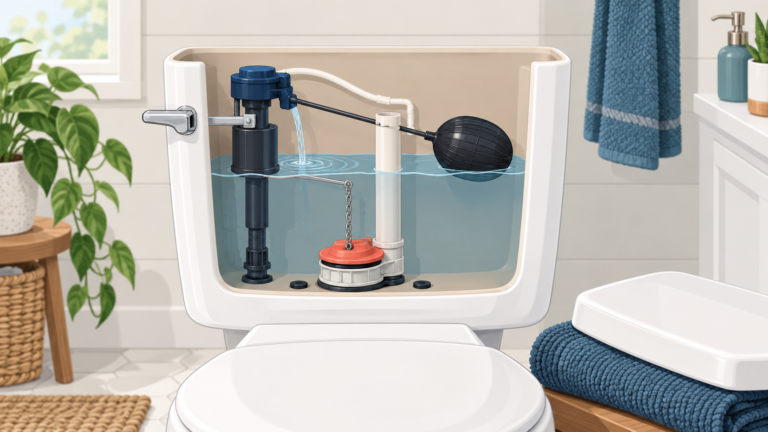
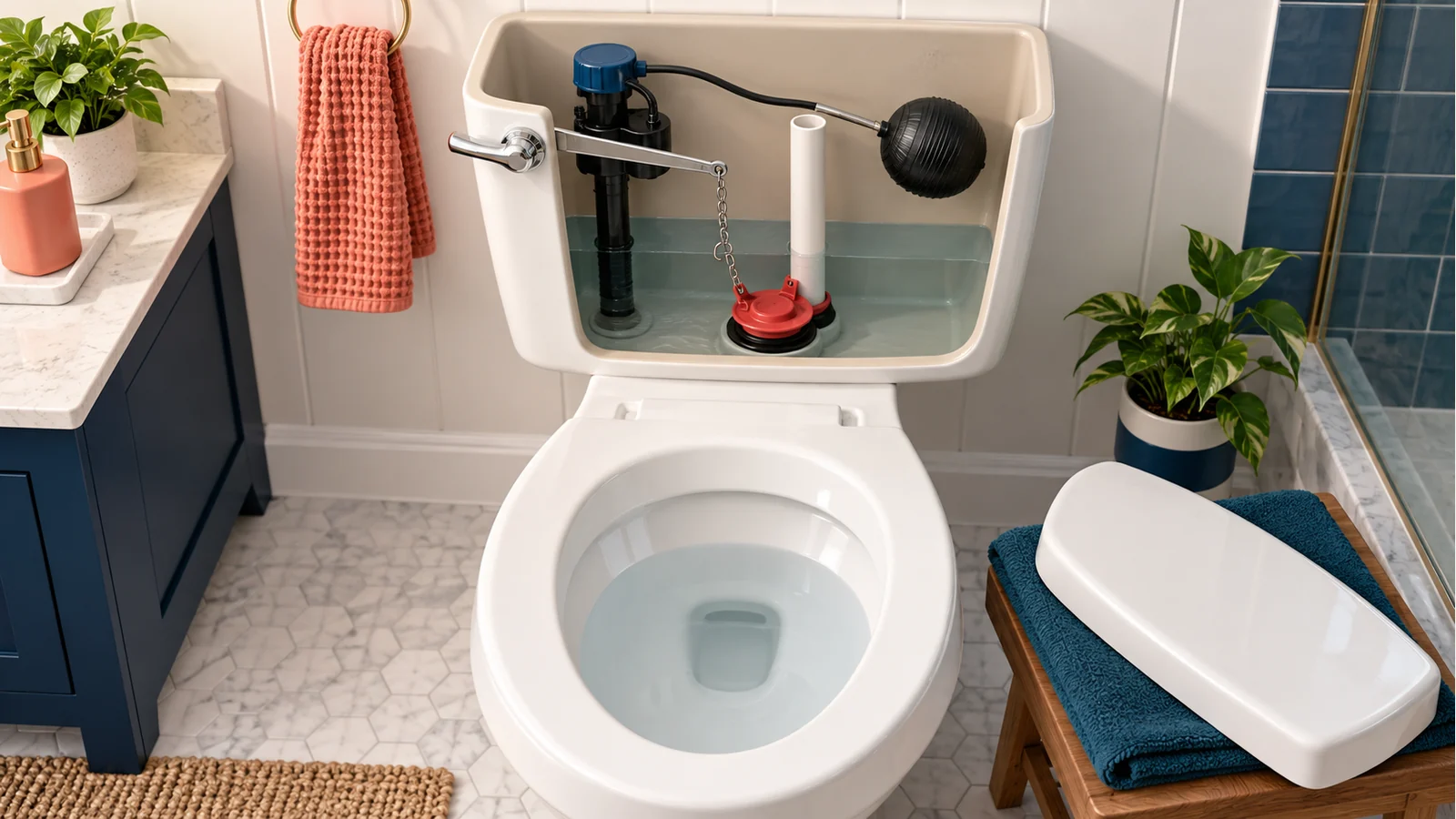
Place a folded towel on a stable surface and lift the porcelain lid with both hands. It can be heavy and may crack if set on tile. Inside a typical gravity toilet, identify the handle arm, chain, flapper or canister, fill valve, float, overflow tube, and small refill tube. Your toilet may use different parts, so locate its model number before adjusting or replacing anything.
3. Check whether the tank contains enough water
The tank needs the designed volume of water to create a complete flush. Look for a molded or printed waterline inside the tank. If there is no mark, use the model’s manual rather than a universal measurement.
- The tank is empty: confirm the toilet supply valve is open and the float is not visibly stuck.
- The tank fills very slowly: the supply valve, supply line, or fill valve may be restricted.
- Water stops below the marked line: the float or fill-valve setting may need model-specific adjustment.
- Water constantly enters the overflow tube: the fill valve or float may not be shutting off correctly.
Do not force an old supply valve or disassemble a pressurized fill valve without the manufacturer’s procedure. Shut off the supply and call a plumber if a valve leaks when touched.
4. Watch the handle, chain, or push-button linkage
With the tank lid removed, press the handle once. The lever should lift the chain, and the chain should lift the flapper or canister. A disconnected chain explains a handle that moves freely without starting a flush. Reconnect it only to the correct attachment point shown in the toilet manual.
The chain needs some slack when the flush valve is closed. Too much slack may prevent a full lift; too little can hold the flapper open and make the toilet run. Kohler guidance for many flapper systems describes roughly one to two links of slack, but use the setting specified for your model.
5. Observe how far the flush valve opens
Flush once and watch the flapper or canister. It should lift freely, release the designed amount of tank water, and close after the flush. If it barely rises or closes immediately, the linkage may be misadjusted or the replacement flapper may be incompatible with the toilet.
Do not assume the whole tank must empty. Some modern toilets use only part of the visible tank water during a normal flush. Compare the movement with the manufacturer’s instructions before changing the chain or valve.
6. Check the refill tube and bowl water level
The small refill tube normally directs water into the overflow opening or its designated port while the tank refills. If it is disconnected or incorrectly positioned, the bowl may start with too little water and flush poorly. Reattach it using the original clip or model-specific connection. Do not push the tube far below the waterline, which can create unwanted siphoning on some designs.
7. Observe the rim and siphon-jet flow
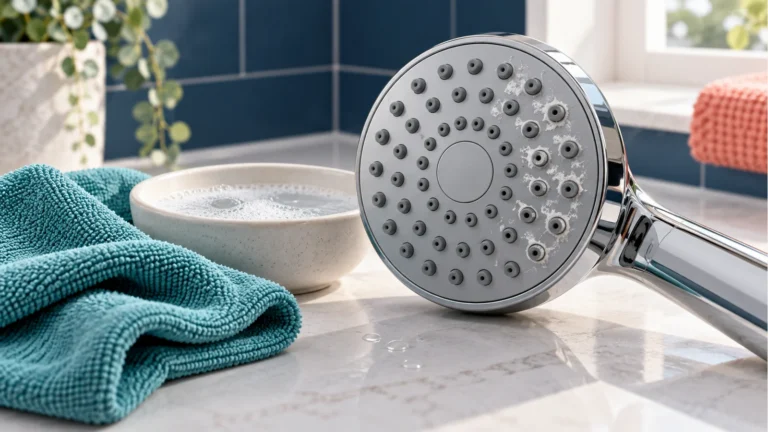
If the tank releases normally but the bowl receives an uneven or weak wash, mineral buildup may restrict rim holes or the siphon jet. Check the toilet manufacturer’s cleaning instructions before using an acidic product. Keep cleaners away from incompatible tank seals and never mix bleach with acid, vinegar, ammonia, or another cleaner.
A partial trapway or drain clog can look like a weak flush even when the tank works correctly. Bowl water that rises before receding, repeated incomplete clearing, or gurgling from another drain moves the diagnosis back to the drain system.
8. Treat dual-flush and pressure-assisted toilets differently
Dual-flush toilets may use push rods, cables, or a canister rather than a lever and chain. Test the half-flush and full-flush buttons separately. A loose button assembly or incorrect rod length can prevent one or both functions, but adjustments vary by model.
A pressure-assisted toilet contains a sealed pressure vessel inside the porcelain tank. Do not open or modify that vessel. Use the manufacturer’s troubleshooting procedure or a qualified technician.
What not to do
- Do not keep flushing a high or slowly draining bowl.
- Do not pour chemical drain opener into a toilet; it can remain in the bowl and expose anyone who later plunges or services it.
- Do not use boiling water, which can damage seals and may crack porcelain.
- Do not bend a float arm, cut a chain, or alter button rods without the model instructions.
- Do not overtighten plastic or porcelain-mounted parts.
- Do not use in-tank cleaning products unless the toilet and replacement-part manufacturers permit them.
When the repair needs a plumber
| Warning sign | Why to stop |
|---|---|
| Supply valve or line leaks | A small tank problem can become water damage |
| Porcelain is cracked | A tank or bowl can fail and release water suddenly |
| Several drains gurgle or back up | The blockage may be in a branch or main drain |
| Toilet repeatedly clogs after clearing | A foreign object, damaged trapway, vent, or drain issue may remain |
| Internal parts do not match common diagrams | The toilet may need model-specific components and settings |
| Pressure-assisted vessel is involved | It is a sealed system requiring its service instructions |
For more household bathroom guidance, browse the Bathroom section. Our bathroom cleaning checklist also helps keep routine maintenance separate from urgent plumbing problems.
Frequently asked questions
Why does the toilet handle move but nothing happens?
The chain, cable, push rod, or lever may be disconnected or broken. Remove the tank lid carefully and observe whether the linkage lifts the flush valve. Use the toilet model’s diagram before reconnecting or replacing a part.
Why is the toilet tank empty?
The water supply may be closed, the float may be stuck, or the fill valve or supply line may be restricted. Confirm that other fixtures have water and that the accessible supply valve is open. Do not force a valve that is seized or leaking.
Why does the toilet flush only when I hold the handle down?
The flapper may close too early because of chain adjustment or because it is not the correct part for the toilet. Compare the chain slack, flapper type, and flush-valve movement with the model’s service instructions.
Can I pour water into the tank to flush?
Manually adding water may provide a temporary flush when the drain is clear, but it does not repair the refill problem. Avoid overflowing the tank, use clean water, and stop if the bowl is high or slow to drain.