How to Deodorize a Mattress Without Masking the Source
The short answer
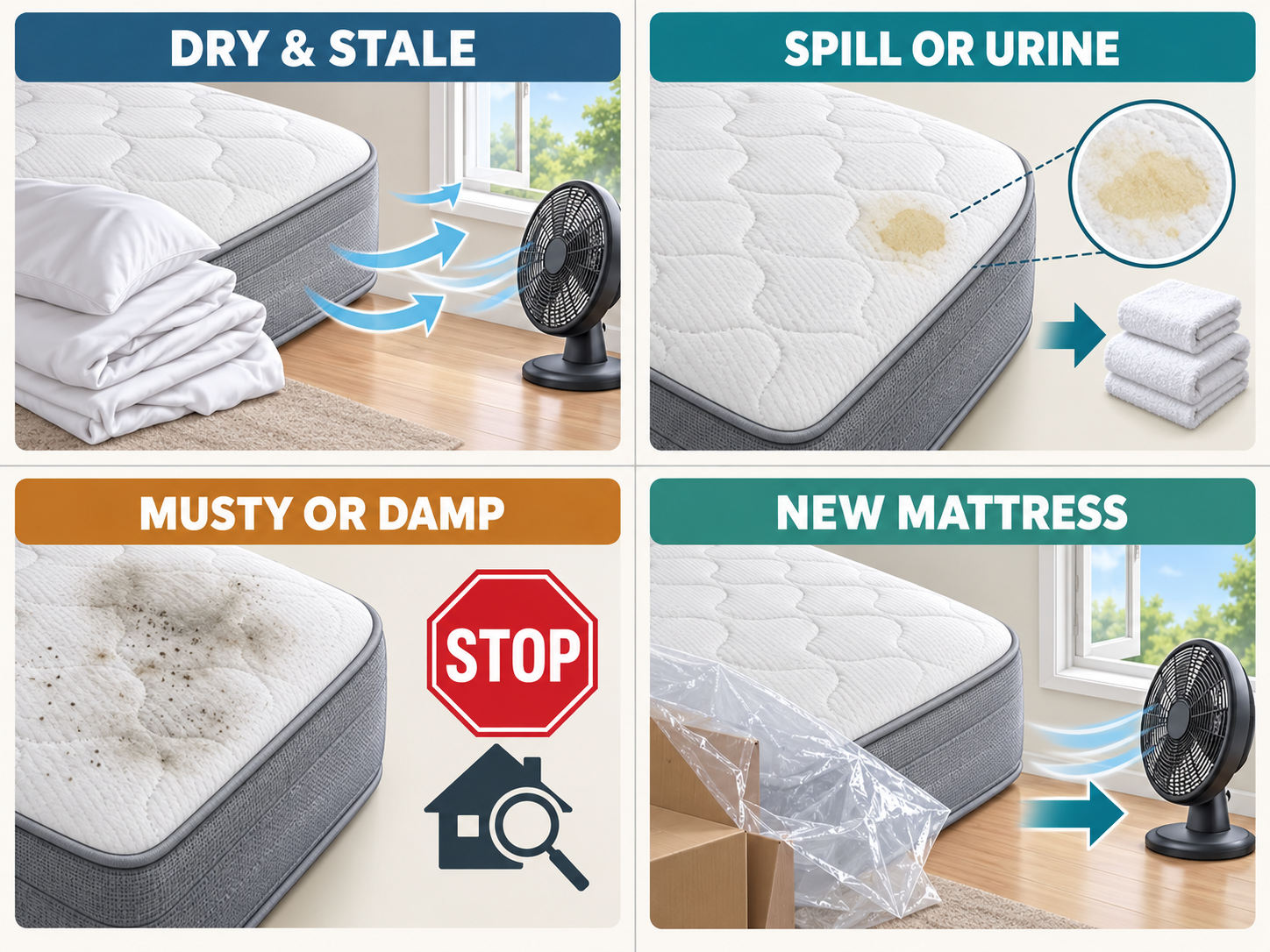
First identify whether the odor is dry and stale, tied to a spill or urine, musty or damp, caused by a new mattress, or left by a previous cleaner. Check the bedding and accessible mattress surfaces, then follow the care label. Do not disturb visible growth or move a heavy wet mattress just to inspect it. For a dry surface odor, airflow and a manufacturer-approved vacuuming or dry-deodorizing method may be enough. Do not saturate the mattress or cover a musty smell with fragrance. If it is damp, visibly affected, or smells from deep inside, stop treating the surface and investigate the moisture source.
A mattress can hold odors in several places: the bedding, protector, removable cover, top fabric, foam or fiber layers, underside, foundation, or the room itself. The same treatment does not suit all of them. A light stale smell on a dry surface is different from urine inside foam, a damp underside, or a new-product odor. For cleaning decisions beyond odor control, use the mattress cleaning guide by material and mess.
Updated October 22, 2026: added safe inspection and dry-care limits, a clearer check after airing or powder removal, and separate next steps for returning odor, dampness, and new-product smell.
Identify the odor pattern · Use the dry-surface route · Check the result
Before moving bedding, vacuuming, or switching on a fan: visible or suspected mold, sewage, flooding, or an unknown chemical spill is not a routine deodorizing job. Keep clear of wet electrical parts, outlets, and powered-bed controls; do not operate a wet base to inspect underneath. If power cannot be isolated from a dry, safe position, get qualified help. For suspected mold or contaminated water, do not direct a fan across the material or use a household vacuum to investigate it. EPA’s remediation course separates clean-water drying from contaminated-water work; it is not permission to extract or heat a mattress.
Start by identifying the odor source
| What you smell or observe | Likely condition | Safest first move | Stop or escalate when |
|---|---|---|---|
| Light stale or body odor; mattress feels dry | Surface odor in bedding, cover, or top fabric | Launder removable bedding, air the room, inspect the care label, then use only approved vacuuming or dry care | Odor returns quickly or seems strongest inside the mattress |
| A fresh wet spot or known drink spill | Local liquid contamination | Blot—do not rub—and follow the maker’s spill instructions; airflow needs safe electrical access and no suspected mold or hazardous spill | Liquid reached the interior, the area remains damp, or the care instructions are unclear |
| Urine or pet odor | Organic contamination that may have penetrated below the surface | Use the urine-depth and surface-care route rather than a deodorizing powder; keep liquid use controlled | Odor remains after drying or contamination reached the core or foundation |
| Musty odor, damp feel, condensation, or visible spotting | Moisture problem; possible microbial growth | Stop adding products and arrange safe assessment of the moisture source and affected mattress/base; inspect only accessible areas without disturbing growth | The mattress is wet, visibly affected, or cannot be fully cleaned and dried |
| Chemical or packaging smell from a new mattress | New-product odor | Follow the brand’s setup guidance and increase ventilation without adding cleaner or fragrance | The odor is severe, persists beyond the maker’s guidance, or causes concern |
| Perfume or cleaner smell after a previous treatment | Residue or masking product | Stop adding products, ventilate, and ask the manufacturer what is safe for the model | The mattress is damp, sticky, discolored, or the odor intensifies |
| Odor is strongest at the side, underside, foundation, or deep inside | Hidden moisture, contaminated support, or inner-material problem | Check accessible base/room clues without opening the mattress or moving wet powered components; do not treat the top again | The source cannot be reached or the mattress cannot be dried completely |
Inspect before adding any product
- Remove the sheets, blankets, pillows, and protector. Launder each item according to its own care label. A clean mattress will not solve odor trapped in bedding.
- Check the top, piping, seams, and safely accessible sides, base, floor, and wall. Note where the smell is strongest from an ordinary distance. Do not lift a heavy wet mattress alone, run a powered base to expose a wet area, or peel open a fixed cover or fire barrier.
- Look for damp patches, stains, residue, or damage without touching suspected growth or putting your face close to it. A damp or cool patch is a reason to pause; a dry-feeling surface or absent odor does not prove that the enclosed core is dry or free of contamination.
- Find the mattress law tag, model name, warranty, and cleaning instructions. A removable-looking zipper does not automatically mean the cover is washable.
- If there was a deep spill, the underside is affected, or moisture depth is uncertain, skip dry deodorizing and seek the maker’s assessment. Do not use surface feel, elapsed hours, or a fragrance-free smell as a core-dryness test.
Mattress designs vary. Tempur-Pedic says its material should not be soaked or saturated. Sleep Number warns against air-freshener sprays and specifies its vacuum attachment. Purple’s cover guidance emphasizes blotting and complete drying. These are useful examples, not a universal cleaning recipe; the exact model’s instructions control.
For a dry, light surface odor
Start with the least invasive steps:
- Air the room only when appropriate. For ordinary dry stale odor with no mold or hazardous spill, open windows when outdoor air and weather permit. Use a fan only on a dry, stable surface with a safe cord and outlet. Do not aim a heater or hair dryer at the mattress. Ventilation supplements source control; it does not clean a contaminated inner layer.
- Separate bedding odor from mattress odor. Launder sheets and the protector by their labels and dry them fully. Wash a mattress cover only when its exact instructions permit removal and washing. Leave the mattress uncovered while checking the source; if the odor belonged only to a removable layer, do not add deodorizer to the mattress.
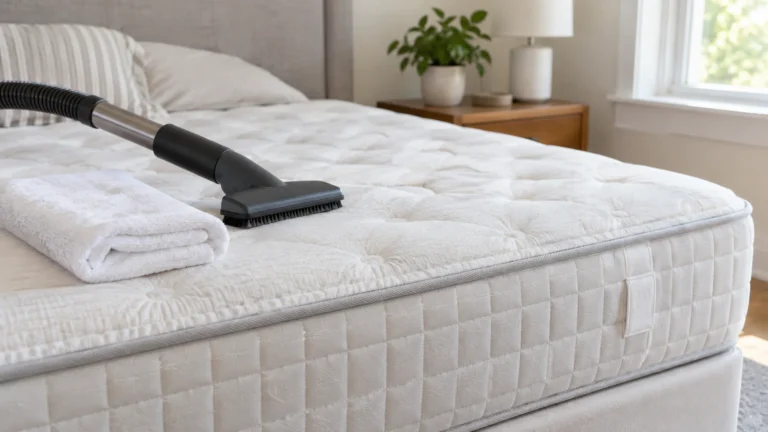
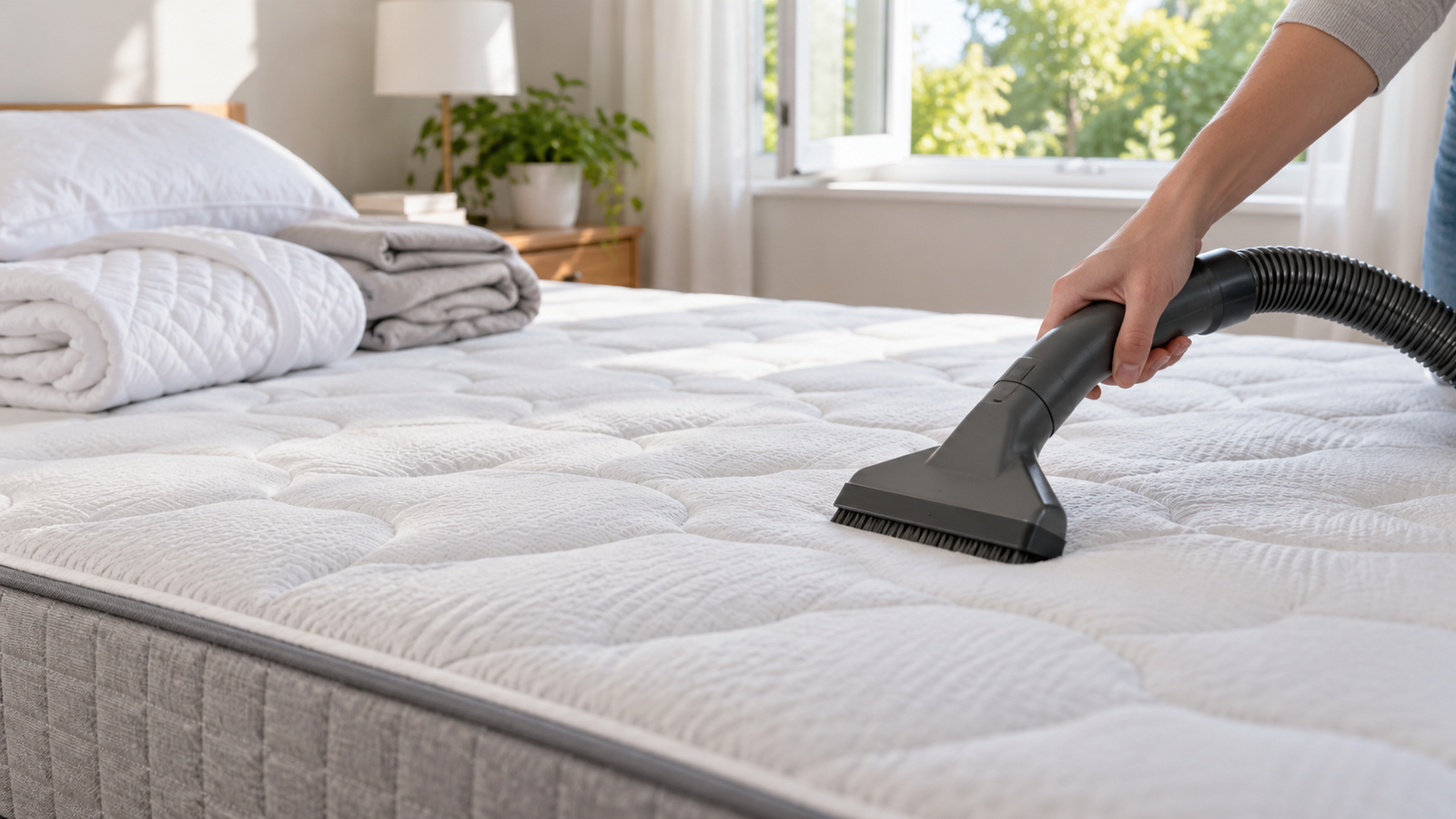
- Vacuum only compatible dry material. Follow the mattress maker’s attachment and suction instructions and the vacuum manual. Keep the nozzle off exposed foam, loose fibers, or damaged fabric unless the exact care directions permit that work. Do not vacuum a wet or mold-suspect mattress. Stop if the attachment snags or changes the fabric.
- Use a dry deodorizer only with a complete removal plan. Saatva’s support page describes baking soda followed by vacuuming. That example does not authorize powder on another model. Confirm the exact product, application, contact period, and removal method with your mattress instructions, and check that the vacuum permits that material. If you cannot remove it by a permitted method, skip powder rather than spreading it into seams or the core. Do not add essential oil, fragrance, water, or another cleaner to it.
- Finish removal and reassess before remaking the bed. Use the approved removal method until accessible seams and fabric are free of loose powder. Do not wet-rinse powder or force a nozzle into the cover. Keep the bed out of use if residue remains or fabric changes; ask the maker instead of covering it with a protector.
If the odor returns after clean bedding and a dry, approved surface treatment, do not keep repeating the same step. Recheck the underside, foundation, nearby carpet, wall, and room humidity. The source may have been missed or the odor may be returning from another layer; it is not a reason to repeat a no-progress treatment.
After airing or dry care, choose the next step
Reassess without fragrance or fresh powder masking the odor. These are routing checks, not a test proving the inside of a mattress is clean or dry.
| What you find now | Next useful action |
|---|---|
| Ordinary dry surface odor has resolved; no spill, dampness, visible growth, loose powder, or fabric change remains | Return clean, fully dry bedding and a compatible protector once the maker’s care steps are complete. Do not add a second product to make it smell perfumed. |
| Odor remains or returns after clean bedding and one completed approved dry-care attempt | Stop repeating the same powder or adding liquid. Recheck the safely accessible base, nearby wall/floor, and spill history; ask the maker if the source is unclear. |
| Cool/damp area, residue, underside odor, suspected growth, or an uncertain deep spill | Keep it out of use and get assessment. Surface touch, odor removal, or a fixed airing time cannot certify the core; do not open its fixed cover to test it. |
| The mattress is new and dry, with no spill or moisture clues | Use that model’s unpacking/airing instructions and contact the seller if the smell is overwhelming or outside its guidance. Do not apply an old-mattress cleaning recipe or assume odor alone proves safety. |
When contacting the maker, give the model, age, where the odor is strongest, whether it followed a spill or cleaning product, and what was already applied. Accessible photos and the care label help; do not take the bed apart to gather evidence.
When the odor has a known source
A spill
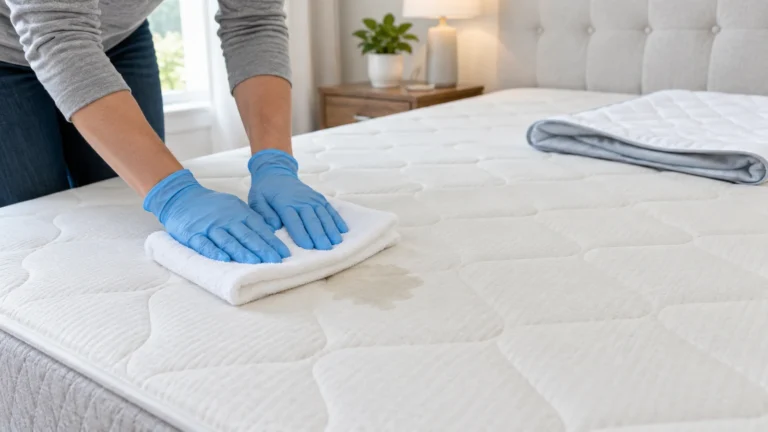
Act before the liquid spreads. Press a clean, dry, absorbent cloth onto the spot and lift it away; rubbing can push liquid outward and deeper. Tempur-Pedic and Sealy both publish blotting and air-drying guidance for spills, with a fan as a possible aid. Use only the cleaner and amount allowed for your mattress. Accessible dampness means it is not ready for use, but a dry top cannot verify hidden layers. If liquid reached the core or the depth is uncertain, seek the maker’s advice rather than trying to confirm deep dryness by touch.
Urine
Urine requires source removal rather than perfume. The correct method depends on whether the mattress is foam, spring, hybrid, latex, or another construction and on how deeply the liquid traveled. Use the mattress urine-cleaning guide for the cover-versus-core decision rather than an improvised mixture. For a foam-specific surface-care question, the memory-foam care guide explains the material limits; neither guide makes deeply contaminated foam washable.
Cleaner or fragrance residue
If the mattress smells strongly after a previous cleaning, adding another scented product can make the source harder to identify. Stop applying products, ventilate the room, and check the bottle label and mattress instructions. Ask the manufacturer what can safely remove the residue from that model. If the mattress remains damp, sticky, or discolored, get product-specific advice before using it again.
A musty or damp mattress is a moisture problem
A musty smell is a reason to investigate moisture; it is not proof of a particular mold species. The CDC notes that mold can have a musty smell and advises removing mold and fixing the moisture problem when mold is seen or smelled. The EPA emphasizes moisture control and prompt drying, ideally within 24 to 48 hours. That prevention guidance is not permission to wait two days, a mattress-drying timer, or proof that an affected bed is safe to use.
Do not keep sprinkling powder or spraying fragrance on a damp mattress. Instead:
- Check for a roof, plumbing, window, or HVAC leak.
- Inspect the mattress underside and the foundation or platform.
- Look for condensation on a wall or window near the bed.
- Check whether the protector trapped moisture.
- Measure room humidity and address the cause if it stays high.
- Keep people and pets away from an area with visible growth until you know how it will be handled.
Porous materials can be difficult or impossible to clean completely once mold has grown inside them. EPA guidance says wet or moldy porous materials may need to be discarded when they cannot be cleaned and dried. For a decision based on the size of the moisture problem and the affected material, use the home moisture and mold decision chart. Our guide to finding the source of a mold smell can help when the mattress may not be the only source.
Safety boundary
Stop surface cleaning if the mattress is wet through, has visible growth, was exposed to floodwater or sewage, or smells strongest from the core. Contact the manufacturer and, where appropriate, a qualified remediation or cleaning professional. Replacement may be safer when a porous mattress cannot be cleaned and fully dried.
For a new-mattress smell
Do not apply baking soda, vinegar, perfume, or upholstery cleaner to a new mattress unless its exact instructions approve it. Follow its unpacking and airing directions and keep packaging away from children and pets. Sealy and Purple publish different descriptions of expected odor duration. Neither is a universal countdown or a reason to wash the core. Purple’s page distinguishes smaller washable products from its mattress Grid; do not transfer pillow or seat-cushion washing instructions to the mattress. Contact the seller or maker if the smell is overwhelming, outside the model’s guidance, or causes concern. Stop using the product and seek appropriate medical advice if you develop symptoms rather than trying to wait them out.
Do not turn deodorizing into a chemistry experiment
These are not generic deodorizing methods. Never mix cleaning products or add bleach to other chemicals. For any separate product treatment, the exact mattress and cleaner instructions must both permit the method:
- Saturating the cover or foam with water
- Combining cleaners, including bleach, vinegar, ammonia, peroxide, enzyme products, or detergent
- Using steam, high heat, or a hair dryer on an unknown material
- Spraying air freshener or essential oils to cover the smell
- Sleeping on the mattress before a treated area is completely dry
- Assuming a zippered cover is machine washable
- Repeating a treatment when the odor is coming from the underside or inner layers
Mixing products can create unsafe fumes or unwanted reactions, and excess liquid can move contamination deeper. Product compatibility is model-specific; the wrong treatment may damage the fire barrier, foam, adhesive, or cover. Check the exact care and warranty terms rather than assume one cleaning mistake automatically voids an entire warranty.
When the mattress may need professional advice or replacement
Contact the mattress manufacturer, a qualified cleaner, or an appropriate remediation professional when:
- The odor returns after the bedding and dry surface have been cleaned.
- Liquid penetrated beyond the cover or the mattress cannot dry completely.
- The odor is strongest inside the mattress or foundation.
- There is visible growth or a continuing damp or musty smell.
- The mattress was exposed to sewage, floodwater, smoke residue, or an unknown chemical.
- A child, pet, or vulnerable household member will use the mattress and the contamination is uncertain.
- Cleaning could affect the warranty or fire-safety components.
Replacement is not necessary for every odor, but it becomes a realistic option when the contamination is deep, the moisture source lasted long enough to affect porous layers, or the material cannot be safely cleaned and dried.
Keep the odor from returning
- Use a washable, manufacturer-compatible mattress protector.
- Wash bedding on a regular schedule and dry it fully before use.
- Deal with spills immediately instead of waiting for an odor.
- Let the mattress and foundation breathe according to the maker’s setup instructions.
- Keep the bed away from active leaks and address recurring window condensation or high room humidity.
- Reinspect the underside and bed base if a smell returns.
Memory foam needs especially careful moisture control. Follow the maker’s instructions for the cover and core rather than treating a removable cover as proof that the foam itself is washable.
Sources
- Tempur-Pedic: How do I clean a spill on my mattress?
- Sleep Number: Cleaning Your Mattress
- Purple: How can I clean the zip cover that protects the Purple Mattress?
- Saatva: How do I clean my mattress?
- CDC: Mold
- EPA: Biological Contaminants and Indoor Air Quality
- EPA: Mold Course, Chapter 4
- Sealy: My new mattress has an odor. Will this go away?
- Purple: Why Does My New Product Smell?
- Sealy: What should I do if I spill liquid on my mattress?
This guide provides general household information. Follow the care label and manufacturer instructions for your exact mattress. For persistent moisture, visible growth, unknown contamination, or health concerns, use qualified professional guidance.