Freezer Not Freezing? Check the Temperature and Cooling Pattern
Quick answer
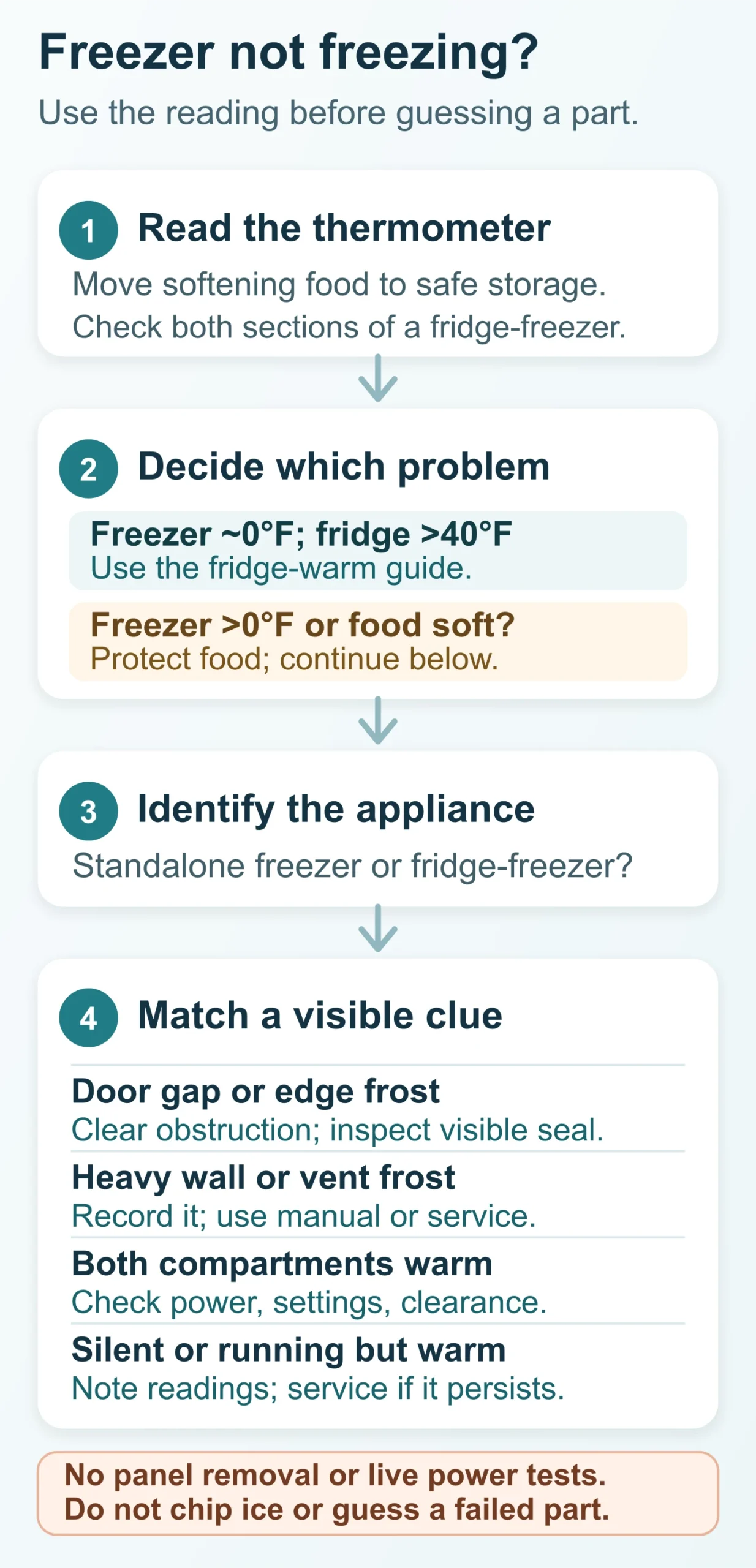
If food is softening, check the freezer with an appliance thermometer and protect the food before trying to diagnose a part. The FDA recommends 0°F (-18°C) for a freezer. A control set to 0°F is not proof the compartment has reached it. Once you know the actual temperature, check whether this is a standalone freezer or the freezer compartment of a refrigerator, then match the visible symptom to a safe next step.
Protect food now
If the freezer has stopped cooling altogether, move vulnerable food to a working freezer if one is available. Do not leave thawing food in place while waiting for a repair or for the appliance to recover.
Protect the food before troubleshooting
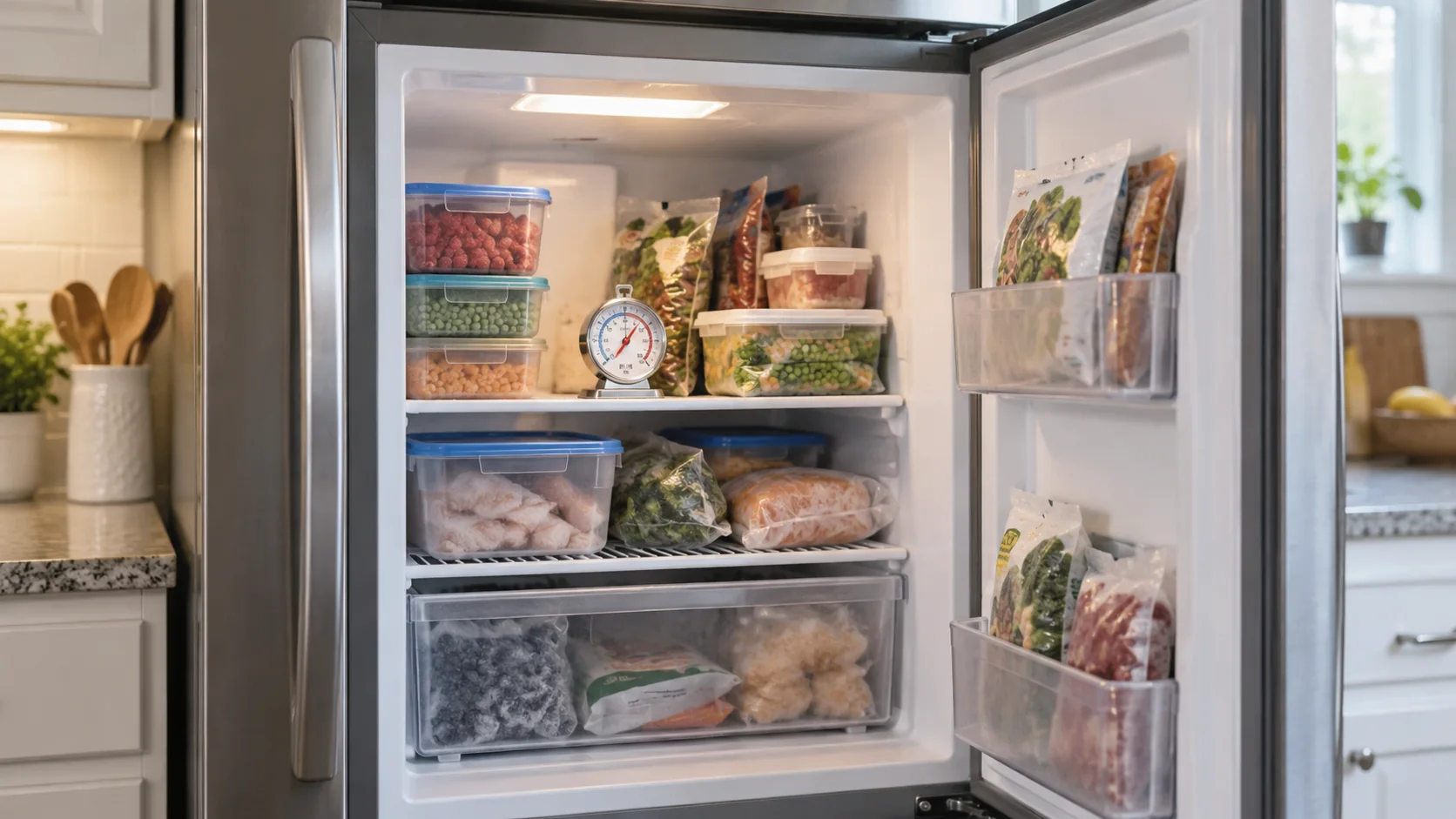
Keep the door or lid closed as much as possible. If you already have an appliance thermometer, note its reading and the time. If you are placing one now, put it near the front where it is easy to read, as the FDA advises, and note when you began measuring. A new reading cannot tell you how long food has been warm. For a refrigerator-freezer, check the fresh-food compartment too; the FDA’s target is 40°F (4°C) or below for the refrigerator and 0°F (-18°C) or below for the freezer. A displayed setpoint is not the same as a thermometer reading.
If packages have started to thaw, assess them one by one using the FoodSafety.gov frozen-food chart. Food that still contains ice crystals or measures 40°F or below may be safe to refreeze, although quality can suffer. The chart gives different instructions for different foods; for example, it says to discard ice cream and frozen yogurt after thawing rather than refreeze them. For meat, poultry, seafood and many prepared foods held above 40°F for more than two hours, it says to discard them. Never taste food to decide whether it is safe. If you do not know how long a perishable item was warm, follow the official chart conservatively rather than guessing from its smell or appearance.
The chart is written for a power outage, but its item-by-item temperature guidance is useful when a freezer fails for another reason. Its estimate that a closed, powered-off freezer can stay cold for a period of time is not a waiting period for a freezer that has already measured warm or has visibly thawing food.
Match the temperature and pattern
| What you find | What it tells you | Safe next move |
|---|---|---|
| Freezer thermometer reads 0°F or below; refrigerator is above 40°F | The freezer is at its recommended temperature on this check; troubleshoot the refrigerator compartment separately | Protect refrigerated perishables, then use our fridge-warm/freezer-working guide |
| Freezer above 0°F; food is softening | The freezer is not holding its recommended storage temperature, but one reading does not identify a failed part | Protect food, then check the control, door/lid seal and visible airflow |
| Refrigerator and freezer are both warming | Cooling may be affected across the appliance | Check power, settings, door closure and model-approved exterior clearance; arrange service if it remains warm |
| Standalone chest or upright freezer is warm and seems silent | It may not be running, but silence alone does not identify the fault | Check its control and an accessible power source safely; record the model and any display code |
| Frost gathers around the door or lid edge | Warm air may be entering through an obstruction or poor seal | Remove trapped packaging and inspect the visible gasket |
| Heavy frost covers a back wall or visible vent | Airflow may be restricted; the cause needs model-specific assessment | Photograph the frost, protect food, and follow the manual or seek service—do not chip ice or remove a panel |
| Freezer runs but remains too warm after external checks | The remaining problem may require internal diagnosis | Give a technician the model, temperature readings, error code and observations rather than buying a part by guesswork |
The distinction between a standalone freezer and a refrigerator-freezer matters. Their airflow paths and condenser arrangements can differ. Maytag notes that advice about cleaning accessible condenser coils on a refrigerator-freezer does not automatically apply to a chest or upright freezer with coils built into its walls.
Check the controls and power without opening the appliance
Read the actual thermometer before changing a setting. Then compare the control position with your model’s use-and-care guide. A control accidentally moved to OFF, a cooling-off or showroom mode on a model that has one, or an error code changes the next step. Write down the exact code; do not use a button sequence found for another model.
For a standalone freezer that appears off, check whether its accessible outlet or breaker has power only if the area is dry and the cord and outlet look intact. If water is near the plug or wiring, the cord is damaged, or a breaker repeatedly trips, stop and call a qualified professional. Do not remove a cover or test live electrical parts. GE’s standalone-freezer guidance lists an OFF temperature control among the owner-observable possibilities, while treating internal controls and wiring as service issues.
A recent installation, a changed setting or an outage can affect how long a particular model takes to cool. Follow that model’s guidance after you have protected the food. Do not use another brand’s recovery time as a reason to leave perishables warming.
Look for an air leak or a blocked path
Open the door briefly and look for a package, drawer or shelf that prevents full closure. Check the visible gasket for debris, gaps, tears or sections pulled away from the cabinet. If it is dirty, clean it according to the owner’s guide and dry it before closing the door. Frost concentrated near the door or lid is an additional clue that warm, moist air may be entering; it is not proof that the gasket itself must be replaced. Samsung’s frost guide begins with door closure and visible seal checks.
On a model with interior vents, move packages away from the visible openings so air can circulate. Do not assume that every chest freezer has the same vent layout as a refrigerator-freezer. Also check whether the appliance has the exterior ventilation space required by its own manual. A crowded freezer, a door that does not seal and blocked airflow are owner-level checks in Whirlpool’s freezer guidance, but exact clearances and loading rules vary by model.
If your manual allows owner cleaning of accessible exterior condenser coils or a rear dust area, turn off or unplug the appliance as instructed and use only the approved access and method. Do not remove an interior panel to reach a coil. LG’s rear-dust guidance explicitly says to unplug before that cleaning; it does not make every cabinet layout identical.
What frost, sounds and a running motor can—and cannot—tell you
Heavy frost over a visible back wall or vent, repeated frost after cleaning a door seal, new error codes, or a unit that runs without bringing the measured temperature down are useful facts to report to service. They do not confirm a failed fan, defrost heater, thermostat, relay, compressor or refrigerant system from a distance.
Do not chip or pierce ice, use an ice pick, or aim a hair dryer or heat gun into the freezer. You could damage a cooling surface or plastic, and the appliance is electrical. Samsung’s frost guidance warns against a hair dryer. If your model’s manual calls for a defrost, move food to safe storage first and follow that manual’s process; do not improvise by opening panels.
Likewise, a quiet cabinet is not a universal compressor test. Some models cycle or run differently, and a temperature fault can involve several systems. If settings, door closure, airflow and accessible exterior care do not restore cooling, arrange qualified service instead of ordering a component based on sound alone.
Recheck, then hand off a useful record
After correcting a clear external issue, close the door and recheck the thermometer according to your model’s guidance. Keep protecting the food while you assess recovery. If it stays too warm, the problem returns, or food continues to thaw, schedule service.
Have these facts ready: the model number, thermometer readings for each compartment and when you took them, whether the freezer is standalone or part of a refrigerator, any exact error code, whether the unit is silent or running, where visible frost appears, recent power or setting changes, and the external checks you completed. This record helps the technician narrow the problem without treating any one clue as a diagnosis.