How to Clean a Cutting Board: Wood, Plastic, and Food-Safety Steps
Quick answer: Wash the cutting board with hot, soapy water after use and between different foods, rinse with clean water, and dry it thoroughly. After raw meat, poultry, or seafood, clean first, then use a sanitizer labeled for food-contact use on that board material. Follow its complete dilution, wet-contact time, rinse, and drying directions—not a recipe assembled from different products. For recalled-food exposure, follow the specific notice’s cleanup instructions. Replace an excessively worn board or one with grooves you cannot clean; color and smell alone cannot prove it is safe.
A cutting board can look clean and still transfer contamination. The useful decision is not “wood or plastic?” alone; it is what touched the board, what material and construction it uses, and whether grooves or cracks can still be cleaned.
Updated October 22, 2026: clarified sanitizer selection and label-specific rinsing, separated food-recall cleanup from routine care, and replaced the unsupported fingernail test with a cleanability-and-condition check. The board-wear illustration added October 20 is retained.
Wash and sanitize in order · Check the sanitizer directions · Decide reuse or replace
Choose the route by material and use
| Board or situation | Cleaning route | Important limit |
|---|---|---|
| Plastic, acrylic, glass, or other nonporous board | Hand-wash; use the dishwasher only if the maker marks it dishwasher-safe | Deep knife grooves can remain hard to clean |
| Solid wood | Hot soapy water, quick rinse, immediate drying; dishwasher only if the maker permits it | Do not soak; moisture can warp or split wood |
| Laminated wood | Hand-wash and dry promptly | USDA notes laminated boards may crack or split in a dishwasher |
| Bamboo | Hot soapy water, rinse, dry; sanitize when needed | Use the maker’s oiling instructions, not cooking oil |
| Used for raw meat, poultry, or seafood | Clean, then sanitize, rinse if required, and dry | Do not place ready-to-eat food on it before the full process |
| Excessively worn, cracked, or deeply grooved | Replace an uncleanable or damaged board; reserve maker-approved resurfacing for sound solid wood with superficial wear | More sanitizer cannot make an uncleanable groove safe |
Time estimate: about 5–10 minutes for washing, plus the chosen sanitizer’s contact time and complete drying. Difficulty: easy. Supplies: dish soap, clean brush or cloth, clean water, a drying rack, and—only when sanitation is needed—a labeled food-contact sanitizer or correctly diluted unscented liquid chlorine bleach.
Chemical boundary: Never mix bleach with ammonia, vinegar, acids, alcohol, dish detergent, or another cleaner. Wash and rinse away the cleaner before a separate sanitizing step. Use only a product whose label permits food-contact sanitizing on your board’s actual material; a hard, nonporous-surface claim is not permission for every wooden board. Follow label dilution, water-temperature, protective-equipment, ventilation, wet-contact, and rinse directions. Keep food, children, and pets away while treating the board. If the label is missing or the material is excluded, choose another suitable product or board—do not guess a stronger mixture.
Clean first; sanitize second
Cleaning and sanitizing are two different jobs. Soap and physical scrubbing remove food, grease, and some microbes. Sanitizer works reliably only after that soil is gone. Spraying sanitizer over dried chicken juice, flour paste, or grease does not replace washing.
- Clear scraps without spreading them. Scrape food into the trash or compost. Do not rinse raw poultry over the sink; FDA and USDA warn that splashing can spread germs around the kitchen.
- Wash both faces and every edge. Use hot, soapy water and a clean brush or cloth. Pay attention to the handle, juice groove, nonslip feet, and the underside where raw liquid can travel.
- Rinse with clear water. Remove soap and suspended soil. Keep the clean board from touching the dirty sink basin.
- Choose the appropriate follow-up. Add sanitizing after raw meat, poultry, or seafood. For a food recall, use the official notice’s cleanup advice for that exposure. Ordinary produce or bread preparation still needs washing between food items; a stain alone does not identify contamination.
- Use one complete sanitizer method. Check the label and method key below before measuring anything. Treat every potentially contaminated area using the permitted application method, and maintain wet contact for the full required time. Wiping immediately after spraying is not the same step. Do not immerse wood or bamboo just because a sanitizer page shows a plastic board soaking.
- Complete that method’s rinse and drying steps. USDA’s household method below requires a clear-water rinse. A product labeled no-rinse may require air-drying instead; do not borrow that permission for another solution. Dry with clean paper towels or air-dry as directed, then let all faces and edges dry fully with airflow before storage or oiling.
Before mixing: match the whole sanitizing method
- Surface: confirm food-contact use and the exact wood, bamboo, plastic, or composite surface—not just “kitchen cleaner” on the front.
- Dilution: use the current container’s measured amount and water instructions. Ready-to-use products are not concentrates.
- Wet time: start the required contact period only once the surface is treated; follow the label if it dries too soon.
- Finish: check whether rinsing with clean water is required and whether the surface must air-dry. Sanitizing and general disinfecting directions may differ.
USDA household reference: its cutting-board guidance specifies 1 tablespoon of unscented liquid chlorine bleach per 1 gallon of water for wooden and plastic boards, flooding the cleaned surface for several minutes, then rinsing with clear water and air-drying or using clean paper towels. This is a complete reference method, not a universal dose for any bleach bottle. Use it only when the current product’s food-contact directions and the board’s care instructions allow that use; otherwise follow the product-specific method or choose a compatible product.
Why not interchange recipes? Clorox’s current Performance Bleach page says its formulation and some usage instructions, including wooden cutting-board sanitizing, have changed. That does not invalidate USDA’s general guidance; it means you should not combine its dose with another product’s contact time or no-rinse claim. If the instructions are unclear or conflict with the board’s care limits, ask the product or board maker and use another clean, suitable board meanwhile.
Dishwasher or hand-wash?
Nonporous acrylic, plastic, and glass boards are common dishwasher candidates, but the product label is the final authority. USDA’s general guidance includes solid wood among possible dishwasher candidates and warns about laminated boards; that does not override a specific maker’s prohibition. For example, John Boos explicitly excludes its wooden boards from the dishwasher and from soaking. A glued board, board with silicone feet, resin detail, or unknown finish should not be treated as dishwasher-safe merely because another wooden board is.
- Use the dishwasher when the maker allows it and the board fits without blocking spray arms.
- Hand-wash boards that can warp, delaminate, swell, lose glued feet, or damage a decorative finish.
- Do not soak wood or bamboo. Extended water contact can open seams and create new hard-to-clean areas.
- Inspect after every machine cycle. Replace a board if heat reveals cracks, separation, or sharp edges.
What to do after raw chicken, meat, or seafood
Move ready-to-eat food away before cleaning. Wash your hands, the knife, board, and any counter or faucet handle touched during preparation. Clean the board with hot soapy water, rinse, then sanitize. Use a clean paper towel or air-dry instead of a kitchen towel that may already carry raw-food contamination.
FDA’s outbreak-cleanup guidance includes affected utensils, counters, and storage surfaces, not just the board. For a recall, follow the notice’s return or disposal instructions for the food; cleaning the board is not permission to eat the recalled product.
The simplest prevention is separation. USDA and FDA recommend, when possible, one board for raw meat, poultry, and seafood and another for produce, bread, and foods that will not be cooked. Color-coding or a clear label on the board’s edge makes the system easier to follow.
Stains and odors: cosmetic fix or replacement signal?
| What you notice | What it may mean | Best next step |
|---|---|---|
| Flat discoloration with a smooth, intact surface | Often cosmetic staining | Clean normally; use only a maker-approved stain method |
| Odor remains after washing and complete drying | Residue may remain in grooves or pores | Clean and sanitize; replace if odor returns or the surface is damaged |
| Deep cuts that trap dark material | The board may no longer be effectively cleanable | Replace it |
| Split wood, separated laminate, swelling, or mold | Structural damage and moisture entry | Discard rather than sanding a contaminated crack at home |
| Rough but shallow solid-wood surface | Normal wear may be repairable | Ask the maker whether professional resurfacing and refinishing is appropriate |
Lemon, salt, baking soda, or vinegar may change odor or appearance, but they should not be presented as substitutes for a validated food-contact sanitizer after raw-food contamination. They can also dry, etch, or alter some board finishes.
The replace-it test
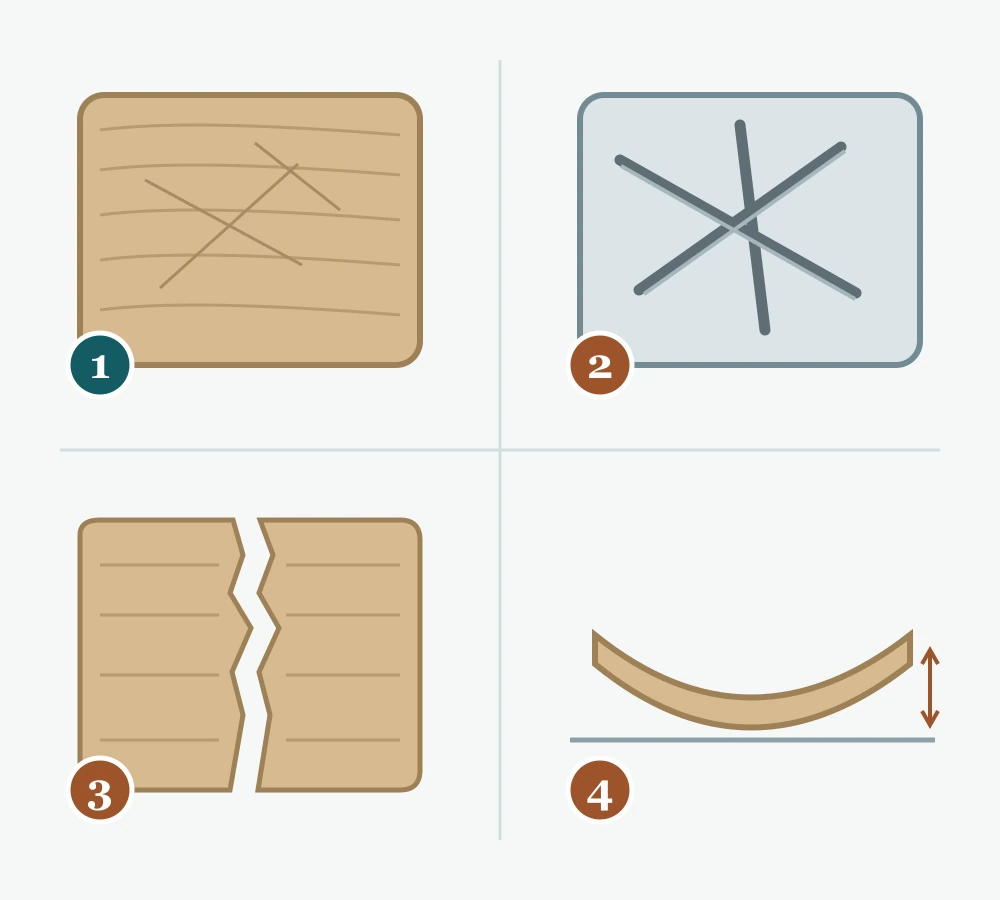
- Shallow marks, intact surface: wash after use and sanitize when appropriate. Appearance alone cannot confirm that a board is sanitary.
- Deep, hard-to-clean grooves: replace a board when food remains trapped in cuts despite proper cleaning.
- Split or separated seam: replace the damaged board; liquid and food can enter the gap.
- Warped or rocking board: stop using an unstable board and replace it rather than trying to cut on a moving surface.
Inspect the washed, dried board in good light; do not run a fingernail through grooves or pry a seam open. USDA’s replacement threshold is excessive wear or hard-to-clean grooves—not a particular scratch depth, color, age, or fingernail result. Retire a split, separating, uncleanable, moldy, or unstable board. Maker-approved resurfacing of sound solid wood with shallow wear is a different question; do not sand an unknown laminate or a contaminated crack to make it look clean.
Before the board goes back into use
- Cleanable, stable, and fully dry: finish the required sanitizing and rinse steps first, confirm no visible food or cleaner film remains, and keep the board away from the dirty sink or raw-food packaging. Appearance is a completion check, not a germ test.
- Food or cleaner film remains: repeat the compatible wash-and-rinse step, then any needed sanitizing using its complete instructions. Do not compensate with more concentrate or longer soaking.
- A crack, uncleanable groove, separated layer, mold, or instability remains: stop food preparation on that board and replace it. A stain or odor disappearing does not repair the damage.
Daily habits that reduce contamination
- Wash the board after each food item, not only at the end of meal preparation.
- Use separate boards for raw animal foods and ready-to-eat foods.
- Keep the clean board off the sink bottom and away from raw-food packaging.
- Dry upright with space between the board and wall.
- Wash hands for at least 20 seconds before and after handling raw food.
- Clean the knife and nearby counter at the same time; cleaning only the board leaves the transfer path open.
Frequently asked questions
Is wood safer than plastic?
USDA allows wood or nonporous boards. Nonporous surfaces are generally easier to clean, but either type must be washed, dried, monitored for damage, and replaced when grooves become hard to clean.
Can I use a disinfecting wipe on a cutting board?
Only if the product label explicitly allows use on food-contact surfaces and you follow its contact-time and rinse directions. Many household disinfectants are not intended for utensils or surfaces that touch food.
Should I oil a wooden or bamboo board?
Follow the board maker. USDA notes mineral oil can help bamboo retain moisture. Do not use a food oil that can turn rancid, and never oil over a dirty or damp board.
Does bleach remove a cutting-board stain?
Sanitizing and stain removal are different goals. Correctly diluted bleach can sanitize after cleaning, but a remaining color does not prove contamination and repeated strong bleach can damage materials. Judge safety by cleanability and condition, not color alone.
Related kitchen guides
- Diagnose a kitchen sink odor before cleaning the wrong component
- Match a baking-sheet cleaning method to its surface
Sources
- USDA FSIS — Cutting Boards
- USDA FSIS — Clean first, then sanitize food-contact surfaces
- FDA — Cleaning surfaces after a foodborne-illness outbreak
- FDA — Preventing cross-contamination while preparing produce
- Clorox US — Performance Bleach formulation and changed wooden-board instructions
- John Boos — Wooden-board dishwasher and immersion restrictions
Board-wear illustration added October 20, 2026. Sanitizer selection, recall cleanup, cleanability, and reuse decisions rechecked October 22, 2026. Follow the current sanitizer label and board manufacturer together; do not improvise when their material or method limits conflict.