Kitchen Sink Smells Bad? Find the Drain, Disposal, Dishwasher, or Water Source
Safety boundary: A rotten-egg odor can also be the odorant added to natural gas. If the smell is strong, widespread, accompanied by hissing, or may be coming from a gas appliance or gas line, do not operate a light, fan, disposal, phone, or other electrical switch. Leave the area and call 911 and the gas utility from a safe location. If drain cleaner, an unknown treatment or chemical water is present, do not add water/products, bail, insert tools or open plumbing. A leak near electrical parts, wet cabinet controls/cords, burning smell, trip or existing drain backup also rules out the trial-water routes. Avoid wet equipment and isolate power only from a safely reachable dry position after gas is ruled out. For backup across fixtures, stop adding household wastewater and seek drain help.
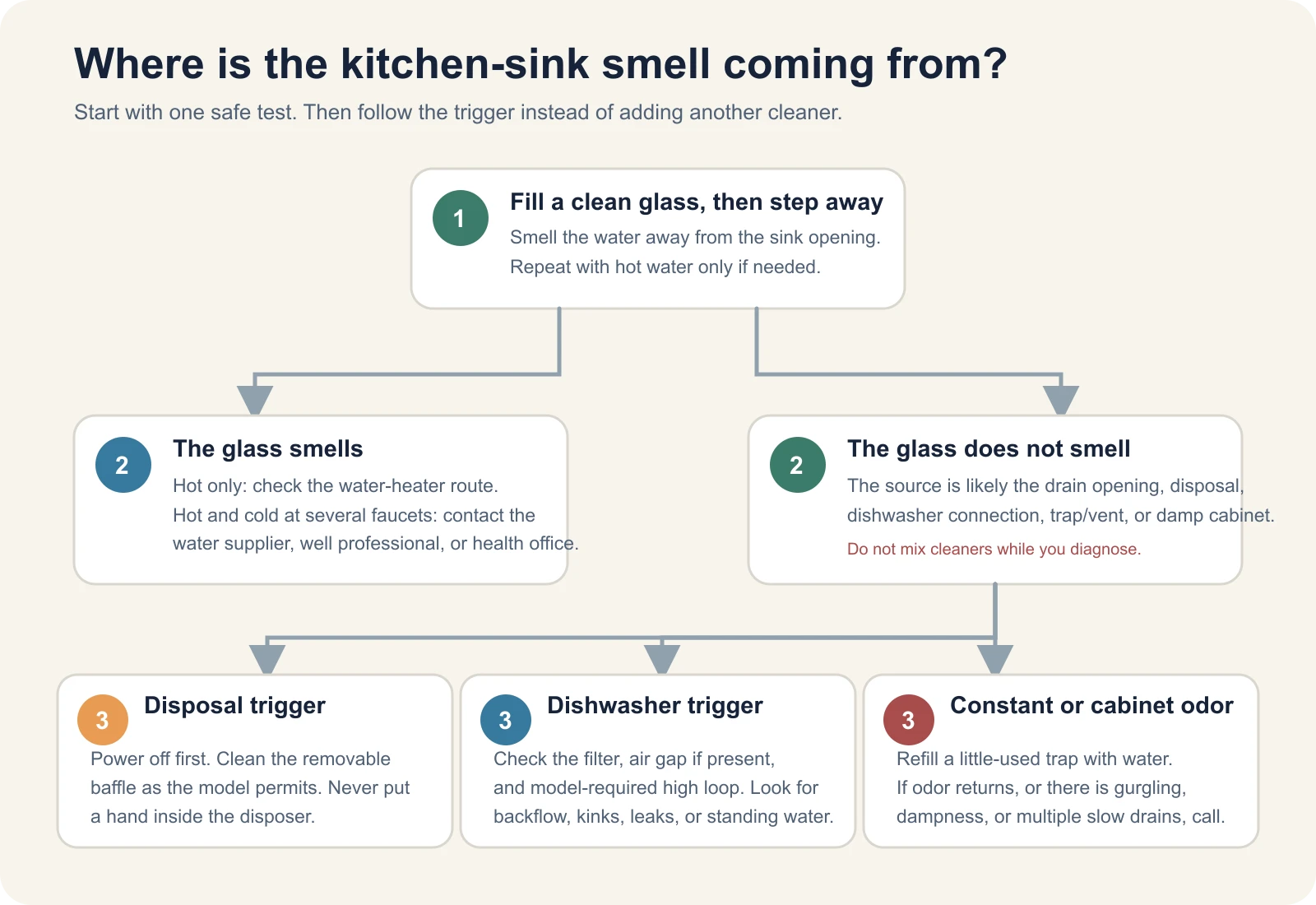
Quick answer: First rule out the gas, chemical-water, electrical and backup warnings below. Only when those gates pass, fill a clean glass with cold tap water and observe its odor away from the sink without tasting it. If the glass does not smell, the source is probably the drain opening, disposal, dishwasher connection, or under-sink plumbing. If the water in the glass smells, compare hot and cold water and check another faucet. This comparison helps sort a drain-area source from a water-related source; it does not prove that the water is safe to drink or identify a failed part. Match the next step to when the odor appears instead of layering cleaners into an unknown residue.
Updated October 22, 2026: added safe water-test exclusions, prior-observation dishwasher and moisture routes, conditional trap refilling, and clear limits on what a negative odor check proves.
Choose your route: If gas may be present or a drain cleaner or unknown product is in the sink, stop and follow the safety boundary above. If the remaining safety gates also pass, test a glass of tap water. If the water smells in the glass, compare hot and cold water. If it does not, match when the odor appears in the table.
Match the smell to when it appears
| What you notice | Most useful first suspicion | Safe check | Stop or escalate when |
|---|---|---|---|
| The glass of water does not smell, but the drain opening does | Organic buildup in the strainer, drain opening, tailpiece, or disposal | Inspect removable parts and clean only as their instructions permit | The drain is slow, the odor returns quickly, or an unknown cleaner is already present |
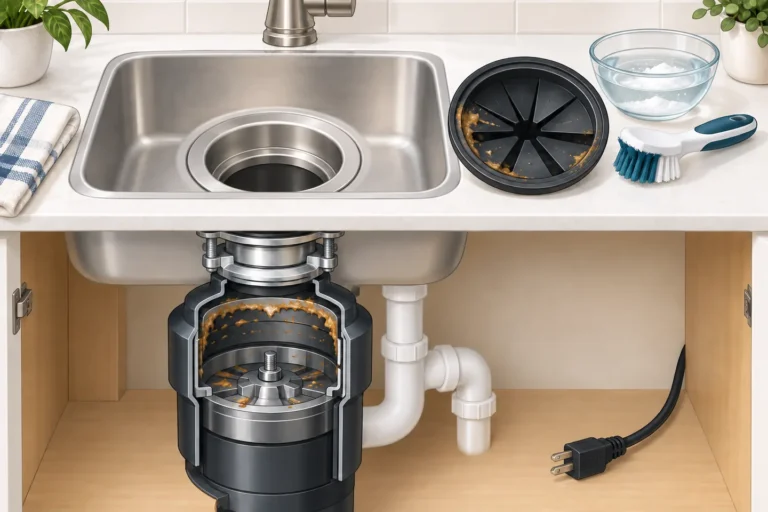
| Odor gets stronger only when the disposal runs | Food buildup under the baffle or in the upper grind chamber | Disconnect power; clean a removable baffle or reachable upper lip according to the model manual | The unit leaks, hums, will not drain, trips power, or requires a hand inside the chamber |
| Odor appears when the dishwasher drains | Dishwasher filter, air gap, hose low point, poor high loop, or disposal connection | Check the filter and visible under-sink hose routing against the dishwasher manual | Water backs into the sink or dishwasher, the hose leaks, or the correction requires moving or rewiring the appliance |
| Sewer-like odor is constant even when the sink is unused | Lost trap seal, loose drain connection, failed air-admittance valve, vent problem, or damaged plumbing | Use the conditional little-used-trap route below; no water for a leak, blockage or uncertain chemical contents | The odor returns in a regularly used sink, several drains smell, or gurgling or backup occurs |
| The cabinet smells musty rather than the drain smelling rotten | Slow leak, damp particleboard, wet insulation, or a hidden dishwasher or supply leak | Record existing moisture from a safe dry position; do not touch wet equipment or unknown wastewater | Materials are swollen, stained, soft, moldy, or become wet again |
| Only hot water in the glass smells | Water-heater or hot-water plumbing issue | Compare with hot water from another faucet | The odor persists; use the heater manufacturer or a qualified plumber rather than changing temperature or parts blindly |
| Hot and cold water smell at several faucets | Water supply, well, pressure tank, or supply-line issue | Ask whether neighbors have the same issue and contact the water authority or well professional | A private well may be contaminated, the odor is new or strong, or the water also looks or tastes abnormal |
The table is a sorting tool, not a diagnosis. More than one source can exist—for example, a disposal can have food film while a dishwasher hose also holds dirty water.
First, rule out a possible gas emergency
Do not assume every sulfur or rotten-egg smell at a sink is sewer gas. Odorized natural gas can smell similar. The Pipeline and Hazardous Materials Safety Administration says not to create a flame, use a phone, or operate electrical switches near a suspected leak. Leave and call 911 from a safe location.
Treat the smell as potentially gas-related when it is not clearly strongest at the drain, is strong across the room or home, comes with a hiss, or seems connected to a gas range, water heater, boiler, or gas piping. Do not start the disposal or exhaust fan as a test.
Do the glass test before cleaning the drain
Stop before this test: A strong or widespread rotten-egg smell, hissing, or odor near a gas appliance or line may signal gas. Leave without using switches or a phone; call 911 and the gas utility from a safe location. If anyone has put drain cleaner or another unknown product in the sink, do not add anything else or open the trap. Do not perform the test if water would enter a blocked, leaking or chemically uncertain sink, or if the area is electrically unsafe. Otherwise, the University of Georgia Cooperative Extension describes this glass comparison as a way to help distinguish water odor from drain odor.
- Use a clean, odor-free glass.
- Fill it with cold water from the affected faucet.
- Walk away from the sink and drain opening.
- Swirl the water and smell it.
- If the water smells, repeat with hot water and compare another faucet.
If the glass is odor-free at that moment, the observation supports a nearby drain-area source; it is not a drinking-water safety test and does not exclude intermittent water problems. Continue with the drain, disposal, dishwasher, and cabinet checks. If the cold-water glass smells at several faucets, contact the public water supplier or a qualified well professional. If only hot water smells, use the water-heater route below.
If the glass does not smell, follow the trigger
The odor is strongest at a plain drain
Remove the strainer or stopper only if it is designed for routine removal. Wash the removable piece with dish soap and water, and clean the accessible sink-side rim with a nonabrasive tool compatible with the sink finish. Food, oil, and soap film can collect where a quick rinse does not reach.
Flush with water at a temperature allowed by the sink, drain, and plumbing instructions. Boiling water is not a universal fix: it does not identify the source, it can splash, and it may be unsuitable for some fixtures, joints, or residual chemicals. Do not use a chemical drain opener merely because the drain smells. A product meant to clear a clog may be corrosive and may not remove the odor source.
If the drain is slow as well as smelly, the obstruction is a separate symptom. Do not keep adding deodorizer over a developing clog. If small flies are also gathering nearby, use the kitchen small-fly identification and source-removal guide to distinguish produce or bin activity from drain-associated flies. A trap or deodorizer alone does not identify the source.
The odor appears when the garbage disposal runs
Food buildup commonly collects under the rubber baffle and around the upper grind chamber. InSinkErator’s current odor guidance says to disconnect power before cleaning and never put a hand into the disposal.
- After gas is ruled out, use only a safely reachable dry control and isolate the identified supply from a safe dry position. A wall switch alone is not isolation; do not touch a wet cord, outlet or disposal. If you cannot verify that power is isolated, stop.
- Remove the rubber baffle only if the model is designed for user removal.
- Clean the removable baffle and the safely reachable upper lip as the model’s care instructions direct. Use a handled brush or scouring pad only where the manufacturer allows it.
- Reinstall the baffle before operating the unit.
- Follow the disposal manual’s flushing method. InSinkErator instructs users to run a moderate stream of cold water during grinding and for a few seconds afterward.
Never reach past the opening, touch grinding components, or rely on the switch position alone. Do not pour chemical drain opener or bleach into a disposal unless its own manufacturer and the product label explicitly permit the exact use; InSinkErator’s care manual tells users not to use chemical drain openers or bleach in its disposers.
For a disposal-specific decision path, use the garbage disposal smell guide. If the sink is also draining slowly, follow the garbage disposal not-draining checks instead of treating odor alone.
The odor appears when the dishwasher drains
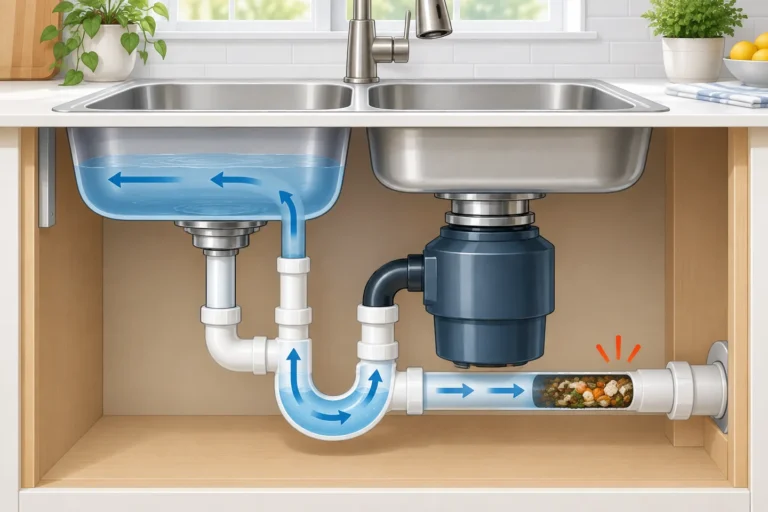
The kitchen sink, disposal, and dishwasher often share a drain connection. A smell triggered by the dishwasher can come from food in the dishwasher filter, dirty water held in the hose, a blocked air gap, a low hose route, or backflow at the connection.
Start with observations that do not require moving the appliance:
- Clean the dishwasher filter according to the model manual.
- If the countertop has an air-gap fitting, inspect and clean it only as its manufacturer directs.
- Look under the sink for a pinched hose, a sagging low point that holds water, moisture at a clamp, or a hose that lacks the model-required high loop.
- Use the timing you previously noticed; do not run a dishwasher cycle to reproduce odor, backflow or leakage. Record visible routing and existing moisture without moving the appliance, disconnecting a hose or loosening a clamp. If it already leaks or backs up, keep it out of use and arrange the appropriate repair.
Whirlpool explains that the drain line needs a high loop to limit siphoning and backflow and that the hose should run without sharp bends or kinks. The exact height and air-gap requirements depend on the appliance instructions and local code, so do not copy a measurement from another model.
If the dishwasher itself smells when opened, or water remains inside it, use the dishwasher odor guide and the appliance manual. Do not keep running cycles through a leaking, backing-up, or non-draining connection.
The sewer odor is constant or comes with gurgling
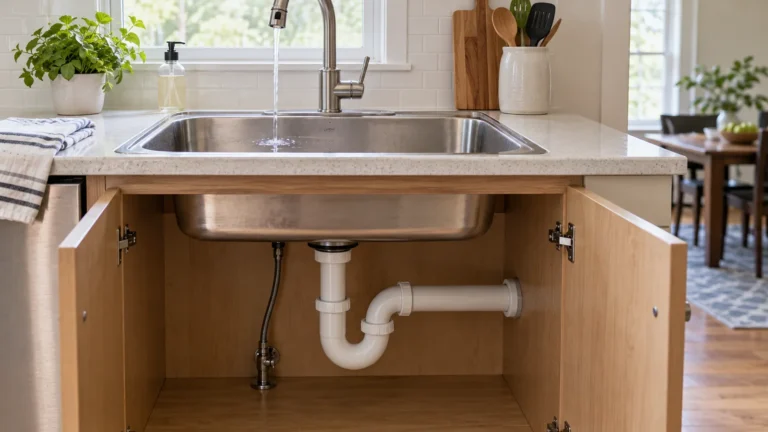
The curved P-trap holds water that blocks sewer gases from traveling back through the drain. A little-used sink can lose that seal through evaporation. Only for a little-used fixture with no gas concern, leak, chemical uncertainty, electrical hazard, blockage or wider backup may plain water refill a dry trap. Stop at rising water or moisture; do not keep adding water as a diagnostic test. A kitchen sink used every day should not need repeated trap refilling.
If the odor returns, inspect for moisture and call a plumber to evaluate a loose or damaged trap, venting, an air-admittance valve, or another drain defect. Do not disassemble the trap when a corrosive cleaner may be inside.
Gurgling changes the diagnosis. It can signal air movement, restriction, or a vent or drain issue rather than a dirty sink surface. Use the sink-gurgling trigger guide and stop using the affected fixtures if wastewater begins to back up. More than one slow or smelly drain, a toilet that bubbles when the sink drains, or sewage at the lowest fixture points to a problem beyond the kitchen sink.
The cabinet smells musty
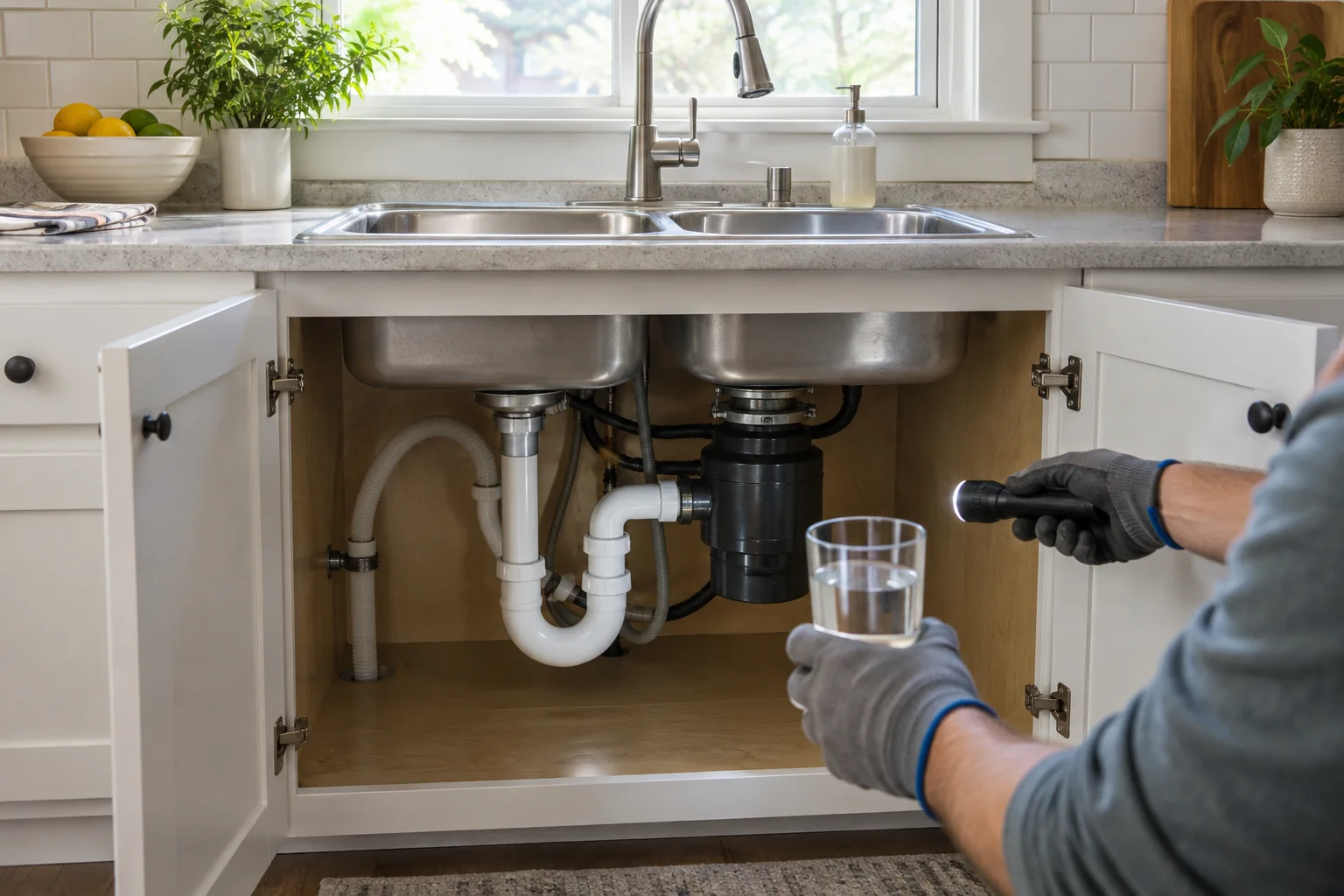
Only if the gas, chemical and electrical gates pass, remove safely reachable stored items without disturbing plumbing; otherwise leave the affected area alone. With the faucet, disposal, and dishwasher off, use a flashlight to check the cabinet base, supply valves, faucet shanks, drain connections, disposal body, dishwasher hose, and wall opening. Look for a fresh droplet, white or green mineral residue, swollen cabinet material, peeling laminate, staining, or a damp item stored under the sink.
Record existing moisture before wiping. Only when the area is electrically safe and reachable moisture is known chemical-free may you absorb it away from electrical parts and put a dry sheet beneath an accessible plumbing joint, not against wiring or a hot motor. Do not run fixtures one by one to make a leak recur, loosen a fitting or open covers. No new drop while everything is off does not rule out an intermittent leak.
Stop if water reaches an outlet, disposal connection, power cord, or other electrical part. Do not operate wet electrical equipment. A leak that returns, soaked cabinet material, visible mold growth, or water entering the wall needs repair and moisture assessment, not deodorizer.
If the water in the glass smells
Only hot water smells
Compare hot water from at least one other faucet. If hot water smells across the home but cold water does not, the source may be the water heater or hot-water plumbing. UGA notes that bacteria in a water heater or interaction with a magnesium anode can produce a rotten-egg odor.
Do not turn the water-heater temperature up, drain the tank, add chemicals, or replace an anode without the manufacturer’s procedure and the skills to isolate energy and pressure safely. A plumber or the heater manufacturer can select the correct inspection route.
Hot and cold water smell at several faucets
For a public supply, contact the water provider and ask whether there is a known change or nearby work. If neighbors have the same new odor, that information helps the provider investigate. For a private well, contact the county health department, extension service, or qualified well professional; do not assume a sulfur odor is harmless or improvise a disinfection dose.
If only one faucet’s water smells but the glass test confirms the odor, the faucet, aerator, or branch plumbing may be involved. Follow the faucet manufacturer’s cleaning instructions or have the branch evaluated.
What not to pour into a smelly sink
- Do not mix cleaners. Poison Control advises never mixing household cleaning products. Bleach combined with acids or ammonia can release dangerous gas.
- Do not create a baking-soda-and-vinegar “pressure” treatment. Poison Control notes that an open drain does not trap enough carbon dioxide to force out a tough grease clog, and the mixture does not replace diagnosis.
- Do not use chemical drain opener in a disposal unless both labels permit it. Some disposal manufacturers explicitly prohibit it.
- Do not add a second product over an unknown residue. If someone already used a cleaner, keep the product container and follow its exposure and disposal instructions.
- Do not mask a recurring sewer or musty odor with fragrance. A dry trap, backflow, vent defect, or leak will remain.
When a kitchen-sink smell needs a plumber or utility
Call the gas utility or 911 from outside if natural gas is possible. Contact a plumber promptly when:
- a sewer odor returns after a little-used trap is refilled;
- the sink gurgles, drains slowly, or backs up;
- more than one fixture smells or drains poorly;
- wastewater enters the sink or dishwasher;
- a trap, valve, hose, disposal, or cabinet is leaking;
- the disposal hums, trips power, or has wet electrical parts;
- the odor persists after the model-approved cleaning step; or
- locating the source would require opening a wall, roof-vent work, drain disassembly, or appliance removal.
Contact the water supplier, county health department, or well professional when water in the glass smells at several faucets. The important outcome is not a sweeter-smelling drain for one evening; it is knowing whether the source is food film, wastewater, plumbing gas, moisture, or the water itself.
If the odor began after raw-meat or poultry preparation, clean the sink area and use our cutting-board material and sanitation guide before the board goes back into service.
Related guides
- Garbage Disposal Smells? Find the Source and Clean It Safely
- Dishwasher Smells Bad? Match the Odor Before You Clean It
- Sink Gurgling? Check What Triggers It Before You Clear the Drain
- Garbage Disposal Not Draining? Safe Steps to Clear It
Sources
- University of Georgia Cooperative Extension: Odors in Your Water
- InSinkErator: Garbage Disposal Installation, Care and Use Manual
- Whirlpool Product Help: Drain Line Installation
- South Davis Sewer District: Understanding Sewer Odors and P-Traps
- Poison Control: Top Tips for a Safe Spring Cleaning
- PHMSA: Recognizing and Responding to Pipeline Emergencies