How to Remove Urine Smell From Carpet: Find How Deep It Soaked
Urine smell that returns after drying calls for a source-and-depth assessment, not more surface cleaner. A small, known fresh pet accident may allow prompt blotting and one compatible, label-directed treatment. For a dried or recurring odor, first establish the location, carpet material, and previous products; repeated surface treatment can add moisture without reaching the source.
Safety boundary: Do not mix cleaning products or add bleach, ammonia, vinegar, peroxide, or another cleaner over unknown residue. If a product is already on the carpet, follow its label before adding anything else. If mixing caused fumes, eye or throat irritation, breathing trouble, heat, or bubbling, leave the area for fresh air and contact Poison Control in the United States at 1-800-222-1222; call 911 for severe symptoms.
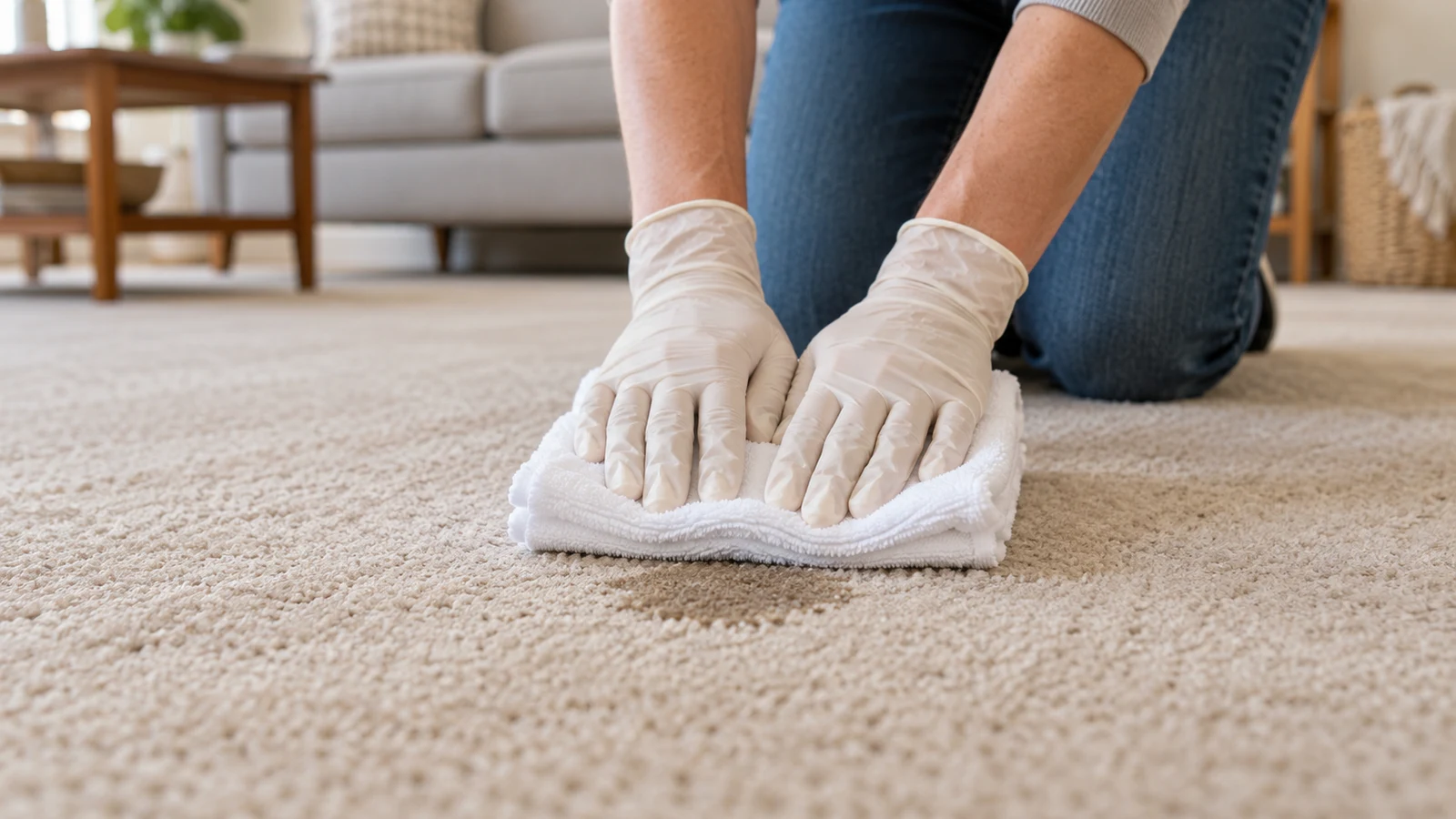
Move children and pets away from the spot. Put on disposable gloves if you will touch wet towels or cleaning residue. Do not let anyone walk through the accident and track it into a larger area.
Do not apply a generic internet recipe to a carpet or rug that is wool, silk, another natural fiber, hand-dyed, antique, valuable, or covered by a warranty you have not checked. Water, alkalinity, acids, oxidizers, enzymes, solvents, and extraction can affect different fibers and dyes differently.
Match the clue to the next safe step
| What you notice | What it may mean | Best next step | Stop or escalate when |
|---|---|---|---|
| The spot is still wet | Liquid is in the pile; its full depth is not yet known | Blot immediately, identify the carpet, then use one compatible label-directed treatment | The accident was large, reached a seam or edge, or the carpet remains wet below the surface |
| The spot is dry and its location is known | Odor residue remains in the pile or a lower layer | Mark the full area, check what was used before, and follow one compatible urine-treatment label | Color transfers, texture changes, or the odor returns after complete drying |
| The smell returns on humid days or after drying | Contamination may be in the backing, pad, or subfloor | Stop repeating surface applications and arrange a depth assessment | The same area has been treated correctly more than once without lasting improvement |
| The room smells but the spot is unknown | One hidden spot or several areas may be involved | Locate the source before treating; inspect common marking locations and carpet edges | The odor is widespread or the contamination boundary cannot be identified |
| Wool, natural fiber, antique, hand-dyed, or warranty-covered carpet | Generic wet cleaning could damage the fiber, dye, backing, or warranty | Use the maker, dealer, installer, or a qualified cleaner familiar with that material | You cannot verify a compatible method |
| An unknown cleaner was already used | A new product could be incompatible or create an exposure risk | Stop adding products; identify the first product and follow its label | There are fumes, symptoms, heat, bubbling, bleaching, or dye transfer |
The table routes the problem; it does not approve a particular cleaner. The carpet instructions and the treatment label control the actual amount, dwell time, rinsing, extraction, ventilation, and pet re-entry directions.
Fresh, known accident: blot safely · Dried or unknown location: collect clues · Returning odor: assess the depth risk
Resolve the carpet and previous-product limits
The material and care record
Look for the purchase record, care booklet, warranty, installer information, or a label on a removable rug. Do not assume every installed carpet is nylon or polyester. Wool, other natural fibers, specialty dyes, and some stain-resistant treatments need different care.
If you cannot identify the material, use the conservative route: blot fresh liquid, add no improvised mixture, and ask the retailer, manufacturer, or a qualified carpet cleaner what is compatible.
Blot fresh liquid with clean white towels, then contact the maker, dealer, installer, rug specialist, or a qualified cleaner familiar with that construction. A successful hidden-area test is helpful but does not prove a method is safe for the whole item or its backing.
The product history
Write down the product name if you know it. Check whether anyone used a deodorizer, spot cleaner, detergent, vinegar solution, peroxide, disinfectant, or rented machine. Do not treat a dry-looking carpet as chemically empty.
If the earlier product is known, use its label for residue removal or rinsing. If it is unknown, stop adding chemicals. Poison Control warns that household products should not be mixed because dangerous fumes can result. It specifically explains that bleach with an acid such as vinegar can release chlorine gas and bleach with ammonia can create chloramine gas.
Locate a dried or uncertain spot before choosing treatment
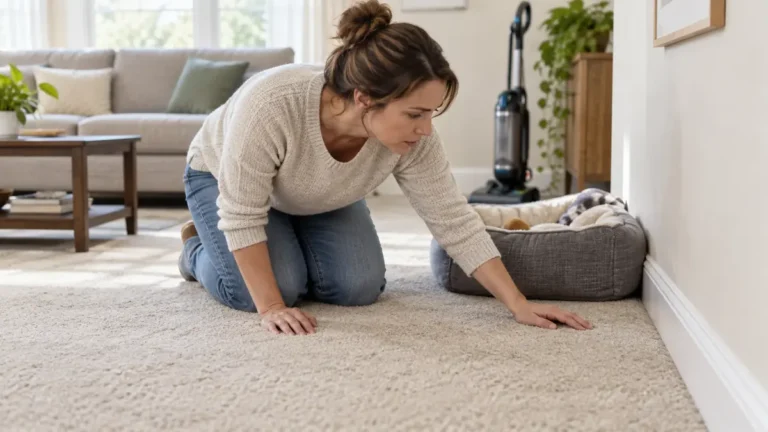
Start by locating the full affected area. Inspect common repeat-marking places such as carpet edges, doorways, furniture legs, and the original accident location. An ultraviolet light may help locate possible biological residue in a dark room, but fluorescence is not proof of urine; cleaners and other materials can also glow.
Use it as a locator aid, then combine that clue with the accident history, odor, and material inspection. Do not deliberately wet the carpet, increase room humidity, or dismantle the installation to reproduce an odor or find a hidden layer.
Record the accident locations, approximate size, repeat incidents, and products already used. These clues help choose the next route; they do not establish that the contamination stayed in the pile.
Do not use fragrance as the test. A perfumed room can still contain urine residue, and scent can fade before the treated layers are dry.
Once the location, material, and product history are resolved, use the single label-directed treatment route below. If the boundary is uncertain or the odor is widespread, arrange assessment rather than treating the room blindly.
Why the urine smell can return after the carpet looks clean
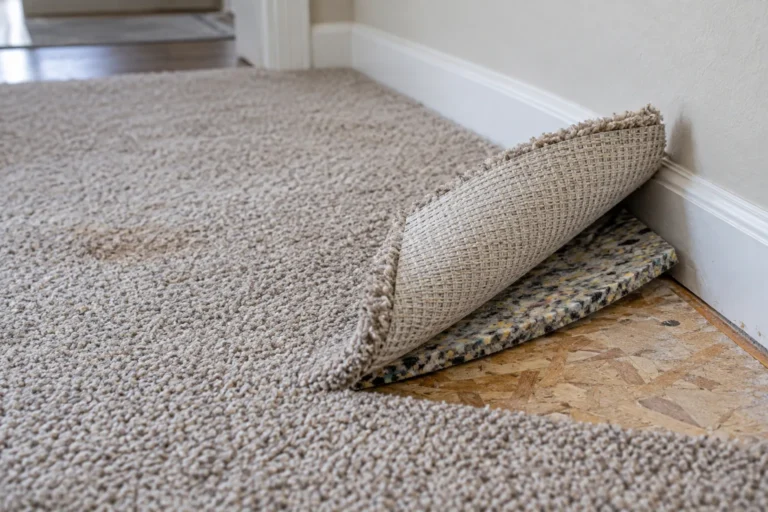
Installed carpet has layers. The visible pile sits above one or more backing layers, then a cushion or pad, and finally the subfloor. A surface product can improve the pile while urine remains below it.
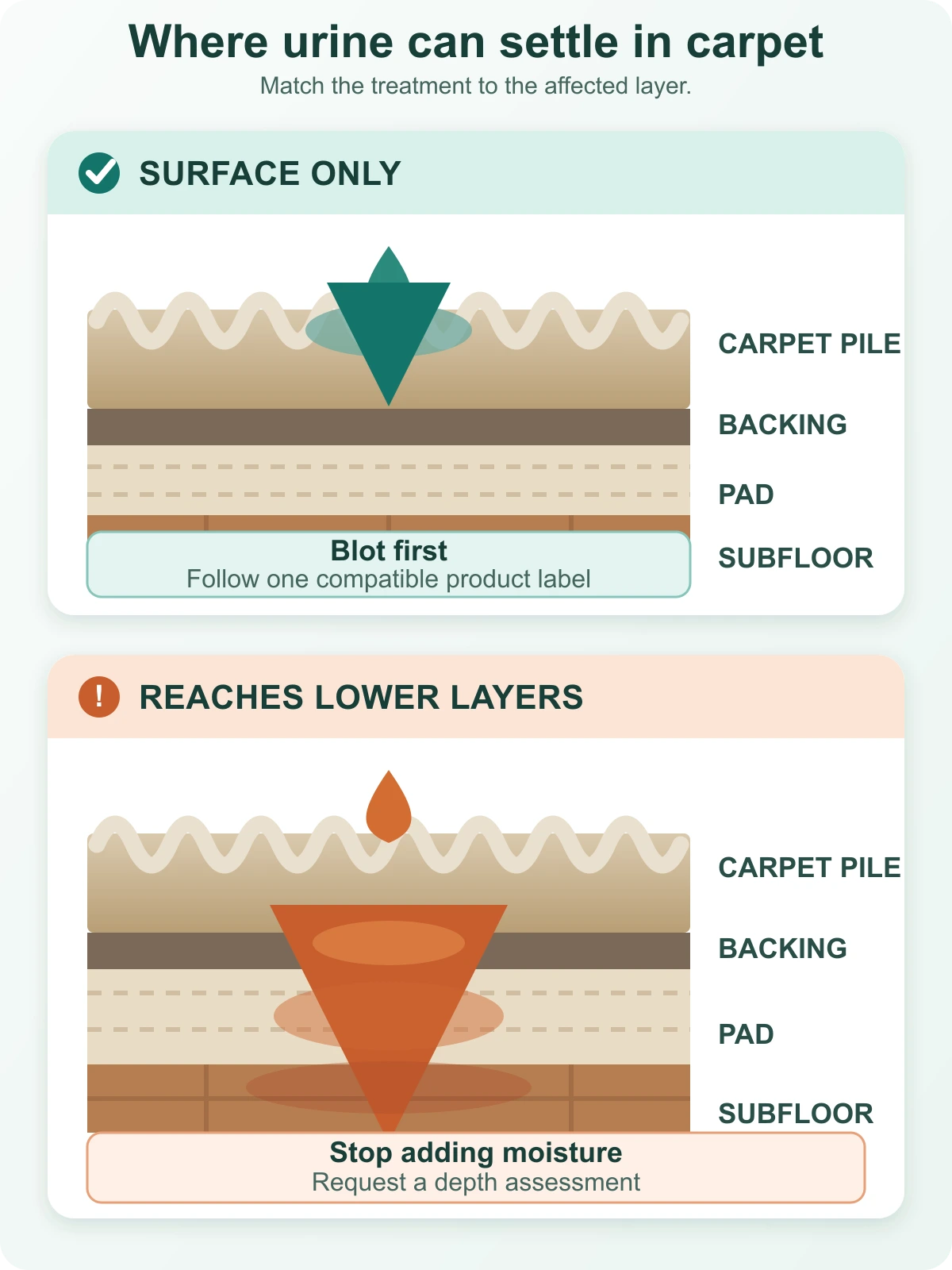
The Carpet and Rug Institute says urine can affect carpet dyes, weaken the bond between carpet layers, and damage vulnerable seams. It also notes that odor can reappear during humid conditions and that some urine stains may not be removable.
As humidity increases or moisture moves through the area, odor can become noticeable again. CRI specifically notes that pet-urine odor may reappear in high humidity. A returning odor therefore calls for a depth decision, not automatically a stronger mixture.
Possible signs of deeper involvement include:
- a large original accident or repeated accidents in the same place;
- odor that is strongest near a seam, edge, or floor transition;
- odor that returns after the pile is completely dry;
- a spot that remains damp longer than the surrounding carpet;
- several correct, label-directed surface treatments without lasting improvement; or
- discoloration or odor detectable from an accessible underside, without dismantling the installation.
These are reasons to stop adding liquid, not proof of a particular wet layer. A cool feel alone cannot locate moisture, and a dry-looking or dry-feeling surface cannot establish dry backing or padding.
The SPCA guidance says odor may be very difficult to remove when urine has reached the padding and that affected carpet or padding may need replacement. That is a possibility, not an automatic conclusion. A qualified carpet-cleaning or flooring professional can assess the depth and installation before more liquid is added.
Blot a small, known fresh accident without spreading it
Press vertically; watch for dye transfer
Place folded clean white towels over the wet area and press straight down. Lift, move to a dry section, and repeat while liquid continues to transfer. Work around the edge as well as the center because the damp boundary may be wider than the visible mark.
White towels make dye transfer easier to see. Stop if carpet color transfers or the pile begins to distort. Scrubbing can spread the urine across the fibers and make the boundary harder to judge.
Watch the existing wet boundary, not a hidden-layer test
Press a fresh dry towel at the edge after the top has been blotted. A spot that remains wet, covers a seam, reaches a wall edge, or resulted from a large volume deserves more caution. Do not cut or lift installed carpet to investigate unless a flooring professional or the installation instructions direct it.
Blotting the top does not prove the cushion is dry. Carpet construction varies: some backing systems resist penetration better than others, according to CRI.
The towel action above is additional blotting, not a test that confirms how deep urine traveled. Do not squeeze, cut, lift, or deliberately re-wet installed carpet to investigate.
Use one compatible treatment only after the scope checks
Use a product only when its current label lists pet urine or pet odor, carpet, and the relevant fiber or surface. Check whether the carpet maker permits that category of treatment. An enzyme-based odor treatment may be an option, but “enzyme” does not mean it is safe for every carpet or compatible with every product already present.
It cannot guarantee removal when urine has damaged dye or reached inaccessible layers.
Follow the exact label for pretesting, amount, dwell time, blotting or extraction, ventilation, protective equipment, and when people or pets may return. A hidden-area test can reduce risk, but it cannot guarantee that the entire carpet will respond the same way.
Treat the complete affected boundary without deliberately soaking beyond the label amount.
Remove moisture only as directed
Do not pour cleaner or rinse water into the spot merely to reach the depth you imagine. Use blotting, extraction, or a clear-water step only when the carpet guidance and treatment label permit it. Over-wetting can carry contamination farther down and can affect backing, seams, adhesive, or cushion.
Dry fully, then judge whether the source remains
Keep the area uncovered and protect it from traffic. Use normal room ventilation and any drying method allowed by the carpet and product instructions. Do not use steam or improvised high heat. The SPCA of Texas cleanup guidance warns that steam heat can set pet odor.
There is no universal drying time. Carpet density, liquid depth, cushion, room humidity, airflow, and the treatment amount all matter. Reassess odor only when the carpet is fully dry.
What not to use as a universal urine-odor remedy
- Do not mix cleaners. A second product can react with the first or leave incompatible residue.
- Do not use chlorine bleach or ammonia as a default treatment. They introduce material and exposure risks and are not universal carpet-care methods.
- Do not combine bleach with vinegar or another acid. Poison Control states that this releases chlorine gas that irritates the airways, eyes, nose, and throat.
- Do not layer vinegar, peroxide, detergent, baking soda, disinfectant, and enzyme products. More ingredients do not prove greater odor removal.
- Do not scrub or use a stiff brush. This can spread the accident and change the pile.
- Do not saturate the carpet. Added liquid can move into the backing and cushion.
- Do not use steam or high heat before the odor source is removed. Heat is not a substitute for extraction and can set odor.
- Do not keep treating a spot that changes color, sheds dye, feels sticky, becomes stiff, or stays damp. Stop and obtain material-specific advice.
When professional assessment is the better next step
Arrange professional help when the odor returns after complete drying, the accident was extensive or repeated, urine may have reached the pad or subfloor, or the carpet material is sensitive or unknown. Also stop household treatment when:
- the affected area includes a seam, wall edge, tack-strip area, or floor transition;
- carpet dye transfers to a white towel;
- the pile, backing, or texture changes;
- an unknown combination of products was used;
- the area remains damp or develops a musty odor; or
- the installation or warranty instructions prohibit the proposed method.
If the concern shifts from urine odor to visible or suspected fungal growth, use the mold-on-carpet decision guide; its cleanup and replacement thresholds are different.
Ask the cleaner how they will determine the affected depth, control moisture, verify drying, and protect the carpet warranty. No product or service can guarantee that every deeply saturated carpet, pad, or subfloor can be restored.
When dog or cat accidents keep happening
The household cleaning decision stays the same: respond to freshness, carpet material, contamination depth, and the treatment label. Do not create separate chemical recipes simply because the pet is a dog or cat.
Cat urine can be especially persistent, and CRI notes that complete odor removal is unlikely if cat urine cannot be completely removed. Both dogs and cats may return to an area where they still detect odor. If accidents repeat, cleaning the carpet is only part of the response; contact a veterinarian to rule out a health concern and seek appropriate behavior guidance without punishing the animal.
Clean the original source completely enough that the pet is not drawn back by residual odor. Restrict access while the area is being treated and until the product label says it is safe to return. Do not punish a pet at the accident site.
A sudden change in elimination habits may need professional evaluation; this carpet guide cannot identify the cause.
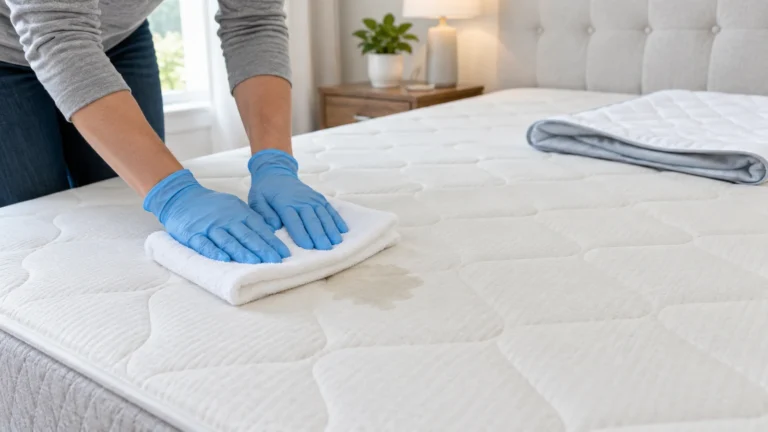
If the accident is on a mattress rather than carpet, use the urine-on-mattress guide so the foam or inner layers are not treated like installed carpet.
For smoke, cooking, musty, or other non-urine carpet odors, use the broader How to Deodorize Carpet guide instead of applying the urine-treatment route to every smell.
Updated October 23, 2026: grouped location and returning-odor clues before treatment, separated fresh-accident blotting from one shared label-directed route, and clarified that towel blotting and a dry surface cannot determine contamination depth. The chemical-exposure response, material restrictions, product-label limits, and professional thresholds are retained.