How to Get Musty Smell Out of Clothes
Start with when the odor appears
Musty odor can come from clothing that stayed damp, a load left in the washer, residue held in one part of a garment, or a damp drawer or closet. Do not start by stacking laundry additives. First note when the odor appears and whether it affects one garment or several loads. Then follow the garment’s care label, wash with the correct amount of detergent, and dry it completely before storage.
Updated October 22, 2026: expanded the localized pretreatment and fully dry result checks, clarified hand-wash and product-removal limits, and added a storage comparison that does not put clean clothes back into a damp space. The odor-timing diagnosis and September 26 illustration are retained.
Rewash within the care limits · Treat a collar or underarm area · Check the dry result · Check a storage pattern
Use the timing to find the likely source
| What you notice | What it may suggest | First useful action |
|---|---|---|
| One or two garments smell only after being stored | They may have gone into storage slightly damp, or the drawer or closet may be damp | Check thick seams, linings, cuffs, and the storage area; move one clean, fully dry garment to a different dry location for comparison |
| A whole load smells when the washer stops | The load may have sat wet, or the washer may be contributing odor | Move the load promptly, then check only the user-accessible areas and cleaning cycle named in the washer manual |
| Odor appears mainly after the garment is worn or warmed | Body soil, deodorant, or detergent residue may be concentrated at the collar or underarms | Turn the garment inside out, inspect those areas, and use only a label-compatible pretreatment |
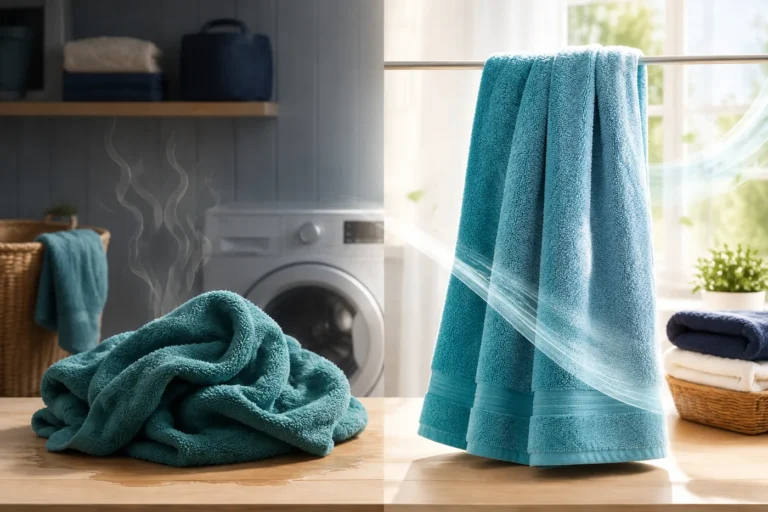
| Towels smell fresh when dry but sour again when wet | Absorbent towel residue or slow between-use drying needs its own check | Use the mildew-smell-from-towels guide |
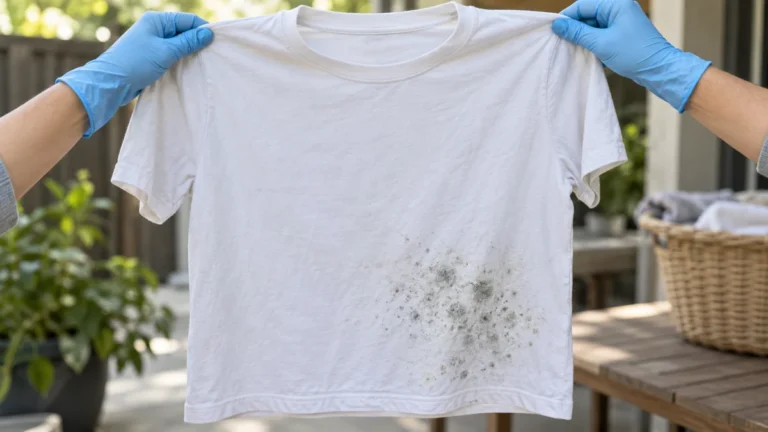
| You see fuzzy growth or persistent spots, or the clothing contacted floodwater or sewage | This is not an ordinary odor-only laundry problem | Isolate the item and use the mold-on-clothes decision guide; contaminated-water items may need professional advice |
These clues narrow the next step; odor alone cannot prove that mold is present.
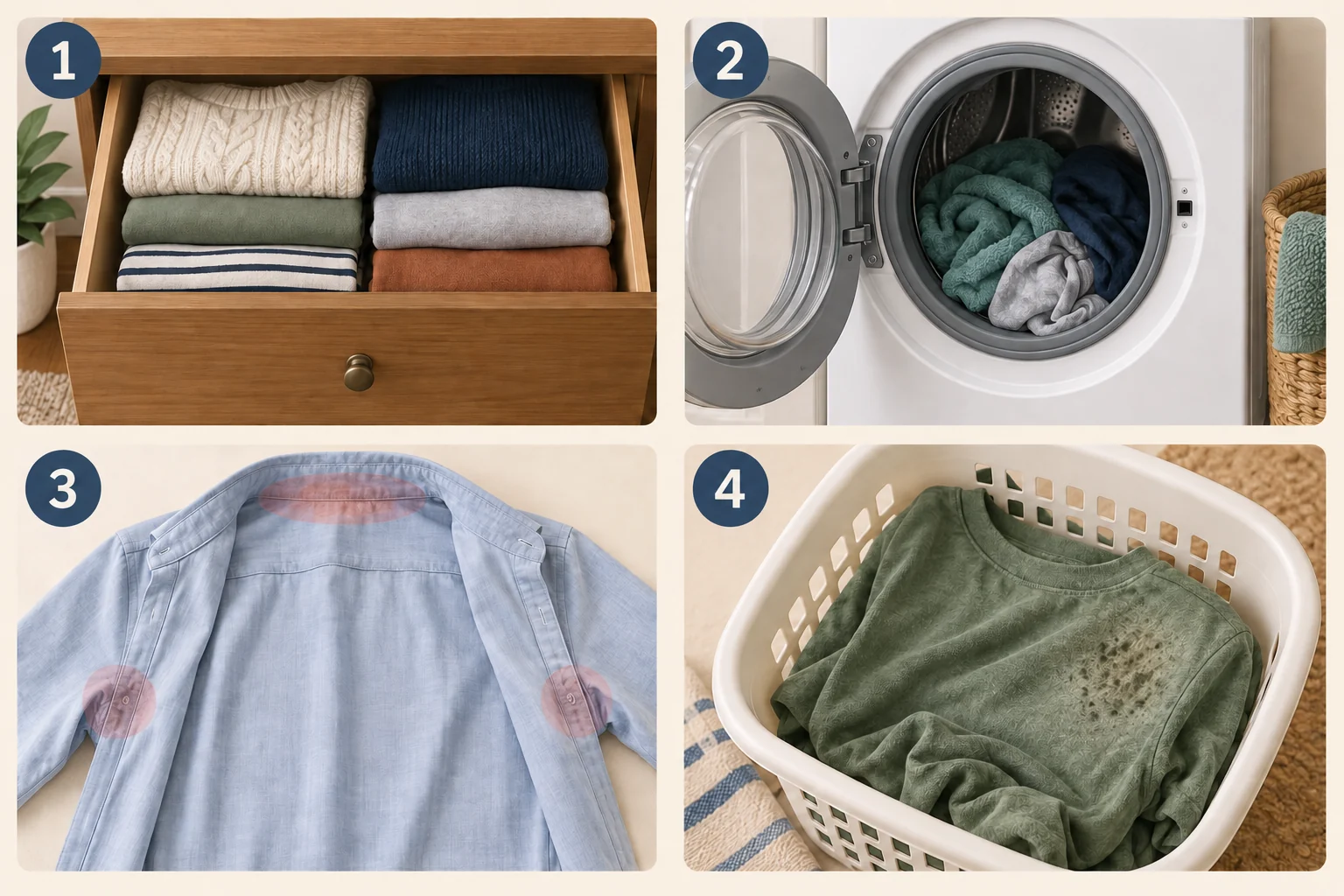
Rewash musty clothes without damaging them
- Separate and inspect the affected clothing. Check for visible spotting, deterioration, and a dry-clean-only label before wetting or washing the item. Empty pockets and look at slow-drying areas such as waistbands, cuffs, linings, and hoods. If the item has visible growth, use the mold-on-clothes guide instead of treating it as odor only.
- Let the care label set the limits. Follow its wash method, temperature, bleach restrictions, and drying instructions. The FTC requires care instructions because heat, agitation, bleach, and drying methods can damage some textiles. A hand-wash-only label is not permission for a machine cycle, and permission to wash does not automatically permit soaking or a strong pretreatment. Check linings, elastic, prints, and trim as well as the main fabric. If the instructions are missing or the construction is uncertain, ask the maker or a professional cleaner. Do not assume a hot or sanitizing cycle is safe for every garment.
- Use the detergent and washer correctly. Leave enough room for the load to move and measure detergent according to its label, the load, and the machine. More detergent is not automatically more cleaning; residue can remain when a product is overused or does not rinse well.
- Choose a localized treatment only when needed. If the smell is strongest at a collar or underarm, use the complete pretreatment check below before the full wash. Do not improvise a mixture or pour several products into the same load.
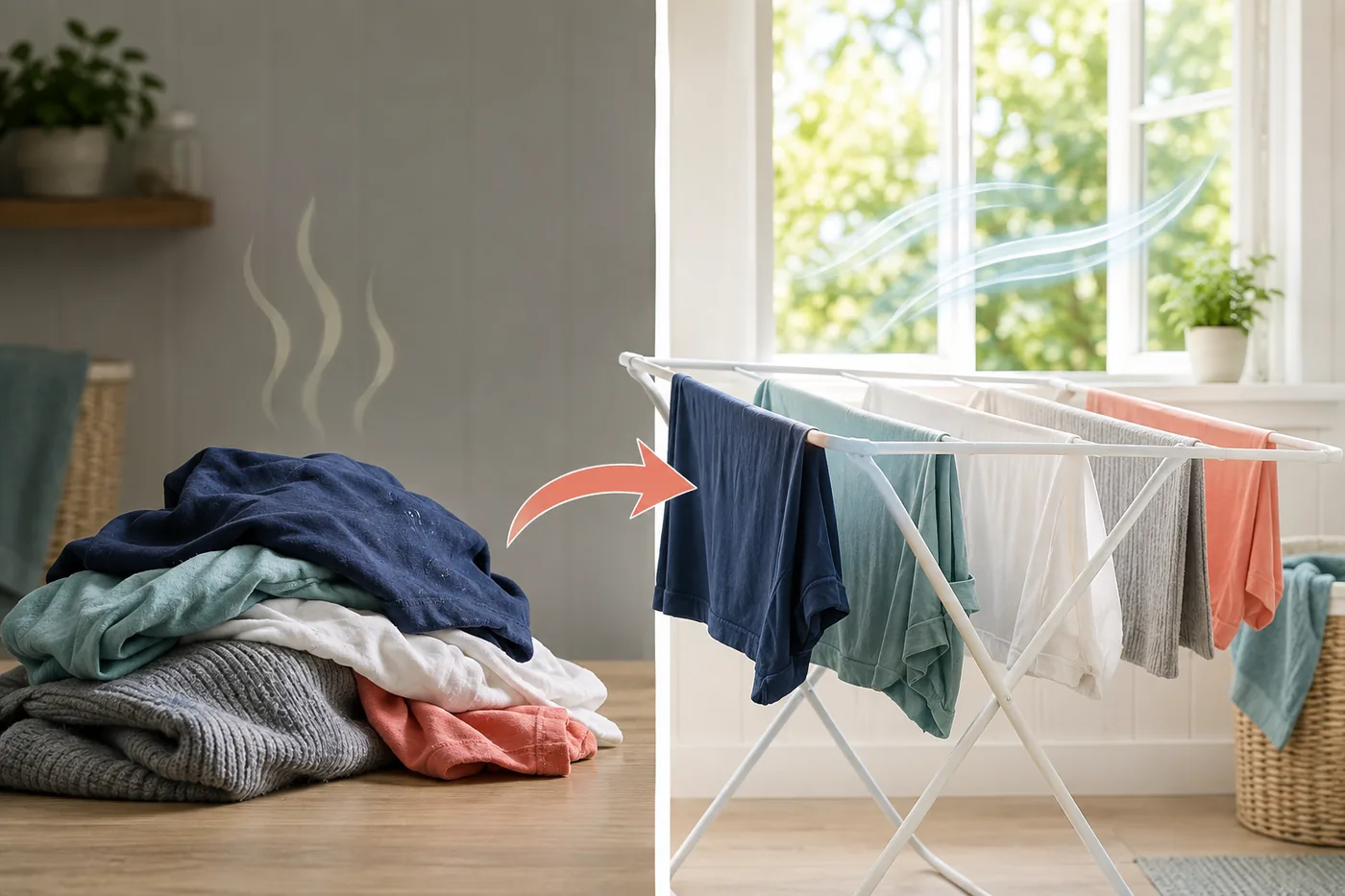
- Remove the load promptly and dry every layer completely. Use the label-approved dryer setting or air-dry with space and airflow. Open pockets, unroll cuffs, and spread hoods or thick sections. Check those areas before folding the garment away. If an odor remains, choose label-permitted air drying for reassessment rather than more dryer heat as an odor-removal test. Drying and a fresh fragrance do not establish that an item is disinfected.
Do not mix chlorine bleach with vinegar, ammonia, acids, or unknown cleaner residues. Poison Control warns that these combinations can release toxic gas. If fumes cause coughing, burning, chest tightness, or trouble breathing, leave the area for fresh air and contact emergency services or Poison Control in the United States at 1-800-222-1222.
Complete a localized collar or underarm treatment
This route is for an ordinary odor-only problem on clothing whose instructions permit the entire treatment and wash. Visible growth, floodwater, sewage, or unknown chemical contamination goes to the stop section—not to a stronger pretreatment.
- Check the product’s actual use. Select a laundry detergent or pretreatment whose label permits this fabric, dye, and soil. A washer cleaner, surface spray, or fragrance product is not a clothing pretreatment. Follow its protective-equipment directions; do not apply the treatment while wearing the item.
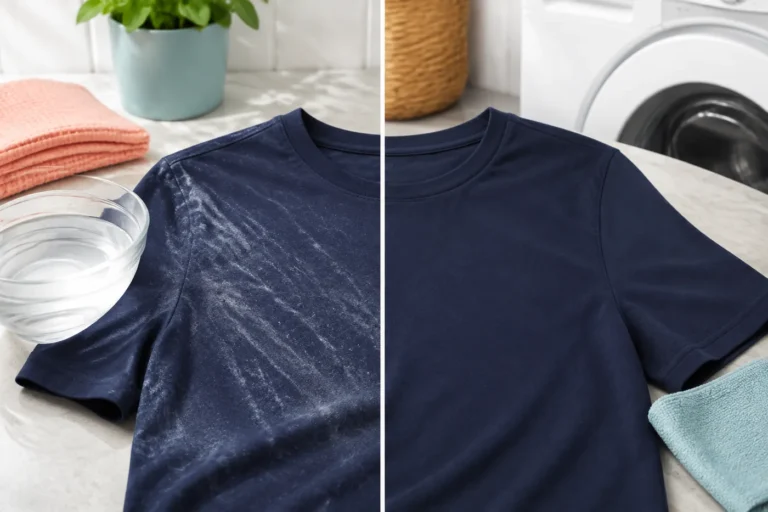
- Test a hidden area of the same fabric first. Use an inside seam or hem, following the product’s application and contact-time instructions. Check the trim separately where relevant. Stop if dye transfers, the surface roughens, or the material changes. Complete the test’s required rinse or laundering on schedule, let the fabric dry, then compare it with the untreated area. If a test requires a full wash, do not delay that wash just to let pretreatment dry on the spot.
- Treat the localized soil, not every part of the garment. If the test remains unchanged and both labels permit it, turn the item inside out and apply the specified amount to the affected collar or underarm. Use only the permitted gentle working action; a stiff brush can be unsuitable for a fine knit or decorated fabric. Do not lengthen the dwell time to make it “stronger.”
- Finish removal through the approved wash. Rinse before laundering only if the selected method directs it; some detergent pretreatments go straight into the wash. Follow the garment’s hand- or machine-wash instructions and the product’s rinse requirements. Do not wear, fold, or store an item with unfinished pretreatment on it.
The American Cleaning Institute’s laundry guidance supports hidden-area colorfastness checks and laundering the whole garment to remove treatment residue. Exact timing and removal still come from your product: Tide’s named liquid-detergent sweat-stain method, for example, goes into the wash without a pre-rinse. That example is not a dosing or timing rule for another product.
Check the fully dry result before another wash
Finish the care-label drying process and inspect thick seams, linings, pockets, and cuffs before storage. Note whether the odor was present at cycle end, after drying, or only after storage. Do not deliberately heat, dampen, or wear a suspect item to provoke a smell.
| Dry result | Useful next decision | Do not infer |
|---|---|---|
| Ordinary odor is gone; no residue, fabric change, or damp layered area | Store in a dry space with room for airflow and monitor during normal use. No extra deodorizing wash is needed simply as insurance. | A scent or absence of odor does not certify disinfection or rule out a building-moisture problem. |
| The same odor remains after a compatible wash and complete drying | Stop repeating an unchanged cycle. Use the timing/source table: several items at cycle end point toward the washer/load routine; one item or area needs its own fabric-care review. Ask a cleaner before an unsupported next treatment. | Persistent odor alone cannot identify mold, prove a failed washer part, or set a universal discard threshold. |
| Fabric fades, stiffens, transfers dye, or retains a visible soapy/waxy patch | Stop that product and do not hide the result with softener or another chemical. Unknown exposure or damage needs product/maker advice. For an ordinary post-wash deposit, see the detergent-residue checks | More detergent or a hotter cycle is not a general repair for residue or damaged dye. |
If the smell returns after storage
Do not keep rewashing without checking the storage space. For an ordinary odor-only problem with no visible growth or known water damage, keep a clean, completely dry garment in another dry, ventilated location and note its condition at your next normal check. Do not return a clean “test” item to a damp or visibly moldy drawer to reproduce the problem. Inspect the original drawer or closet for condensation, a damp wall, a leak, or tightly packed clothes that block airflow. If the space is humid, use the indoor-humidity guide to check the room rather than masking the odor in the fabric.
Record the garment, the wash and drying method, the storage location, and when the odor returns. Change only the storage location for this comparison rather than adding fragrance, softener, and a new wash treatment at the same time. If the odor appears only in the original space, that is a storage clue—not proof of mold. If it persists elsewhere too, the comparison has not established the cause; return to the garment and washer checks or seek textile-care advice.
EPA guidance emphasizes moisture control because mold problems return while the moisture source remains. If you find visible growth on the wall, widespread water damage, or a continuing leak, address that building problem before returning clean clothes to the space.
If several loads smell
When different garments smell as soon as a wash ends, the common source may be the washer or a wet load left in the drum. A washer-cleaning cycle is an empty-machine maintenance procedure, not a stronger cycle for the odorous clothes; follow the exact manual, permitted product, and required empty rinses before the next laundry load. Inspect only parts the manufacturer says the user may clean, such as an accessible gasket or dispenser, and run the model-approved cleaning cycle. Keep the door or lid in the position recommended by the manual between uses, especially around children and pets.
Match a different odor to the correct guide. A sulfur or rotten-egg odor may point to the water supply, washer residue, or drain area; use the rotten-egg washer guide. A drain or sewage odor has a different route in the washing-machine sewage-smell guide.
When to stop the ordinary laundry routine
- Dry-clean-only or valuable item: take it to a professional cleaner and describe when the odor appears.
- Visible growth or persistent spotting: isolate it and use the mold-on-clothes decision guide; do not keep adding stronger products.
- Floodwater, sewage, or unknown chemical contamination: keep the item separate and get local public-health or restoration advice. An ordinary wash may not be an appropriate safety decision.
- Irritation or breathing symptoms: leave the affected area and seek medical or poison-control advice as appropriate.
- Garment remains odorous after correct washing, complete drying, and a storage or washer check: follow the maker’s care guidance or ask a textile-care professional. There is no universal number of washes that proves an item is safe or requires replacement.
Prevent musty odor from returning
- Move finished laundry out of the washer promptly.
- Dry clothing completely, including thick seams and layered areas, before folding it.
- Do not put damp gym clothes or wet garments into a closed hamper or drawer.
- Avoid packing closets and drawers so tightly that air cannot move around clothing.
- Correct leaks, condensation, or persistent high humidity instead of relying on fragrance to cover the smell.
- Use only the amount of detergent and softener directed for the load and machine.
Sources
- Federal Trade Commission: Care Labeling Rule — garment wash, bleach, drying, and professional-care instructions.
- U.S. Environmental Protection Agency: Mold cleanup in your home — moisture correction, complete drying, porous-material limits, and contaminated-water escalation.
- Maytag: Removing odor or smell from a washer — wet-load removal, detergent residue, and model-approved washer cleaning.
- Whirlpool: How to get mildew smells out of clothes — care-label checks, complete drying, storage ventilation, and washer-source checks. Its product-specific recipe is not generalized here.
- Persil: How to get smells out of clothes — localized residue, label-directed washing, detergent amount, prompt removal, and air drying.
- Poison Control: Chlorine gas — toxic-gas risk from mixing chlorine bleach with acids, vinegar, or ammonia.
- American Cleaning Institute: Laundry basics — hidden-area testing and removing treatment residue through laundering.
- Tide: Sweat and armpit stains — its named detergent pretreatment goes straight into the wash; not universal timing or dosing.