How to Clean a Memory Foam Mattress Without Soaking the Foam
Quick answer: Before cleaning a memory foam mattress, find the instructions for the exact model and determine whether you are dealing with a separate protector, a removable cover, a non-removable cover, or the foam core. Remove dry debris only by the method the manufacturer permits. Blot a fresh spill with dry white towels. Spot-clean a small surface mark only when the product instructions allow it, using as little moisture as possible, and leave the bed uncovered until the treated area is completely dry. Do not machine-wash, soak, steam, or extract-clean the foam unless the mattress maker explicitly approves that method.
Updated October 22, 2026: Added a fully dry patch-test check, after-cleaning decisions, and clearer limits for hidden moisture and contaminated spills.
For a permitted small surface mark, go to the spot-cleaning steps. If you have already cleaned it, use the dryness and result check before remaking the bed.
Identify the layer before you clean it
A mattress can have several layers that look like one piece when the bed is made. They do not necessarily share the same cleaning instructions. If the mattress is a different material or you have not identified its layers, use the mattress cleaning guide to choose a suitable route before applying a treatment.
- Mattress protector: A separately purchased protector usually has its own sewn-in care label. Remove and launder it only by that label.
- Removable mattress cover: Some models have an outer cover designed for consumer removal and washing. Others use a zippered cover that is not washable or is not intended to be removed.
- Non-removable surface fabric: This is usually limited to light surface or spot cleaning by the maker’s instructions.
- Foam core: Memory foam absorbs liquid and can dry slowly. A treatment that seems gentle on the fabric can still carry moisture into the foam.
A zipper is not permission to remove the cover. Tempur-Pedic, for example, identifies certain covers as washable while other current models are spot-clean only. Sleep Number also publishes different instructions for different mattress covers and foam layers. Find the model page, care tag, or owner’s guide before opening the cover or choosing a cleaner.
Choose the least-wet cleaning route
| What you find | Safe starting route | Stop or change course when |
|---|---|---|
| Dry dust, hair, or crumbs | Use only the dry-cleaning or vacuum method permitted for that cover | The instructions prohibit vacuuming, the fabric snags, or the attachment pulls the cover |
| A removable cover with separate care instructions | Remove and wash only the cover if the exact instructions permit it | The cover is structural, not washable, or the spill has reached the foam below |
| A fresh liquid spill on the surface | Blot immediately with dry white towels, then follow the maker’s spill directions | A large area is saturated or moisture has penetrated the foam |
| A small surface mark | Use the least-wet, model-approved spot-cleaning method | Color transfers, the mark spreads, the foam becomes wet, or the instructions are missing |
| A light odor without visible contamination | Air the mattress and use only a dry treatment approved by its maker | The odor returns, follows a biological spill, or suggests moisture inside the bed |
| Visible mold, persistent dampness, pest signs, sewage, or deep contamination | Stop ordinary cleaning and contact the manufacturer or an appropriate remediation or pest professional | Do not cover, saturate, steam, or continue using the mattress while the condition is unresolved |
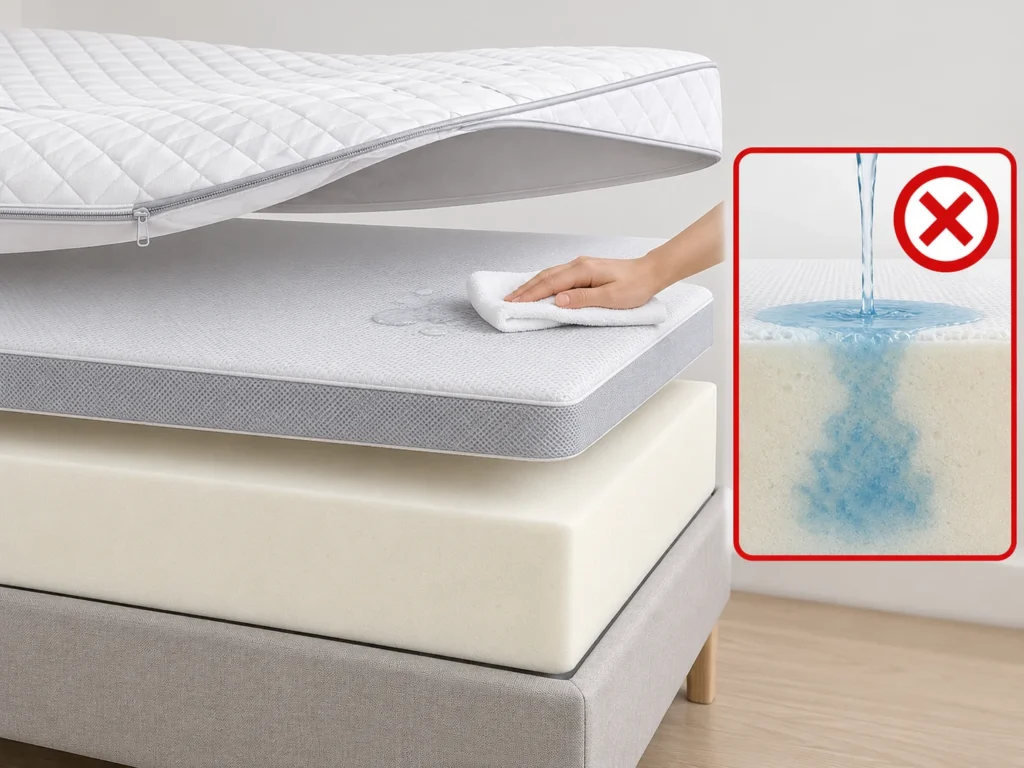
Why one mattress-cleaning recipe is unreliable
Current manufacturers do not give one universal method for every foam mattress. Tempur-Pedic says never to wash its TEMPUR material and instructs owners to blot spills and use moving air. Serta discourages applying liquids because moisture or chemicals may stain the fabric or damage the foam. Sealy allows a small amount of mild soap and water for spot cleaning but says not to soak the mattress.
Even one company may use different care routes across its product line. Sleep Number lists some foam layers as spot-clean only and some separate outer covers as machine washable. For another model-specific example, Tuft & Needle distinguishes selected removable Mint top covers from fixed covers and non-removable lower portions. These exceptions must not be applied to an unverified model. Fill type alone cannot tell you whether vinegar, baking soda, detergent, an enzyme product, or another cleaner is suitable.
Treat the exact mattress instructions as the controlling source. If you cannot identify the model or locate reliable care directions, stay with dry debris removal and prompt blotting rather than improvising a wet treatment.
How to clean routine dust and dry debris
1. Strip the bed and inspect the surface
Remove sheets, pillowcases, and a separate protector. Wash those items by their own labels. Look across the mattress in good light for an open seam, torn cover, wet patch, stain, mold-like growth, pest signs, or an area that feels different from the surrounding surface.
Do not continue with routine cleaning when you find live insects, eggs, spotting associated with pests, visible mold, or a wet area that extends into the mattress. Those conditions need a different identification and response from ordinary dust, and surface cleaning can hide rather than solve the problem.
2. Check whether vacuuming is permitted
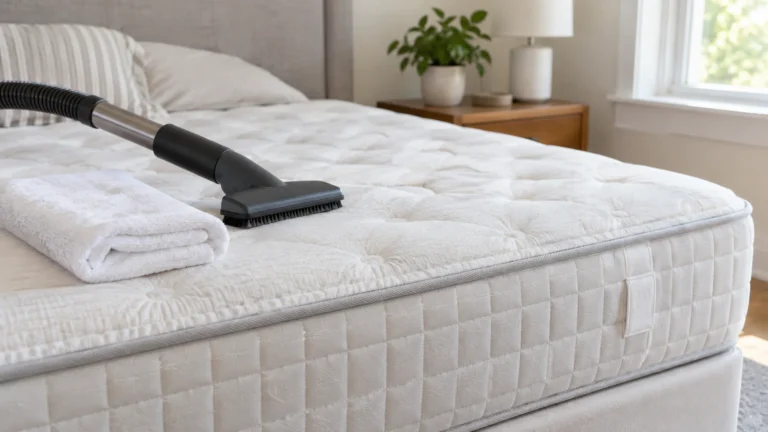
Some mattress makers recommend a particular upholstery attachment; others warn that direct vacuum contact or a bristled tool can damage the cover. If your instructions permit vacuuming, use the named attachment and move it lightly over the surface without pressing or dragging at seams. Do not assume the same method is safe for every knit, quilted, or cooling cover.
If the maker does not permit vacuuming, use its stated dry-cleaning route. Do not substitute a stiff brush, lint shaver, or adhesive tool that could pull threads or remove the surface finish.
What to do when liquid spills on the mattress
The blotting and airflow route below is for a known ordinary household spill, not sewage, floodwater, an unknown chemical, or a mattress with visible mold. For those conditions, keep the bed out of use and seek appropriate professional advice; do not add cleaner or aim a fan at suspected growth. If the liquid is urine, use the mattress urine guide for its cover-versus-core contamination decision.
1. Remove bedding and blot immediately
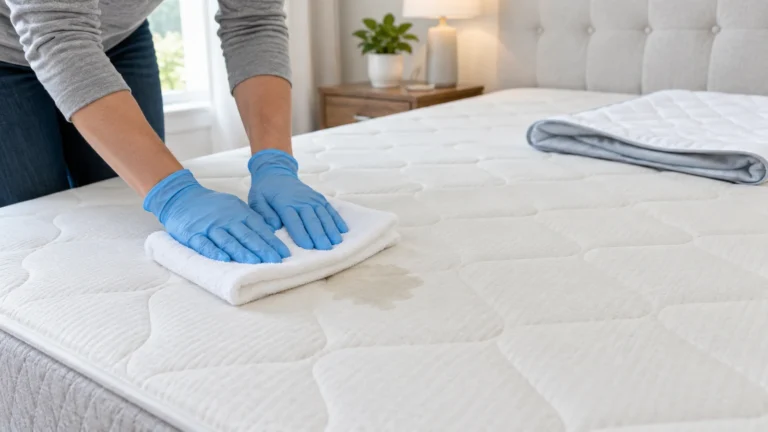
Lift off the sheets and protector so liquid is not held against the mattress. Press clean, dry white towels into the wet area, then switch to a dry section of towel and repeat. Do not scrub or push liquid across a larger area.
White towels make color transfer easier to see. Stop if dye or surface material appears on the towel.
2. Separate the cover only when the instructions allow it
If the exact model has a consumer-removable, washable cover, follow its washing and drying directions. Do not remove a non-washable or structural cover merely because it has a zipper. A washable cover also does not mean the foam beneath it can be washed.
If the spill reached the foam, continue blotting with dry towels and follow the manufacturer’s spill procedure. Do not rinse the foam, pour cleaner through it, or use a wet extractor to pull liquid back out.
3. Start safe airflow
Leave the mattress uncovered and direct ordinary room airflow across the treated area if the manufacturer permits it. Tempur-Pedic recommends complete air drying after blotting and permits a fan across the affected area; its instructions also warn that stain or odor removal is not guaranteed. Do not use a hair dryer, space heater, heating pad, iron, or steamer as a shortcut; concentrated heat can damage materials, and surface warmth does not prove that deeper foam is dry.
If a large spill penetrated deeply, the mattress remains wet, or the liquid involved sewage or another hazardous contamination, stop. Ask the manufacturer whether the product can be recovered and use the appropriate professional route rather than adding more cleaner.
How to spot-clean a small surface stain
If the mark is blood rather than a general spill, use the mattress blood-stain guide for that stain-specific decision.
Use this route only when the mattress instructions permit spot cleaning.
- Read the product-specific method. Confirm that both the mattress instructions and cleaner label permit the intended surface and method. Check any dilution, amount, contact time, and residue-removal directions; do not substitute a homemade recipe when those instructions are missing. Keep the cover on unless its exact instructions allow removal.
- Test a hidden part of the same cover fabric first. Use the approved method on a small inconspicuous area, with the cover left in place as required. Complete any label-directed residue removal and let the test dry fully before comparing color, texture, sheen, and stiffness with untreated fabric. Stop immediately for spreading color, pilling, tearing, or other damage; do not wait for it to dry or move on to the visible mark. A successful test does not override a product prohibition.
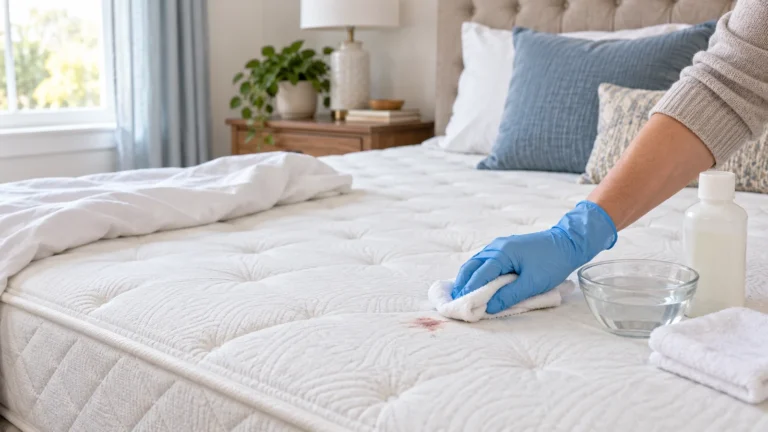
- Dampen the cloth, not the mattress. When the maker’s directions call for mild soap or another solution, apply it to a clean white cloth rather than pouring or broadly spraying the bed.
- Blot the mark. Work gently and keep the treated boundary small. Do not scrub the fabric or drive moisture into the foam.
- Remove residue only as directed. Some makers allow a second cloth lightly dampened with water; others restrict liquids further. Follow the exact instruction.
- Press with a dry towel. Lift remaining surface moisture without twisting the cover or compressing one spot repeatedly.
- Leave the mattress open to dry. Do not add sheets, a protector, or bedding until the surface, seams, and surrounding area are fully dry.
Safety boundary: Do not mix cleaning products. Avoid chlorine bleach, peroxide, alcohol, solvent, vinegar, enzyme cleaner, fragrance spray, or another treatment unless the mattress manufacturer approves that specific product and method. A formula recommended for one brand or stain should not be treated as safe for every foam, adhesive, fire barrier, dye, or cover fabric.
How to tell whether the mattress is dry
There is no reliable universal drying time. Mattress thickness, spill depth, room temperature, humidity, airflow, cover construction, and the amount of liquid all change the result.
After a small, surface-only treatment, inspect the treated fabric and nearby seams, and check the underside only if it is accessible without bending or damaging the mattress. Any remaining dampness is a reason to keep the bed uncovered. A dry-feeling top or absence of odor cannot prove that hidden foam is dry. If liquid reached the core, the depth is uncertain, or the underside is affected, ask the manufacturer about recovery rather than using touch or a timer as clearance to sleep on it. Do not unzip a fixed cover or cut into a barrier to test the foam.
Keep the bed uncovered when any doubt remains. If the area stays damp despite airflow, the odor returns, or moisture appears to have reached internal layers, contact the manufacturer. Bedroom humidity can also slow drying; the guide to healthy indoor humidity explains how to separate normal variation from an ongoing moisture problem.
Decide what to do after the spot dries
For a small surface mark that stayed within the maker-approved cleaning scope, compare the dry result before applying anything else:
- The mark improved and the fabric is unchanged: end treatment once residue has been dealt with as directed and the treated area is fully dry. There is no need to chase a completely invisible result.
- A dry discoloration remains but no progress is apparent: do not enlarge the wet area, strengthen the cleaner, or switch chemicals. Some stains do not come out; ask the maker before another attempt.
- A ring, stiffness, changed texture, or color transfer appears: stop the treatment. Ask the mattress or cleaner manufacturer about the residue or damage instead of soaking the surrounding fabric to blend it.
- Dampness persists or an odor returns: stop surface treatment and arrange assessment of the spill depth and affected layers. A lighter stain or weaker smell is not proof of decontamination or dry foam.
When cleaning is no longer a surface job
Memory foam is porous. The EPA’s mold guidance says mold can grow into the spaces of porous materials and may be difficult or impossible to remove completely. A mattress with visible growth, persistent internal dampness, or a recurring mold odor needs a different decision from an ordinary surface stain.
Stop routine DIY cleaning when:
- a large spill has soaked through the cover into the foam;
- the mattress remains damp or the odor returns after drying;
- visible mold appears on or beneath the cover;
- contamination involves sewage, floodwater, or another hazardous source;
- bedbugs or other pests are suspected; or
- the foam, seam, fire barrier, or cover is damaged.
Contact the mattress maker first for model-specific recovery or warranty guidance. For visible mold or a room-level moisture problem, use the Home Moisture and Mold Decision Chart before deciding whether cleaning, replacement, or professional assessment is appropriate. Do not cover the condition with fragrance, sheets, or a protector.
Prevent the next deep stain
Use a protector that the mattress maker says is compatible with the model. Keep the care instructions and photograph the model label before it fades. Blot spills immediately, and do not remake the bed until every affected layer is dry.
Wash the protector and bedding on their own schedules instead of repeatedly wet-cleaning the mattress. The same layer-first principle applies to pillows: use the separate guide for washing pillows in a washing machine before putting the pillow fill into a washer.
Common questions
Can you wash a memory foam mattress?
Do not put a whole memory foam mattress in a washing machine or soak it. Follow the exact manufacturer’s instructions for the cover and surface. A removable, washable cover does not make the foam core washable.
Can you use baking soda on memory foam?
Only when the exact mattress maker permits it. Serta currently recommends baking soda for its mattresses, while other brands publish different cleaning rules. A recommendation for one product is not universal permission for every memory foam mattress.
Can you steam-clean a memory foam mattress?
Do not steam it unless the manufacturer explicitly approves that process for the exact model. Steam adds heat and moisture, and several current manufacturers instead direct owners toward minimal-moisture spot cleaning or no liquid on the foam.
How long does a memory foam mattress take to dry?
There is no fixed safe number of hours. Drying depends on how much liquid entered the mattress, the depth of the wet area, airflow, humidity, and construction. Keep the mattress uncovered until the treated area and nearby layers are fully dry, and contact the maker if moisture or odor persists. Surface feel and elapsed time cannot confirm that a previously soaked core is dry.
Sources
- Tempur-Pedic – Product Care
- Tempur-Pedic – How Do I Clean a Spill on My Mattress?
- Sleep Number – Cleaning Your Mattress
- Sleep Number – Cleaning Your Mattress Pad and Toppers
- Purple – How Can I Clean the Zip Cover That Protects the Purple Mattress?
- Sealy – How Should I Care for My Sealy Mattress?
- Serta – How Do I Clean My Mattress?
- U.S. Environmental Protection Agency – Basic Mold Cleanup Steps