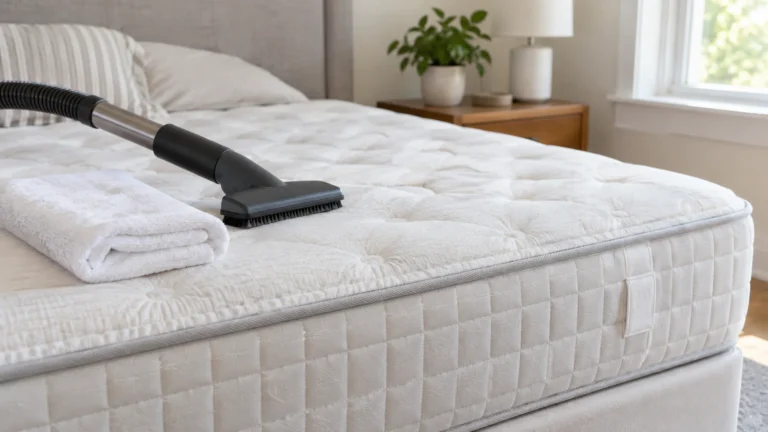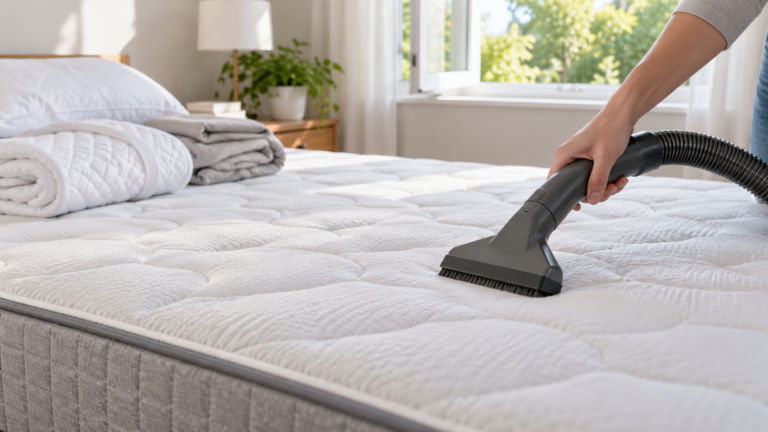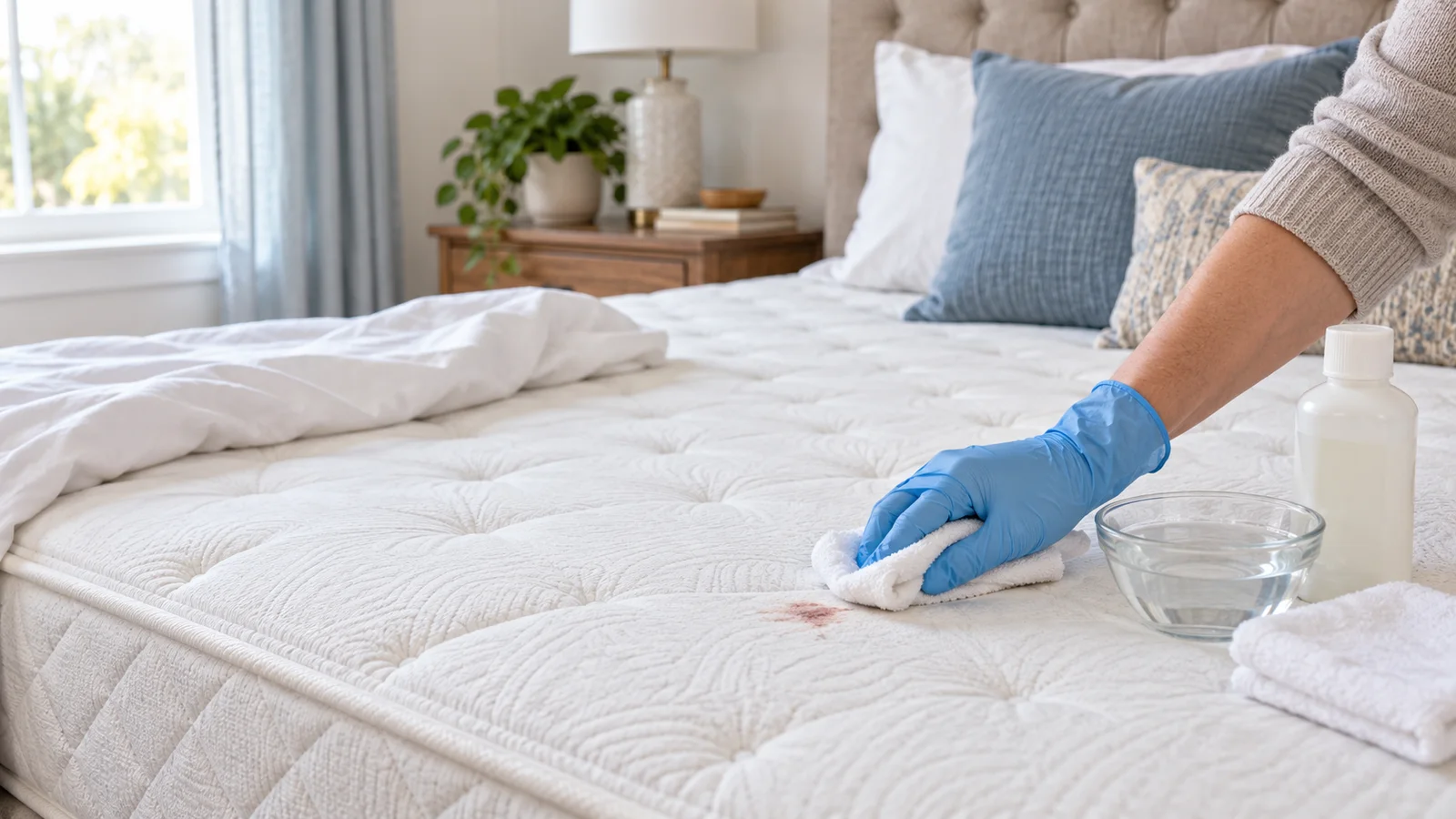
How to Remove Blood Stains From a Mattress Without Soaking It
Quick answer
For a small, known blood stain limited to the outer fabric, wear disposable gloves and dry-blot without rubbing. Check the exact mattress care instructions before adding water or cleaner. If they permit cold-water spot care, dab from edge to center with a well-wrung white cloth, alternating with a dry cloth. Use a cleaner only when both labels permit the complete application and residue-removal method. Unknown blood, sharps, deep soaking, or uncertain depth is a stop-and-assess situation. A faded mark, dry top, or clean-looking cloth does not prove disinfection or a dry core.
Updated October 23, 2026: repaired the decision-table labels and consolidated repeated fresh/dried-stain instructions. The exposure, material, cleaner-removal, and hidden-moisture precautions reviewed October 22 are retained.
For an unknown stain or a different mattress-care problem, start with the mattress cleaning guide by material and mess. The steps below are a limited household surface-cleaning route, not an infection-control procedure.
Choose the route · Check product compatibility · Decide after cleaning
Before handling the bedding: attend to any ongoing injury first. Keep children and pets away from the stained area. For blood you can safely handle as a small household surface stain, use disposable gloves, keep soiled bedding away from clean surfaces, and do not shake it. MedlinePlus describes these handling precautions in healthcare cleaning guidance; its bleach/spill protocol is not a mattress-cleaning recipe. Do not reach into seams, press on a suspicious lump, vacuum dried blood, or try to retrieve a suspected sharp. If blood reached your eyes, mouth, broken skin, or a puncture, stop cleaning and seek prompt medical advice; CDC’s exposure guidance explains why exposure needs assessment. Keep clear of wet powered-bed controls, plugs, and outlets; do not run a wet adjustable base to inspect underneath.
Choose the right route first
| What you see | Safest first route | What not to do | Stop when |
|---|---|---|---|
| Small, fresh, still-damp stain | Wear gloves and dry-blot; add a cold-water cloth only if the exact model permits that spot-care method | Do not rub, scrub, or flood the spot | The stain spreads, liquid reaches the inner layers, or the cover starts to distort |
| Dry, brown, or older stain | Check care instructions and both product labels; complete a hidden outer-fabric test before any permitted cloth treatment | Do not jump to hot water, steam, bleach, or multiple cleaners | The cover lightens, pills, transfers dye, or stays wet |
| Zippered cover | Confirm in the model instructions whether it is removable and washable | Do not unzip simply because you can see a zipper | The maker prohibits removal, the instructions are unclear, or removal could disturb a fire barrier |
| Large, deeply soaked, or unknown blood | Keep people away and get qualified assessment; gloves alone do not make sharps or unknown contamination a DIY job | Do not keep adding liquid or attempt to disinfect porous inner layers with improvised mixtures | Blood reached the core, there are sharps, or safe cleaning and complete drying cannot be confirmed |

Check the cover and construction before wet treatment
A zipper is not removal permission. Tempur-Pedic distinguishes washable removable covers from non-removable covers; Purple says not to remove its mattress cover. Confirm the exact model and care tag. Wash an outer cover separately only when removal and washing are expressly allowed; do not open a fixed cover, additional inner layer, or fire barrier to investigate depth. If wet care is prohibited or unclear, stop at safe dry blotting and ask the maker.
Foam, springs, and specialty fabric need different care. TEMPUR material should never be soaked or washed. Memory foam can retain hidden moisture; see our memory-foam mattress cleaning guide. An innerspring or hybrid may still contain foam, fiber, wool, latex, adhesives, and a fire barrier, so springs do not authorize extra water. For latex, wool, or specialty covers, confirm that the exact detergent, enzyme, oxidizer, and application are permitted rather than borrowing a generic recipe.
What to gather
- Disposable protective gloves suitable for the cleaner and the limited surface-care task above
- Several clean white cloths or plain white paper towels
- Cold water in a small bowl
- A manufacturer-approved mild detergent or enzyme stain remover, if needed
- A fan only when appropriate after the permitted small surface-cleaning step, with a dry cord, stable position, and safe outlet
- A leak-resistant container for soiled disposable items while following local waste guidance; never put suspected sharps into an ordinary bag
White cloths make transferred color easier to see and reduce the chance of moving fabric dye onto the mattress. Keep the bowl and product bottle beside the bed rather than on the mattress. Do not mix products, and do not use a cleaner unless both its label and the mattress instructions allow it.
One surface-cleaning procedure for a small, known stain
1. Strip the bed and check the care instructions
Remove the sheets, protector, and topper without shaking them or dragging the stained area across clean bedding. Treat washable bedding separately by its own label; a sheets-soaking method is not an assembled-mattress method. Follow the cover and material permissions above before unzipping or wetting anything.
2. Blot up free liquid
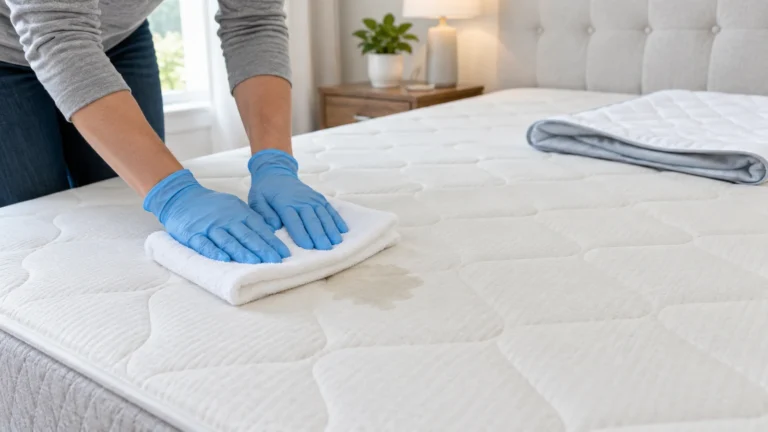
With gloves on, press a dry white cloth gently onto the accessible outer fabric, lift it, and move to a clean section. Do not scrub, squeeze the mattress, or press hard to force liquid out of hidden layers. If there is a suspected sharp, unknown blood, deep soaking, or an uncertain exposure, do not continue this step. Lack of further transfer is not a test for remaining contamination or moisture depth.
3. Dab with cold water
Only if the exact mattress instructions permit this water-based spot care, dampen a fresh white cloth with cold water and wring it out well. It should not drip. Work from the outside edge toward the center with gentle press-and-lift motions, alternating with a dry cloth. Stop if the wet area expands, moisture keeps transferring without progress, or the fabric changes; do not keep re-wetting it to chase the mark.
4. Test a permitted cleaner before treating the mark
Check that the exact mattress and cleaner directions both permit the product, dilution, application, contact time, and residue-removal method. “Mild,” “enzyme,” and “upholstery” are not compatibility guarantees. If the cleaner requires soaking, steam, or a rinse you cannot complete within the mattress limits, choose neither an improvised dilution nor a shorter exposure: ask the maker for an appropriate method.
On an inconspicuous part of the accessible outer fabric, test the exact permitted preparation and removal sequence, then let that small spot dry fully. Compare its color and texture with the untreated fabric. Stop immediately if it changes, pills, becomes tacky, or transfers the cover’s dye; do not wait through visible damage. Only proceed if the dry test is unchanged and the care instructions permit the larger treatment. Do not unzip or wet the core to create a test spot.
For an approved cloth-applied method, put the prepared solution on a clean white cloth rather than pouring or spraying onto the mattress. Dab edge to center and use only the labeled contact period. Keep the wet area from expanding and stop if the fabric changes or no further progress occurs.
Remove residue exactly as both labels permit, then dry-blot gently. A barely damp cloth is appropriate only when that is sufficient for the approved removal directions; it is not a substitute for a required thorough rinse. OxiClean’s mattress page uses a white towel and prohibits oversaturation, but gives its own product-specific preparation and temperature directions. Do not combine those directions with a generic cold-water or enzyme recipe, or treat the product as approved for every mattress. If instructions conflict, stop and clarify compatibility before using it.
5. Air-dry without treating the top as a core test
After the approved small surface treatment, dry-blot gently and leave the bed uncovered. Use room-temperature airflow only when the maker permits it and the fan, cord, outlet, and powered base are dry and safe. Do not blow a fan across unknown blood or suspected mold as a cleanup method. Do not use a hair dryer, heating pad, steam, or other high heat. A damp or cool patch means pause; a dry-feeling top, fixed number of hours, or lack of odor cannot verify enclosed layers. Keep the bed out of use and ask for assessment if liquid entered the core or depth is uncertain.
If the blood has dried
Use the same care-label, hidden-test, cloth-treatment, residue-removal, and drying sequence above—not a second recipe. Do not vacuum, brush, scrape, or pick dried blood from the mattress. For unknown blood, possible sharps, deep soaking, or uncertain depth, use the assessment route rather than re-wetting the mark.
ACI’s fresh/dried blood advice is for washable clothing and includes soaking and laundering; those instructions and pre-soak times do not transfer to a mattress. Whirlpool’s mattress section suggests an enzyme option subject to the care tag. Neither source permits every enzyme product or overrides wool, specialty-cover, rinse, or moisture limits.
A second treatment is not automatically safe. Consider another pass only if both labels permit it, the area has dried unchanged, and the first complete treatment made progress without saturation. Stop for fabric change, spreading, dampness, no progress, or uncertain depth. A remaining shadow or lack of color transfer does not establish hygiene or a dry core; do not keep wetting or bleaching it to make it invisible.
Should you use hydrogen peroxide, bleach, baking soda, or steam?
These methods are common in search results, but none is a universal first choice.
| Method | Why people try it | Why it is not the default |
|---|---|---|
| Hydrogen peroxide | It can lighten some blood stains on compatible washable fabrics | It can also lighten the cover or affect material; Whirlpool advises spot-testing it on sheets, not treating every mattress as compatible |
| Chlorine bleach | It is associated with disinfection and whitening | It can damage or discolor mattress components, creates a mixing hazard, and is not a practical way to disinfect porous inner layers |
| Baking soda paste | It is easy to make and absorbent | A wet paste adds moisture and may leave residue; it is not a substitute for a care-label-approved blood treatment |
| Vinegar | It appears in many home-cleaning recipes | Mattress makers do not universally approve it, and it should never be combined with bleach or other cleaners |
| Steam or hot water | Heat seems like it should sanitize or loosen the stain | Heat can set blood staining and can introduce too much moisture or damage foam, adhesives, or covers |
Do not mix cleaning products or add bleach to another chemical. If a maker approves a particular treatment for your exact model, the cleaner label must also permit that material and complete method. Do not combine instructions from separate recipes, heat the mixture, or move to a different chemical over unknown residue.
Cleaning a stain is not the same as disinfecting a mattress
Removing visible color does not prove that a porous mattress has been disinfected. Workplace or healthcare blood-spill protocols, especially hard-surface bleach methods, are not recipes for foam or quilted fabric.
Blood from another person, an unknown source, a communicable-disease concern, suspected sharps, or heavy contamination needs qualified guidance, not this cosmetic surface-care route. Do not push a hand into or compress a suspect area. After the permitted small-stain treatment, remove gloves without touching their contaminated outside and wash your hands; gloves do not eliminate exposure risk.
Safety boundary
Stop DIY cleaning when blood has soaked into the core, the area is larger than you can treat without saturation, the mattress cannot dry completely, the cover or fire barrier is damaged, or exposure is uncertain. Contact the mattress maker and a qualified cleaning, disposal, or healthcare professional as appropriate.
Decide what to do after the surface treatment
Let the permitted surface treatment dry before judging the appearance in ordinary daylight. Do not add water solely to perform a transfer test or assume a remaining shadow is harmless. The decisions below do not certify infection control or core dryness.
| What remains | Next action |
|---|---|
| Small, known surface stain treated by the complete permitted method; fabric unchanged and no remaining dampness or residue | Remake the bed only after the model’s drying directions are satisfied and there is no reason to suspect deeper contamination. This is a surface-care decision, not a disinfection claim. |
| Dry discoloration, but no new dampness, damage, or odor | Stop chasing appearance with extra water or bleach. Ask the maker whether further surface treatment is appropriate; the shadow alone cannot establish hygiene or depth. |
| Dampness, tacky residue, dye transfer, spreading, or no progress | Stop adding products and keep the bed out of use. Ask the maker for residue/damage assessment; do not apply a second chemical or hide the area under a protector. |
| Core/underside involvement, uncertain depth, unknown blood, suspected sharp, or recurring musty odor | Keep people away and get qualified assessment of cleaning, replacement, or disposal. Do not unzip a fixed cover to inspect inside or assume airing makes it usable. |
For assessment, record the mattress model, approximate size and location of the stain, whether the source is known, when it happened, what product and dilution were used, and any fabric change or persistent moisture. Photograph only safely accessible surfaces; do not disassemble the bed or probe the stain to gather evidence.
If the area smells after it is dry, the stain may have penetrated deeper or cleaner residue may remain. Do not mask it with fragrance. Use the source-checking process in How to Deodorize a Mattress Without Masking the Source. A musty smell, damp underside, or visible growth is a moisture problem; use the home moisture and mold decision chart instead of continuing stain treatment.
For a urine accident rather than blood, the chemistry and odor path differ. Follow How to Clean Urine From a Mattress Without Soaking It. If the same incident reached carpet, use the separate low-temperature method in How to Remove Blood From Carpet Without Setting the Stain.
Prevent the next stain from reaching the mattress
- Use a washable, waterproof mattress protector compatible with the mattress warranty.
- Keep a spare protector available so the bed is not left unprotected during washing.
- Treat fresh stains on bedding before machine drying; heat can make blood harder to remove.
- Do not remake the bed until every cleaned layer is fully dry.
- Keep the mattress model and care instructions accessible for future spills.
Sources
- American Cleaning Institute: Stain Removal Guide
- American Cleaning Institute: About Cleaning Product Ingredients
- Tempur-Pedic: How do I clean a spill on my mattress?
- Tempur-Pedic: Product Care
- Purple: Mattress Cover Contents and Care
- Whirlpool: How to Get Blood Out of Sheets and Bedding
- OxiClean: How to Remove Blood Stains From Bedding and Mattresses
- American Red Cross: Bloodborne Pathogens Training Manual
- MedlinePlus: Healthcare handling precautions, not a mattress bleach protocol
- CDC/NIOSH: Blood exposure and prompt medical assessment
This guide provides general household information, not medical or infection-control advice. Follow the cleaning instructions for the exact mattress and product. For unknown blood, sharps, deep contamination, or a health concern, use qualified professional guidance.