How to Clean Urine From a Mattress Without Soaking It
Quick answer: Remove the bedding and protector, then press clean white towels into fresh urine without rubbing. Check the mattress care label before adding any cleaner: some covers are washable, some are spot-clean-only, and some should not be removed. Use one compatible, label-directed product with as little added liquid as possible. Keep the mattress uncovered until it is completely dry. If urine reached deep foam, the underside smells, dampness persists, or mold appears, stop adding liquid and contact the manufacturer or a qualified mattress cleaner.
Urine on a mattress is not one cleaning problem. A washable protector needs a different response from a built-in cover, and a small fresh surface accident is different from urine that reached the foam core. The safest method starts by identifying what got wet—not by choosing the strongest homemade mixture.
Updated October 22, 2026: added a fully dried hidden-area test, clearer limits for judging internal moisture, powered-bed precautions, and a four-way after-treatment decision. Clarified that the Purple manual is for an adjustable base, not mattress-fabric cleaning.
Check which layer got wet · Check the treatment first · Decide before remaking the bed
Before moving the mattress or starting a fan: if liquid may have reached an outlet, cord, powered base, or bed electronics, keep clear of wet electrical parts and controls; do not operate the base to inspect underneath. Use only dry, safely accessible isolation as its manual directs, or get qualified help. The Purple Ascent base manual, page 4, addresses that base’s electrical precautions—not how to wash a mattress. Visible mold, sewage, or an unknown chemical spill also changes this from the limited household-urine surface task below to a specialist assessment.
First, determine what actually got wet
Strip the bed carefully so the wet fabric does not touch a clean part of the mattress. Separate the layers and check them in order:
- Sheets and blankets: move washable bedding directly to the laundry area and follow each care label.
- Mattress protector: check whether it stopped the liquid. Wash it only as its care label permits so you do not damage the waterproof layer.
- Removable mattress cover: do not assume a zipper means the cover is washable or intended for removal. Read the mattress label or manufacturer instructions first.
- Built-in or non-removable cover: this usually requires limited spot cleaning rather than washing.
- Mattress core and underside: inspect only the accessible side and underside without opening the mattress or lifting a heavy wet bed alone. Visible wetness or liquid transfer to a dry towel means more drying or assessment is needed; no transfer does not prove the enclosed core is dry. Do not unzip or dismantle a fixed cover, fire barrier, or mattress to investigate.
Tempur-Pedic’s spill instructions distinguish a removable washable cover from a non-removable cover and warn that TEMPUR material should not be soaked, washed, or allowed to become wet. Tuft & Needle says its built-on cover is not meant to be removed. These examples show why a universal mattress recipe is unreliable.
Check the exact model as well as the brand. Tuft & Needle identifies specific Mint and Mint Hybrid removable-top exceptions; its general built-on-cover warning is not permission to remove other layers. Serta’s care page advises against adding liquids. If your mattress prohibits wet cleaning, a hidden test or an enzyme-cleaner claim does not override that restriction.
Match the condition to the safest next action
| What you find | Safest first action | Cleaner boundary | Stop or escalate when |
|---|---|---|---|
| Protector is wet; mattress beneath is dry | Remove the protector and follow its wash label | No mattress cleaner is needed | Liquid reached the mattress despite the protector |
| Fresh urine is still on the surface | Blot repeatedly with clean white towels | Use one care-label-compatible product only after blotting | Moisture is spreading, the underside is wet, or the core is affected |
| Removable cover is wet | Confirm that the cover is removable and washable | Follow the exact cover label; do not improvise a wash cycle | The label says spot clean only or the core is wet |
| Dried mark has little or no odor | Check the label and test one approved spot treatment in a hidden area | Do not soak the mark just because it is old | Color transfers, texture changes, or the stain extends into foam |
| Odor remains after the surface is fully dry | Check the side and underside and identify the original spill depth | Use a labeled urine or upholstery treatment only if both labels permit it | Odor is strongest below the surface or returns after repeated treatment |
| Pet urine is present | Blot fresh liquid and check the material instructions | A pet-urine enzyme product may be used only when its label lists the surface and the mattress maker allows it | The product is incompatible, the core is wet, or the pet repeatedly marks the bed |
| Material is memory foam, latex, wool, or unknown | Use the material-specific care instructions | Avoid generic wet-cleaning directions | Instructions cannot be found or wet cleaning is prohibited |
| Mattress core or underside is wet | Stop adding liquid and improve safe ventilation | Do not try to flush the core with cleaner | Dampness or odor cannot be removed and complete drying cannot be verified |
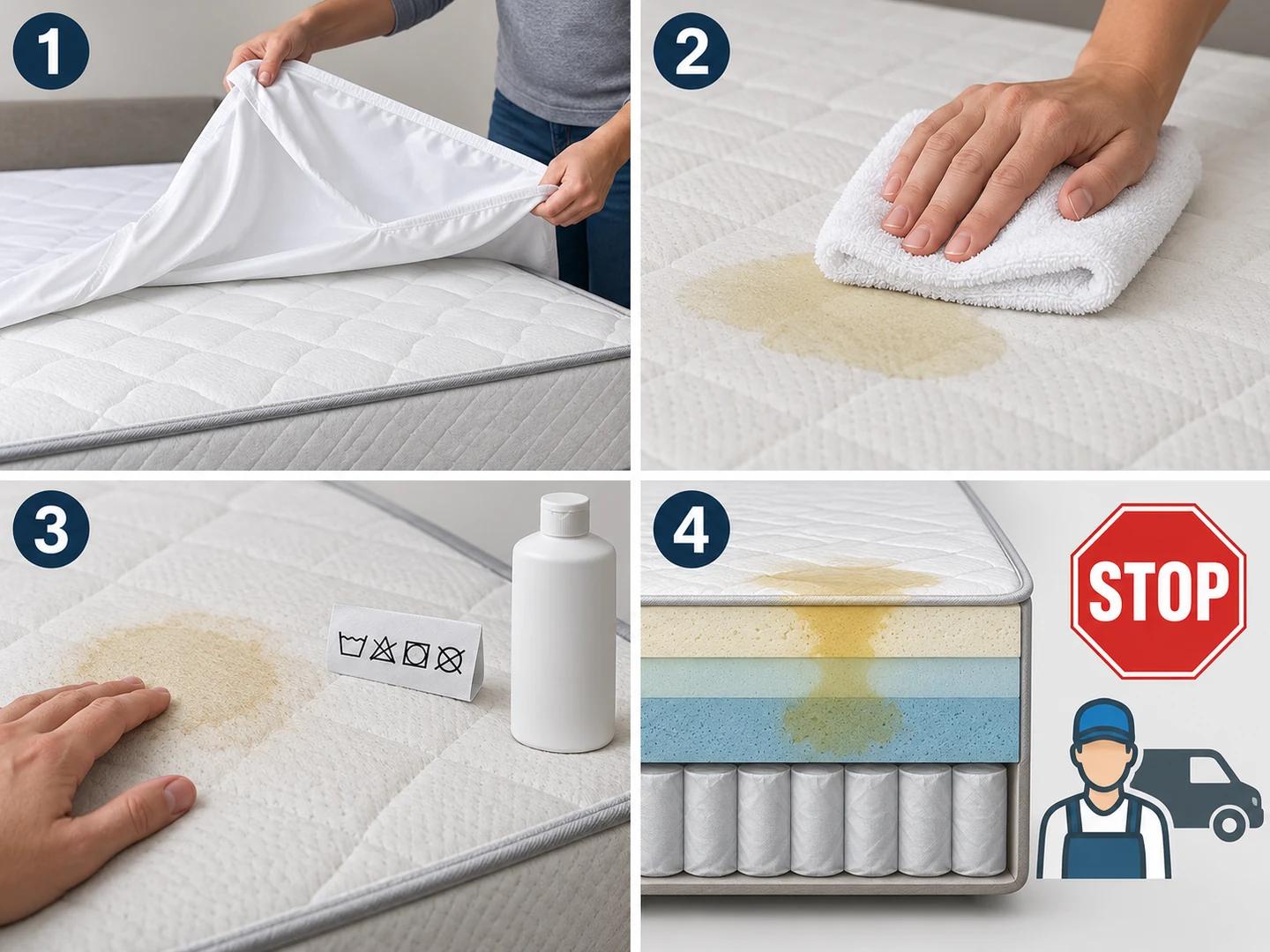
The table is a routing tool, not permission to apply a particular cleaner. Your mattress instructions and the cleaner label control the method.
Safety boundary: Do not combine cleaning products or add a new chemical over an unknown residue. CDC healthcare environmental-cleaning guidance specifically says not to use chlorine-based disinfectants on urine spills; for this household mattress accident, do not add chlorine bleach. The US Environmental Protection Agency advises reading and following product labels and warns that mixing cleaning products can create toxic vapors. If mixed products create fumes or symptoms, leave the area for fresh air and contact Poison Control in the United States at 1-800-222-1222; call 911 for severe symptoms.
What to gather before you clean
- clean white absorbent towels or paper towels
- disposable gloves
- a washable container or bag for soiled bedding
- the mattress care label or manufacturer instructions
- one cleaner whose label specifically permits the intended mattress or upholstery surface, if the manufacturer allows spot cleaning
- a fan for room airflow, if it can be used safely
White towels make color transfer easier to see. Gloves reduce direct contact with the accident and cleaner. The most important item, however, is the care information: Sleep Number’s current mattress-cleaning guidance, for example, says not to remove the cover and to spot-clean with a clean white cloth lightly dampened with water, then air-dry fully; other brands publish different methods.
How to handle fresh urine
1. Remove washable layers
Lift the bedding and protector away without dragging the wet area across the mattress. Follow their labels rather than transferring mattress-cleaning instructions to washable fabric.
2. Blot—do not scrub
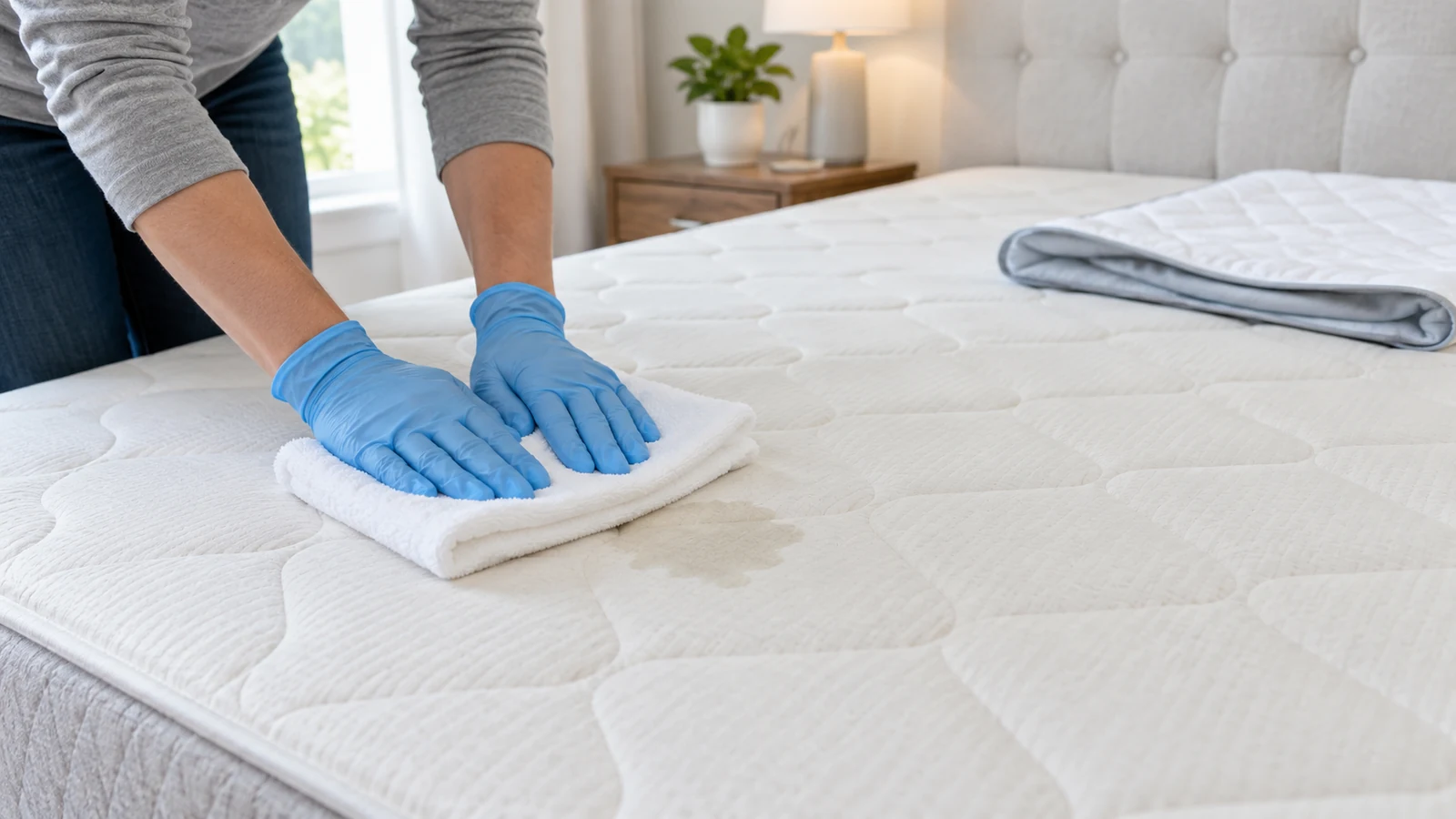
Press a folded dry towel straight down, lift it, and move to a clean section. Repeat until the towel is no longer picking up much liquid. Scrubbing spreads moisture across the cover and can push it farther into the mattress.
3. Check the cover and core instructions
Confirm whether the cover can be removed, machine washed, or only spot-cleaned. If the mattress is memory foam, use the more specific guidance in How to Clean a Memory Foam Mattress Without Soaking the Foam.
4. Test one compatible treatment before treating the mark
If the manufacturer permits spot cleaning, choose one product whose label lists the relevant upholstery or mattress material and the type of stain. Follow its amount, dwell time, ventilation, protective-equipment, and residue-removal directions exactly. The NAFC home-hygiene guide also advises following product directions and testing an inconspicuous area before treating furniture; that does not make its general mattress recipe suitable for every foam or cover.
- Choose a small hidden part of the permitted outer fabric—not exposed foam or a fire-barrier layer. If the maker cannot identify a suitable test location, ask before adding liquid.
- Use the exact cleaner concentration, application, contact time, and residue-removal method specified for that fabric. Keep the test small; do not saturate it.
- Let the test dry fully by the approved method before judging it. Compare it with untreated fabric in good light for a new ring, fading, roughness, stiffness, or dye transfer to the white cloth.
- Stop immediately if a damaging change occurs; do not wait out the test or add a second cleaner. Proceed on the urine mark only if the dry test is acceptable and the original material restrictions are met.
Do not start with vinegar, then add detergent, peroxide, alcohol, bleach, fragrance, or another cleaner. Even familiar household substances can damage fabric, foam, adhesive, or fire-barrier material, and layering products can create unsafe residues or vapors.
5. Remove moisture as directed
Blot away excess product only when the label or mattress instructions tell you to do so. Avoid rinsing the mattress with enough water to carry the cleaner and urine deeper into the core.
6. Dry the mattress uncovered
Keep sheets, a protector, and a topper off the treated area. For a small known urine accident with no suspected mold or electrical hazard, provide the airflow its maker permits. Tempur-Pedic recommends complete air drying with a fan blowing across the affected area. Set any fan on a dry, stable surface with its cord and plug away from liquid; do not put it on the wet bed. If mold is visible or suspected, stop the fan-assisted home-cleaning attempt and get assessment rather than blowing across the growth. EPA’s cleanup guidance warns that fans can spread visible mold; this is a contamination limit, not a flood-cleanup recipe for a mattress.
There is no reliable universal drying time. Material, spill depth, cleaner quantity, temperature, humidity, and airflow all change how long it takes. The surface and surrounding material must be completely dry before the bed is remade. A remaining cool or damp patch, a wet edge, or moisture picked up by a clean dry cloth is a reason to keep it out of use. Check the accessible treated cover, seams, and nearby edges without squeezing the mattress or removing a fixed barrier. The absence of these signs is not a measurement of hidden moisture: if the core was soaked, the underside is affected, or spill depth remains uncertain, ask the maker about assessment instead of declaring it dry from touch, odor, or elapsed hours.
Decide before remaking the bed
Use these checks only after the permitted treatment and drying steps. A fading mark does not prove that urine was removed from inside the bed, and a dry-feeling surface does not certify a wet core.
| After treatment | Next action |
|---|---|
| Small surface-only accident; permitted care completed; treated cover, seams, and accessible edges dry; no returning odor, residue, or fabric change | Return clean, dry bedding and a compatible clean protector only when the product’s drying and re-entry directions are also met. A faint cosmetic mark alone is not permission for another chemical treatment. |
| A damp or cool patch, damp seam, or moisture transfer remains | Keep the bed uncovered and out of use. Continue only the approved drying route; get advice if drying stalls or internal wetness is possible. Do not accelerate with a hair dryer, steam, or unapproved heater. |
| Ring, roughness, dye transfer, tacky cleaner residue, or odor returns after the treated surface dries | Stop adding products. Tell the maker or qualified cleaner what was used and what changed; do not repeat a no-progress treatment just to erase the visible mark. |
| Wet core or underside, uncertain spill depth, mold, extensive or repeated contamination | Stop the surface-cleaning cycle and arrange assessment. Do not open the fixed cover or use fragrance or a protector to conceal the unresolved source. |
For that assessment, record the mattress brand/model, which layers were affected, whether the accident was fresh or dried, any underside wetness, and each product already used. Photos of the label and visible affected area are more useful than guessing a core-drying time.
How to approach dried urine or a returning odor
A dried yellow mark and a urine odor are related, but removing the visible mark does not prove that the contamination or moisture is gone.
First, smell near the top, side, and underside without pressing your face against the mattress. Check whether the odor is localized or strongest below the original spot. If the surface is dry and the care instructions permit treatment, use one compatible urine or enzyme product exactly as labeled. Use the fully dried hidden-area check before enlarging a permitted treatment area.
Do not re-soak an old mark to the depth you imagine the original accident reached. You cannot reliably extract liquid from a sealed foam core at home, and adding more solution can enlarge the damp area.
Reassess only after the mattress is completely dry. If the odor remains strongest at the side or underside, or returns after a permitted surface treatment, treat that as a sign that the source may be deeper than the cleanable cover. Contact the mattress manufacturer or a qualified upholstery or mattress-cleaning service before adding another product.
Human urine and pet urine need the same material check
Fresh human and pet accidents both require fast blotting, limited added moisture, and complete drying. Pet-urine products often use enzymes, but “enzyme cleaner” does not automatically mean “safe for every mattress.” The product label must list the intended surface, and the mattress maker must permit that type of spot treatment.
Keep children and pets away while any product is being used and until the treated area meets the label’s drying or re-entry directions. Never use fragrance to judge whether the urine source is gone; perfume can mask odor without resolving material beneath the cover.
What not to do
- Do not soak the mattress. More liquid is not the same as deeper cleaning.
- Do not remove a built-in cover. A zipper may exist for assembly rather than laundering.
- Do not mix cleaners. The EPA warns that mixed cleaning products can create toxic vapors.
- Do not use steam or high heat without specific permission. These methods add heat and moisture that some mattress manufacturers prohibit.
- Do not scrub aggressively. This can spread the accident and alter the surface texture.
- Do not cover a damp mattress. Trapped moisture creates conditions in which mold can grow.
- Do not assume a faded stain means the mattress is clean. Appearance, odor, contamination depth, and dryness are separate questions.
When home cleaning is no longer reliable
Stop repeating surface treatments and seek manufacturer or professional guidance when:
- urine reached deep foam or the underside;
- the mattress stays damp or develops a musty odor;
- visible mold appears;
- the accident was extensive or repeated;
- an unknown combination of cleaners was already used;
- the mattress maker says the core must not become wet;
- the affected material cannot be accessed, cleaned, and dried completely.
A professional may be able to assess the construction and contamination depth, but no service can guarantee restoration of every saturated mattress. Replacement may be the dependable option when deep contamination, odor, or moisture cannot be removed and complete drying cannot be verified. If you see mold or a persistent musty pattern, use the Home Moisture and Mold Decision Chart before attempting another cleaning cycle.
Preventing the next accident
A washable waterproof protector can turn a future accident into a laundry task instead of a mattress-core problem. Choose one that fits the mattress depth without compressing the edges, and follow its care label so the waterproof layer is not damaged. Households managing recurring accidents may benefit from keeping a clean spare protector ready.
The protector does not replace mattress care. After any accident, confirm that the mattress beneath it is dry before remaking the bed.
If the accident is on carpet rather than the mattress, use our carpet urine-smell guide because carpet pile, backing, and padding require a different moisture-depth decision.
Sources
- Tempur-Pedic: How do I clean a spill on my mattress?
- Tuft & Needle: How do I get urine out of the mattress?
- Sleep Number: Cleaning Your Mattress
- Purple Ascent Adjustable Base: electrical and base-care precautions (not mattress-fabric instructions)
- US EPA: Flood Cleanup to Protect Indoor Air and Your Health
- US EPA: Mold and moisture guidance
- CDC: Environmental cleaning procedures, including urine-spill chlorine restriction
- Poison Control: Get help online or call 1-800-222-1222
- Poison Control: Chlorine-gas exposure and fresh-air response
- Serta: Liquid-cleaning restriction
- Tuft & Needle: Model-specific cover-removal exceptions
- NAFC: Home Hygiene guide, page 6 — furniture product testing