How to Clean a Mattress: Match the Material, Mess, and Moisture
Updated October 23, 2026: Narrowed fan use to known safe spill conditions, replaced close odor testing with existing observations, and removed the implied small-mold exception for a porous mattress.
Quick answer
Before cleaning a mattress, check its care label or model instructions and identify what you are actually cleaning: a protector, a removable cover, a non-removable cover, or the mattress core. Vacuum dry debris only if the instructions allow it. Blot fresh liquid instead of rubbing, apply any permitted cleaner to a cloth rather than pouring it onto the bed, and use as little moisture as possible. Leave the mattress uncovered until every treated layer is fully dry.
Stop before adding another product: Do not remove a zippered cover unless the manufacturer says it is removable and washable. Do not use bleach, steam, an upholstery extractor, or a household mixture merely because another mattress guide recommends it. Never mix cleaners or apply a new product over an unknown residue. If liquid reached deep foam or fill, the mattress was exposed to sewage or floodwater, or you find visible mold in porous material, home surface cleaning may not make it usable again.
Choose the right cleaning route first
A mattress does not have one universal “deep-clean” method. Two beds that look similar can have different covers, foams, adhesives, fire-barrier systems, and warranty instructions. Start with the condition you can verify.
| What you find | First action | Best route | Stop condition |
|---|---|---|---|
| Dry crumbs, hair, or surface dust | Check whether the maker permits vacuuming | Use the routine dry-cleaning steps below | Stop if the tool pulls threads, pills the cover, or the instructions prohibit vacuuming |
| A fresh spill still on the surface | Remove bedding and press a dry white towel straight down | Blot, check the cover instructions, then dry with airflow | Stop if liquid reached the foam, fill, seams, electrical components, or the underside |
| Urine or a returning urine odor | Identify whether the protector, cover, or core is affected | Use the urine-on-mattress guide | Stop when contamination is widespread or deep, or the mattress cannot dry completely |
| Blood | Keep heat away and begin with the least-wet route | Use the mattress blood-stain guide | Stop before using a product the care instructions do not permit |
| Odor with no active wetness | Find the source before masking it | Use the mattress deodorizing guide | Stop if the odor is musty, chemical, electrical, or returns with humidity |
| Memory foam or an all-foam core | Treat the cover and foam as different layers | Use the memory-foam mattress guide | Stop if moisture entered the foam or the cover instructions are unclear |
| Visible mold, floodwater, sewage, or deep saturation | Isolate the problem and avoid disturbing it unnecessarily | Contact the maker, a qualified restoration professional, or replace the mattress | Do not rely on surface appearance or fragrance as proof that a porous core is clean |
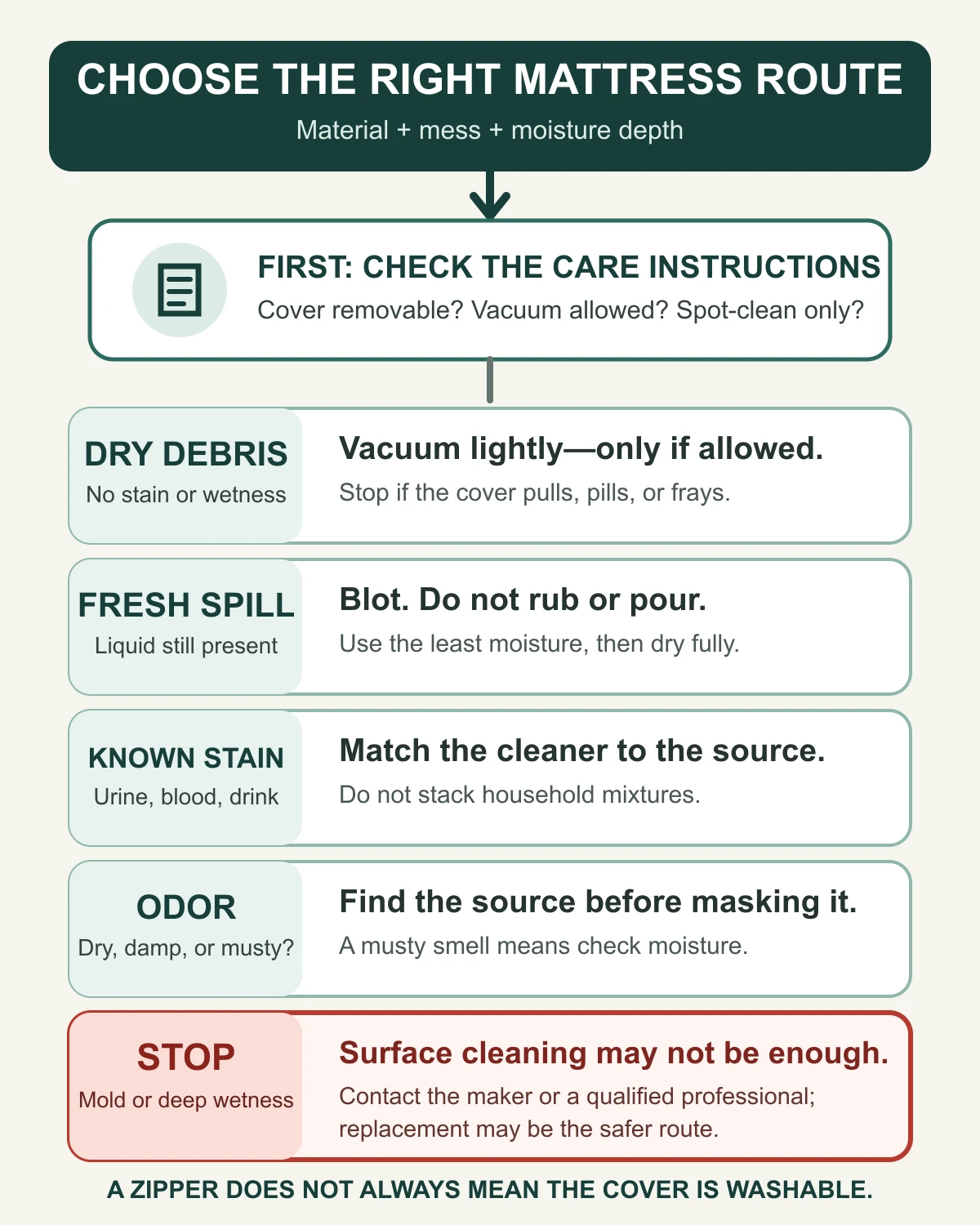
This page is the route map. Once you know the material and the mess, use the focused guide rather than combining several methods.
Before you clean, identify the layer
Strip the sheets, blankets, pillows, protector, and pad. Wash only the items whose own care labels allow it. A mattress protector is not the same thing as the mattress cover, and a zipper does not automatically mean that the cover should be removed.
Find the mattress law tag, care label, model name, receipt, manual, or manufacturer support page. Look for answers to four questions:
- Is the outer cover removable?
- If it is removable, is it machine washable or spot-clean only?
- Does the maker permit vacuuming, steam, an upholstery machine, or a particular cleaner?
- Can the mattress be flipped, or should it only be rotated?
The variation is real. Tempur-Pedic lists some removable washable covers but tells owners of other models to spot-clean only. Purple tells owners to blot spills, avoid over-wetting, remove residue with a damp cloth, and let the mattress dry fully. Casper says the zippered cover on its mattresses should not be removed. Those examples are not instructions for your bed; they show why the exact model guidance comes first.
If the label is missing, use the least-wet reversible steps—dry debris removal and careful blotting—while you identify the model. Do not guess that a hidden zipper is permission to expose the inner layers.
How to clean a mattress with only dry debris
Routine cleaning is the simplest route because it does not require adding liquid.
- Open the room for airflow. Choose a time when the bed can remain uncovered. Keep outdoor humidity, rain, and airborne dust in mind before opening a window.
- Inspect before vacuuming. Look for loose threads, torn seams, exposed foam, wet areas, insect evidence, and visible mold. A cleaning pass is not the right response to every finding.
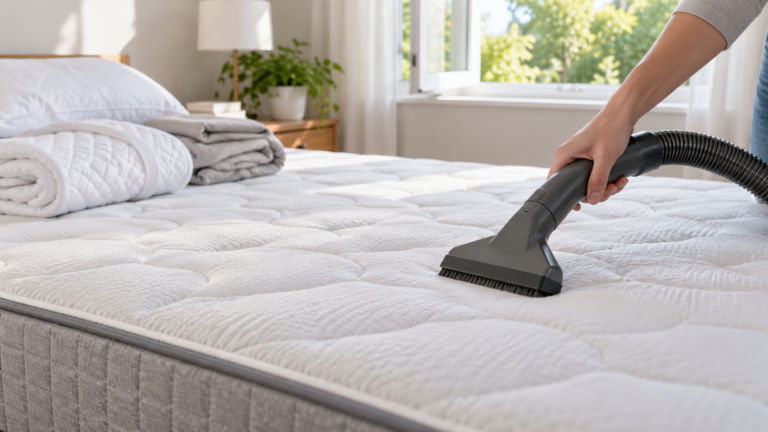
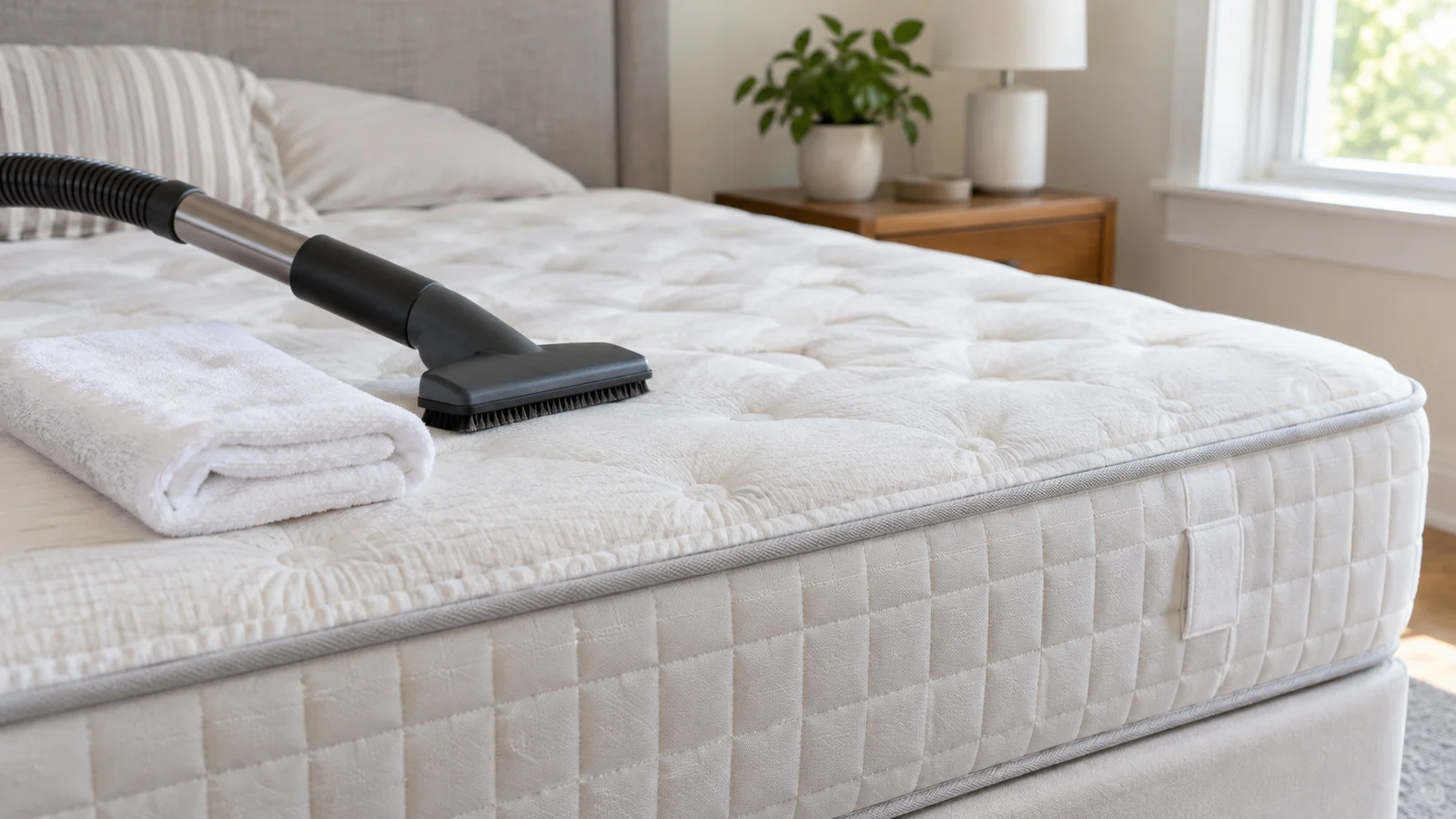
- Use a clean upholstery attachment if permitted. Use light passes across the top and sides. Pay attention to quilting and seams without forcing the tool into the fabric.
- Stop if the surface changes. Pulling, fuzzing, or pilling means the suction or attachment is too aggressive for that cover.
- Clean the bed frame separately. Dust from slats, a foundation, or the floor can return to the mattress. Follow the frame maker’s instructions and keep wet surfaces away from the mattress until dry.
Vacuuming removes loose material. It does not prove that a stained, moldy, pest-affected, or deeply contaminated mattress is sanitized.
How to handle a fresh liquid spill
Act quickly, but do not turn speed into scrubbing or soaking.
- Remove the bedding and washable protector.
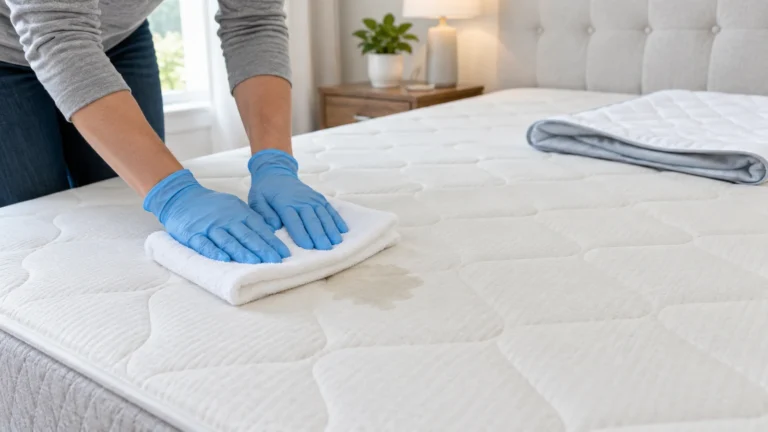
- Put a clean, dry, colorfast towel over the wet area and press straight down. Lift, move to a dry section, and repeat. Rubbing can spread the liquid sideways and push it deeper.
- Check the model instructions before unzipping the mattress cover or using any cleaner.
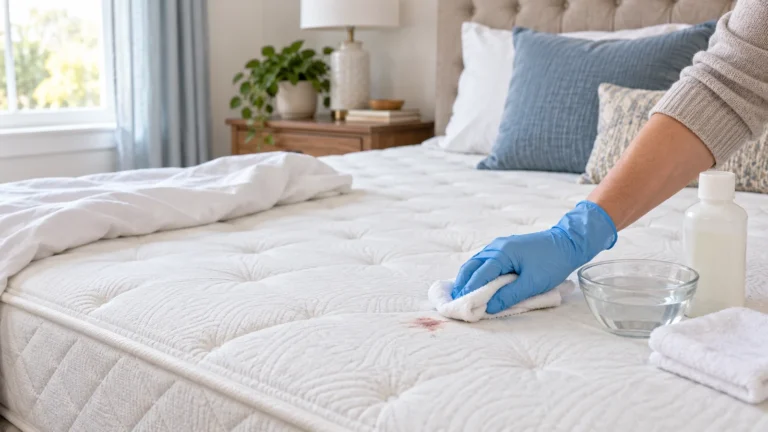
- If spot cleaning is permitted, put the allowed solution on a white cloth—not directly on the mattress—and work on the smallest affected area.
- Use a second cloth dampened only as the maker directs to remove residue. Do not create a wet rinse zone.
- Blot again with a dry towel. Use a fan only for a known nonhazardous spill when the mattress maker permits it, the electrical setup is dry and safe, and there is no suspected mold or contaminated water. Do not blow air across suspected growth or an unknown chemical source. Keep the mattress uncovered until the treated layer and the material beneath it feel fully dry.
Tempur-Pedic’s spill guidance, for example, says to blot without rubbing, follow the removable- or non-removable-cover route, avoid saturation, and air-dry fully. Purple gives a similar moisture boundary for its cover. The transferable principle is minimal moisture; the exact cleaner and cover handling still come from your mattress instructions.
If the spill reached an adjustable-bed motor, cable, controller, outlet, or power strip, do not touch wet electrical equipment. Disconnect power only from a dry, safe location and use qualified service when necessary.
Match a stain to its source instead of its color
A yellow or brown mark does not identify what caused it. It could be a drink, body oil, urine, cleaner residue, oxidation, or an older stain changed by heat. Treating the wrong source can set the mark, discolor the cover, or leave a residue that complicates the next step.
Before treatment, record:
- what spilled, if known;
- whether the mark is fresh or already dry;
- whether it has been heated, steamed, or treated before;
- every product already applied;
- whether the stain is on a washable protector, a removable cover, or the fixed mattress surface.
Use the specific route for urine or blood rather than stacking vinegar, peroxide, detergent, baking soda, alcohol, enzyme cleaner, or bleach on the same spot. If the source is unknown, start with the care instructions and a hidden-area compatibility check only when the product label calls for one.
A lighter mark is a cosmetic result. It does not prove that contamination below the cover has been removed.
If the mattress smells but is not visibly wet
Do not cover an odor with fragrance before checking where it is strongest. Use where the odor was already noticeable and the spill/moisture history; do not put your face near the mattress, deliberately sniff suspect material or disturb layers to identify an odor. Look for a dry spill edge, cleaner residue, pet access, a damp wall, condensation, or poor airflow under the bed.
If the odor is strong, chemical or causes symptoms, leave the area and contact Poison Control for exposure advice from a safe location rather than continuing to inspect. For an ordinary dry, light surface odor with no stain or moisture evidence, follow the maker’s routine cleaning instructions and improve airflow. For a known urine source, use the urine route. For a general odor that returns, use the mattress deodorizing decision guide instead of repeatedly adding powder or spray.
A musty odor is different. It is a reason to investigate moisture, not a cue to perfume the surface. The home moisture and mold decision chart can help distinguish a room-humidity problem from a one-time spill.
When mold or deep saturation changes the answer
Mattress cores are porous. If liquid entered foam or fill, drying the top fabric does not prove the interior is dry. The risk is higher after a large spill, repeated bed-wetting, a roof or plumbing leak, floodwater, sewage, or storage in a damp space.
The EPA notes that mold can enter the spaces inside porous materials and may be difficult or impossible to remove completely. It also advises professional help when water or mold damage involves sewage or other contaminated water. A mattress is not a hard surface that can be scrubbed and visually cleared.
Stop home cleaning and contact the manufacturer or an appropriate professional when:
- any visible suspected mold or growth is on the mattress;
- a musty odor returns after the room and surface are dry;
- liquid reached the underside or a thick foam/fill layer;
- the mattress remained wet for an unknown period;
- contaminated water was involved;
- the cover or fire-barrier area is torn or exposed;
- the mattress cannot be dried completely before use.
Replacement may be safer and more practical than repeated surface treatment. Do not zip a protector around a wet or moldy mattress and treat concealment as remediation.
Adjust the method to the construction
Memory foam and all-foam mattresses
Foam can absorb liquid and dry slowly. Keep moisture at the surface, follow the model’s cover rules, and use the memory-foam cleaning guide for a cover-versus-core decision. Do not steam or soak foam unless the manufacturer explicitly permits the exact method.
Hybrid and innerspring mattresses
Coils do not make the upper comfort layers waterproof. A hybrid may still contain several inches of foam, fiber, wool, or latex above the springs. Clean according to the cover and comfort-layer instructions, not the word “hybrid” alone.
Latex, wool, pillow-top, and specialty mattresses
These materials and finishes vary. Some covers may shrink, felt, discolor, or lose a finish when exposed to water, heat, enzymes, or oxidizers. Use the product manual or manufacturer support instead of importing a recipe from a conventional mattress.
Adjustable air and smart beds
Treat the mattress surface, air system, sensors, hoses, power components, and base as separate systems. Follow the maker’s cleaning and disconnection instructions. Do not allow liquid to reach electrical or pneumatic components.
Methods to avoid unless your mattress maker permits them
- Removing a zippered cover: a zipper may exist for assembly or service, not consumer washing.
- Steam or a hot iron: heat and moisture can affect foam, adhesives, finishes, and drying time.
- Carpet or upholstery extraction: suction does not guarantee that moisture has been removed from deep mattress layers.
- Bleach or harsh solvents: they can damage covers and internal materials and may leave difficult-to-remove residue.
- Mixing household cleaners: never combine bleach, ammonia, acids, vinegar, peroxide, alcohol, disinfectants, or unknown residues.
- Saturating the entire surface: more liquid does not equal deeper cleaning when the item cannot be rinsed and dried like washable fabric.
- Making a sanitizing claim from appearance or smell: stain removal, deodorizing, and disinfection are different outcomes.
If a previous product left residue, stop and identify it before applying anything else. When that is not possible, ask the mattress maker or a qualified cleaner rather than experimenting.
Keep the mattress cleaner after it dries
Use a mattress protector that is compatible with the bed’s construction and warranty, and wash it according to its own label. A protector can reduce how much liquid reaches the mattress, but it does not correct moisture already trapped inside.
Wash sheets and other bedding on their labels’ schedules. Keep food and open drinks away from the bed when practical. Address spills immediately, allow airflow under the mattress as the bed maker requires, and investigate room moisture rather than repeatedly treating a musty smell. Washable pillows are a separate job; use the pillow-washing guide only if the pillow’s care label permits machine washing.
The most useful maintenance habit is simple: when the mattress is dry and clean, record the brand, model, cover rules, and warranty page. That information makes the next spill easier to handle without guessing.
Common questions
Can you steam-clean a mattress?
Only when the manufacturer explicitly permits steam for that exact mattress and you can meet its drying requirements. Steam is not a universal mattress-cleaning method, especially for foam, adhesive-bonded, wool, smart, or specialty constructions.
Can you wash a mattress cover?
Sometimes. A removable-looking zip cover may still be spot-clean only or not intended for consumer removal. Follow the model instructions, not the zipper.
Can baking soda clean a mattress?
Baking soda may be permitted as a dry odor-management step on some surfaces, but it does not remove every odor source, stain, allergen, mold problem, or deep contamination. Check the care instructions and use the odor-source guide when smell is the main problem.
How do you know when the mattress is dry?
There is no reliable universal clock. Drying depends on the material, amount of liquid, room conditions, and airflow. Keep the mattress uncovered and do not use it while the treated area or layer beneath it feels cool, damp, or different from the surrounding material. Deep saturation may not be verifiable from the surface.
Sources
- Tempur-Pedic: How do I clean a spill on my mattress?
- Tempur-Pedic: Can I clean the cover of my mattress?
- Purple: How can I clean the zip cover that protects the Purple Mattress?
- Casper: How to Clean a Mattress
- US EPA: Mold Cleanup in Your Home
Manufacturer examples apply to the products they describe. Use the instructions for your exact mattress.