Dryer Not Spinning? Check What Happens When the Cycle Starts
Quick answer
If the controls respond but the drum does not turn, use what you already observed: did the timer advance, was there a hum, or did the cycle never start? If you already heard a motor hum with a stationary drum, cancel the cycle and arrange service; do not restart it to gather more clues. A single load-size correction is only for an apparent overload with no stationary motor hum, repeated stop, or safety warning, and only as the manual permits. Do not open the cabinet.
Updated October 23, 2026: clarified that later timer and sound checks use previous observations, added safe power isolation and result limits, and retained the October 10 single overload-retry restriction.
Stop and get help first
Stop using the dryer immediately if you notice smoke, a burning or electrical odor, sparking, unusual heat, a damaged plug or cord, or a gas odor. For smoke or flame, leave and call 911 from outside. For a suspected gas leak, leave without operating switches, plugs, breakers or phones indoors, and call 911 or the gas utility from a safe location. Do not handle a damaged, hot or wet electrical connection to unplug it. Never bypass a door switch, remove a service panel, or reach into a dryer while it is connected to power.
First confirm what the dryer is doing
Start with observations from the failed cycle rather than running it again. Record whether the timer advanced, whether the drum moved, and whether you heard silence, a click, or a continuing motor hum. If a cycle is currently active but the drum remains stationary, cancel it; do not wait a full minute to collect evidence. A previously observed stationary motor hum, repeated stop, unusual heat, or another safety warning is enough to stop further testing and arrange service.
If the controls stay dark, the cycle is never accepted, or the machine is completely silent, use Dryer Won’t Start? Match the Response Before You Call for Service instead. That is a no-start problem. This guide is for a dryer that appears to enter a cycle but the drum remains still or stops turning.
Match the symptom before the next check
| What you observe | Safe next step | What the clue means |
|---|---|---|
| Timer counts down, but the dryer is silent and the drum does not move | Cancel the cycle, confirm the door is fully closed, and check the display for a lock or error message | The cycle may be paused or an internal control, switch, or drive problem may need service. The symptom alone does not identify a failed part. |
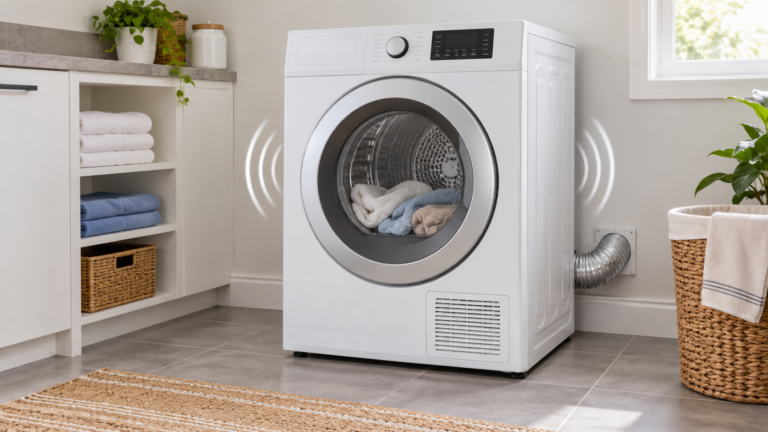
| Motor hums or sounds active, but the drum stays still | Stop the cycle rather than repeatedly pressing Start | A drive or motor problem is possible. Manufacturer guidance commonly treats this as a service condition. |
| Dryer begins turning, then stops during the cycle | Cancel the cycle, let the appliance cool, and record when it stopped and any code | Overheating, a restricted or seized moving part, or another internal problem may be involved. Do not keep restarting it. |
| A very heavy or tightly packed load does not tumble | Cancel and reduce an apparent overload. Try one manual-approved load only if there was no stationary-drum hum, repeated stopping, or other hazard; otherwise leave it off for service. | The motor may be unable to move an overloaded or unbalanced load. If a normal load still will not turn, arrange service. |
| Drum turns normally, but clothes stay cold or wet | Follow the guide that matches the remaining symptom | Use the dryer not heating guide or the long drying time guide. |
These clues narrow the service conversation; they do not prove that a belt, motor, roller, switch, or control has failed.
Use only the applicable external check · Read the next-step decision
Safe checks before you arrange service
1. Remove an overloaded load
Turn the dryer off. If the drum is packed with heavy wet towels, blankets, or several bulky items, remove everything and separate the load. GE identifies a heavy wet load as a possible reason the drive belt may slip. Check the capacity and bulky-item instructions in your manual.
Try one normal-size load only if an apparent overload is the issue, the manual permits that correction, and there has been no stationary motor hum, repeated stopping, burning or gas odor, unusual heat, smoke, or electrical damage. Stop immediately if the drum does not turn, the motor hums, or the cycle stops again. Do not use repeated attempts to diagnose an internal fault.
2. Use the timer behavior already observed
A lit display alone does not establish that a cycle began. On the Samsung models described by its support page, a counting-down timer helps distinguish an accepted cycle from a control-lock or start-action issue. Use the previous failed cycle’s behavior; this is not an instruction to restart a stationary drum or wait for a countdown.
Read a current lock or error indication and the exact manual without starting a cycle. If timer behavior is unknown, report it as unknown. Do not hold, tape or bypass the door switch. If the door closes but the dryer does not recognize it, arrange service.
3. Record the sound and timing
Record sounds already heard from outside the closed dryer: a click, steady hum, repeated stop, scrape or silence. Do not run the dryer to collect a sound recording or complete this list. If the drum turns but makes scraping, rumbling, or thumping sounds, switch to Dryer Making a Loud Noise? Identify the Sound Before You Arrange Service.
Record whether the problem happened immediately, after several minutes, or only with a heavy load. Photograph any error code before turning the dryer off.
4. Check empty-drum resistance only when it is safe
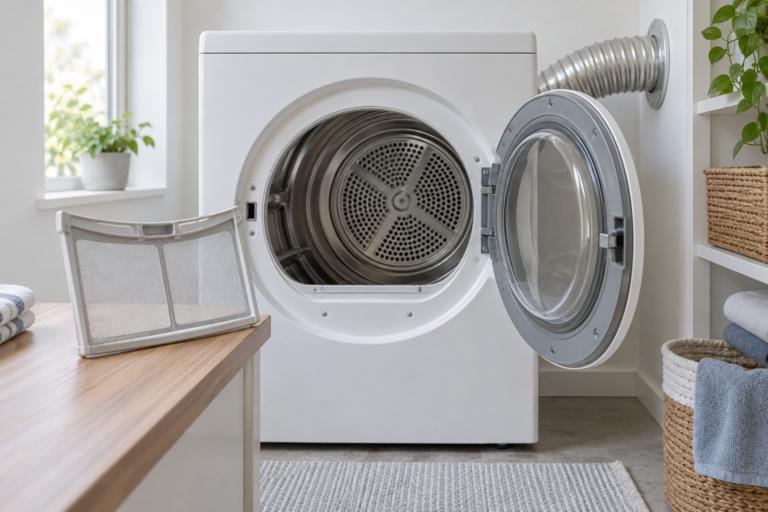
Skip this optional check if there is any gas concern, hot or damaged connection, water near electrics, or unsafe access. Where access and connections are dry, cool and intact, isolate power by the exact manual’s method before touching the drum. For a gas dryer, do not move it or disturb a gas connection. Continue only if the owner manual actually provides this external drum check. With the dryer empty and the door open, gently turn the drum by hand—never force it and never reach behind or beneath it.
An unusually free-spinning drum can be consistent with a loose or broken drive belt, while a drum that is very difficult to move can suggest a jammed or seized component. GE and manufacturer troubleshooting pages use these as clues, but neither result identifies the exact failed part. An abnormal resistance result is a reason to leave the dryer off for service, not to reconnect it for another trial.
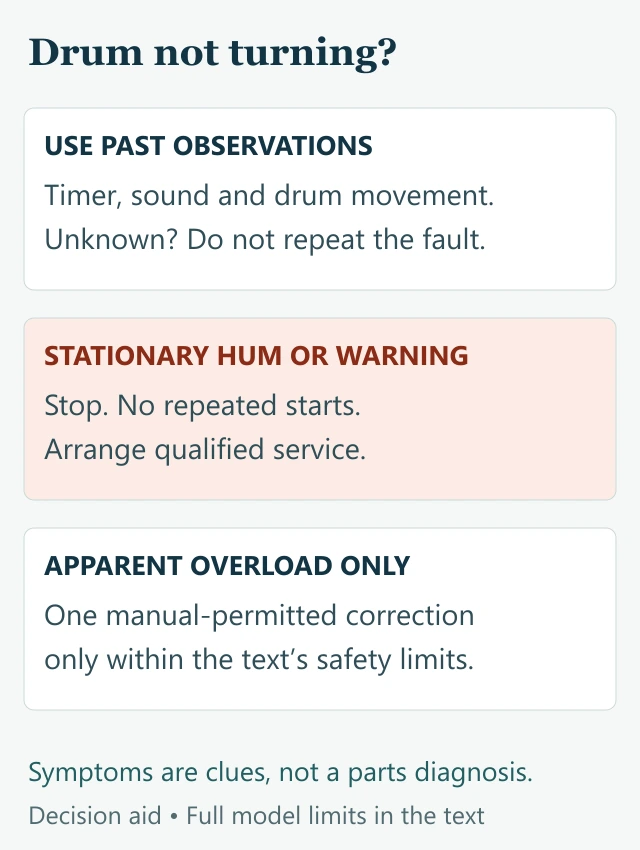
If the motor hums but the drum does not turn
Cancel the cycle and do not keep pressing Start. Whirlpool and Maytag note that a motor sound with a stationary drum can be consistent with a drive-belt problem, but it can also involve the motor or another moving component. Confirming which one requires access inside the cabinet and model-specific testing.
Do not remove the top, front, or rear panel to look for the belt. Dryers contain electrical, moving, hot, and—on gas models—fuel-related hazards. Give the technician the model number, the exact sound, whether the timer advanced, and whether the empty drum felt unusually easy or hard to turn.
If the drum stops after the cycle begins
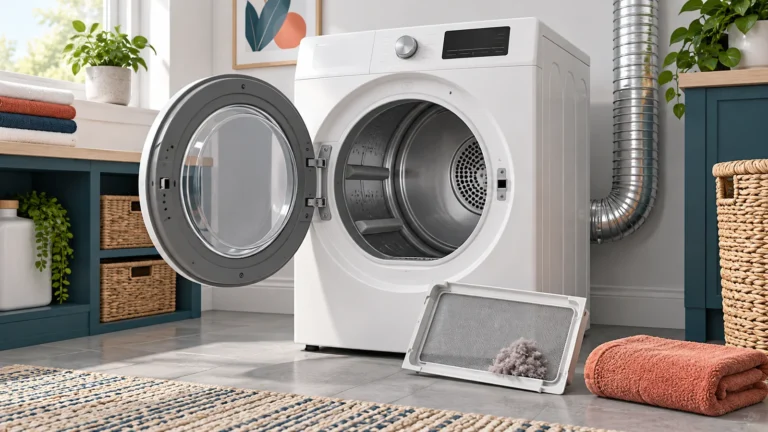
A dryer that starts normally and stops after a few minutes is not the same as one that never begins. Note the elapsed time and whether the display stays on. Let the appliance cool and check the lint screen, but do not treat a clean lint screen as proof the machine is safe to restart.
CPSC advises keeping the lint screen and exhaust path clean because restricted airflow can raise dryer temperatures and create a fire risk. If the dryer was unusually hot, smelled scorched, or stopped repeatedly, leave it off. If the drum was turning normally but drying had become slow before this happened, the long drying time guide explains the safe airflow checks.
Why a broken belt is only one possibility
A belt is a common explanation in manufacturer troubleshooting, especially when the motor can be heard but the drum does not move or when the empty drum turns with unusually little resistance. It is not the only explanation. Load size, the door or control state, the motor, rollers, pulleys, and other internal components can produce overlapping symptoms.
Naming one part too early can lead to an unsafe repair attempt or an unnecessary purchase. The useful goal at home is to distinguish no-start, no-spin, noise, heating, and airflow problems, then give the technician evidence that shortens diagnosis.
After the applicable check
Still stationary, humming or stopping: leave it off for service. A timer response, normal-looking door or hand-turn result does not clear an internal drive or electrical fault.
One permitted overload correction restores normal tumbling: follow the model’s loading guidance. That result supports the load branch but does not prove a belt or motor is undamaged. Stop if the symptom or any warning returns.
The display never accepted the cycle: use the linked no-start route after excluding hazards. Do not repeat the overload trial to investigate a control-lock, door or start-button problem.
What to record before requesting service
- Brand and full model number from the appliance label
- Electric, gas, heat-pump, or condenser dryer type
- Whether the timer counted down
- Whether you heard a click, hum, scrape, or repeated stopping
- Whether the drum never moved or stopped after a specific time
- Any previous difference with an empty drum or normal load; record “unknown” rather than run another comparison
- Any error code and when it appeared
- Any burning odor, unusual heat, smoke, cord damage, or gas odor
Keep the dryer out of use for service after a safety warning or stationary motor hum. Disconnect only through a safe, model-approved isolation method; do not touch a suspect plug or investigate a gas odor.
Sources used for this guide
- Whirlpool: How to Fix a Dryer Not Spinning
- Maytag: How to Fix a Dryer That Won’t Spin
- Samsung: Dryer drum does not spin
- GE Appliances: Dryer drum is not turning
- U.S. Consumer Product Safety Commission: Overheated clothes dryers can cause fires
- PHMSA: Pipeline leak recognition and what to do
This article provides general household guidance. Your dryer’s owner manual and qualified service instructions take priority.
If the drum does turn and the main problem is heat, drying time, odor, noise, or shutdown, use our dryer troubleshooting guide to select the correct symptom path.