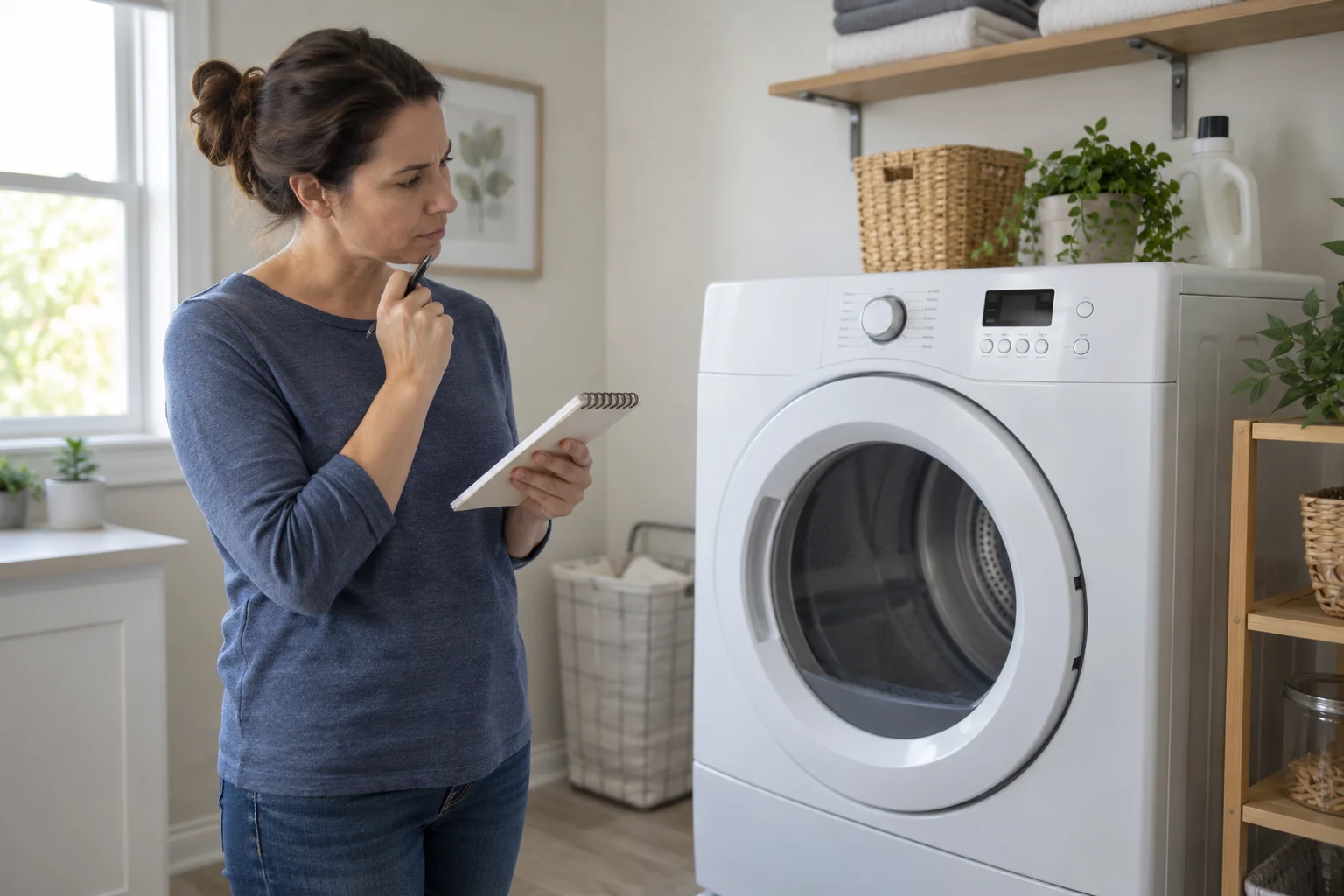
Dryer Troubleshooting: Match the Symptom Before You Start
Quick answer
Start with the first failed function: power, tumbling, heat, airflow, noise, or staying on. Follow the closest route instead of guessing a part. The stop guidance below overrides routine troubleshooting; do not restart a dryer to recreate a hazard.
Stop and get help: For smoke or flame, get everyone out and call 911. For a gas odor or hissing, leave without operating switches, plugs, breakers, appliances, or phones inside; call 911 or the gas utility from a safe location. Keep the dryer off for the other warning signs listed below.
Choose the first symptom you can observe
Use the earliest row that matches. A dryer that runs but leaves clothes damp needs a different path from a dryer that never tumbles, and a normal END message is different from an abrupt shutdown.
| First symptom | What to record before changing anything | Best next guide |
|---|---|---|
| No lights, no response, or a click without a cycle | Whether the drum light or display works, the exact sound, and whether a code appears | Dryer won’t start |
| The controls respond, but the drum does not turn | Whether you hear humming, scraping, or the motor running | Dryer not spinning |
| The drum turns, but the load stays cool and damp | Gas or electric model, selected cycle, and whether any heat appears | Dryer not heating |
| The dryer heats, but one load takes much longer than normal | Load size, lint-screen condition, visible duct shape, and outside airflow | Dryer takes too long to dry |
| A new thump, rattle, scrape, squeal, or grind appears | The sound, when it begins, and whether the drum still turns normally | Dryer making a loud noise |
| You smell burning, hot rubber, melting plastic, or a sharp electrical odor | Stop the cycle; note the odor, timing, heat, sound, and whether the drum was turning | Dryer smells like burning |
| The dryer starts, then stops before the cycle should finish | Whether the display went dark, showed END, stayed on, or restarted only after cooling | Dryer keeps shutting off |
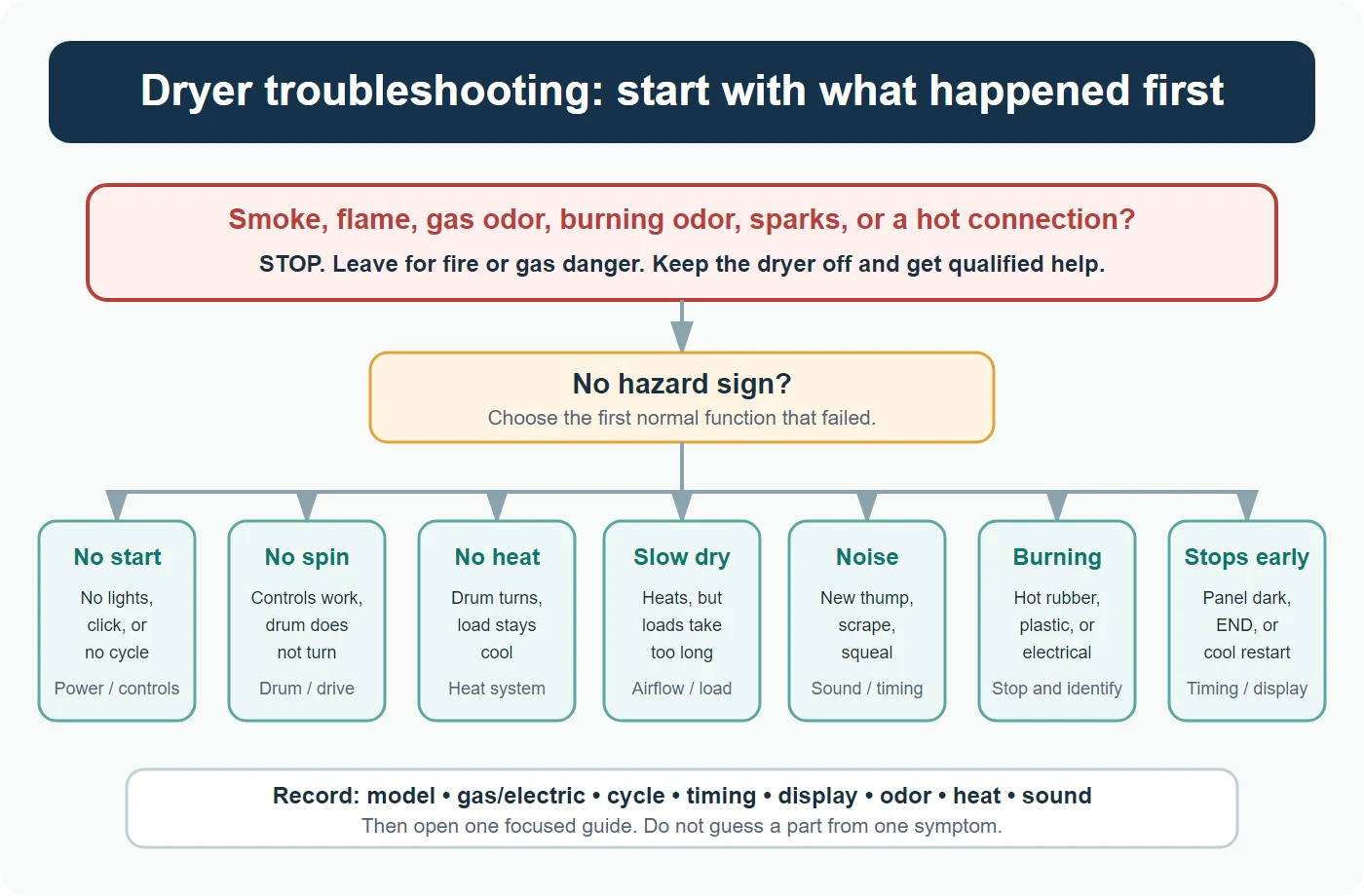
Safety signs override the symptom chart
Do not run another test cycle just to reproduce a hazard. Leave the dryer off when you notice:
- smoke, flame, sparks, or glowing;
- a gas odor or hissing near a gas appliance;
- a burning, hot-rubber, or melting-plastic odor;
- a hot, loose, cracked, scorched, or discolored plug, cord, or outlet;
- water near a plug, outlet, or electrical connection;
- a breaker that trips again after one reset;
- unusual cabinet or clothing heat; or
- a harsh scrape or grind that begins suddenly.
The U.S. Consumer Product Safety Commission warns that lint in a dryer or exhaust duct can restrict airflow, create excessive heat, and contribute to a fire. The U.S. Fire Administration advises cleaning the lint filter, checking that the vent behind the dryer is not crushed or restricted, and confirming that the outdoor vent opens during normal operation. Those are maintenance rules, not permission to keep testing a dryer that already showed a hazard sign.
If the dryer will not start
Separate a completely dead dryer from one that has lights, a working drum lamp, a click, or a hum. Then record the selected cycle, door behavior, control-lock status, and any code. A machine with power but no tumbling may belong in the not-spinning branch rather than the no-start branch.
Check only ordinary user controls and visible, cool, dry connections described in the model manual. Do not remove an outlet cover, open the terminal block, bypass the door switch, or test live voltage. If a breaker trips again, the cord or outlet looks damaged, or the next step requires internal access, leave it off and arrange qualified service.
If the drum will not spin
The useful clue is what happens when you press Start. Does the dryer hum, click, sound as though a motor is running, or remain silent? Did the drum stop after a bang or a new scrape? Do not reach into a moving drum, hold a door switch closed, or open the cabinet to watch the belt.
If the controls accept the cycle but the drum does not turn, use the focused not-spinning guide. If the dryer also smells hot or burned, the odor is the higher-priority symptom: stop using it and follow the burning-smell route.
If the drum turns but there is no heat
Confirm that the dryer actually tumbles and that you are not using an air-only or no-heat cycle. Record whether the load is cold throughout or briefly warms and then cools. Electric and gas dryers have different heat systems, so identify the fuel type and full model number before interpreting a code or ordering a part.
Do not light or inspect a burner, open a gas connection, probe live circuits, or assume a thermal fuse is the only possible cause. The focused no-heat guide keeps power, settings, airflow, and service-only checks separate.
If drying takes too long
Slow drying is usually easier to route when you compare airflow, heat, and the wetness of clothes leaving the washer. Note whether the dryer becomes unusually hot, whether the outside hood opens normally during an otherwise safe cycle, and whether a recent load size or vent change preceded the problem.
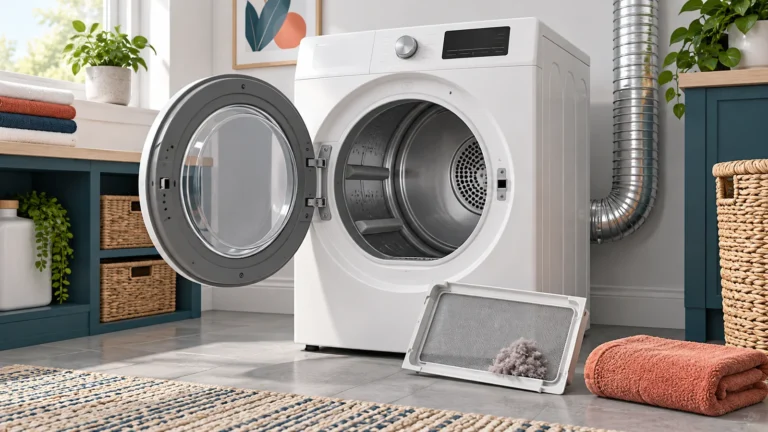
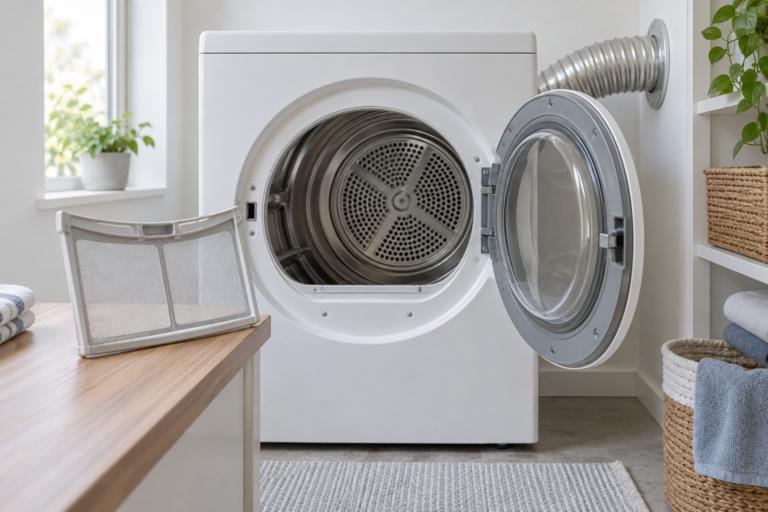
Clean the normal lint screen by the model-approved method. Look only at the accessible transition duct after the dryer is off and cool. A clean lint screen does not prove that a concealed or long exhaust route is clear. A roof outlet, inaccessible duct, crushed connector, or persistent weak airflow calls for a qualified dryer-vent professional. Stop rather than testing again if there was burning odor, unusual heat, smoke, or electrical damage.
If the dryer makes a new noise
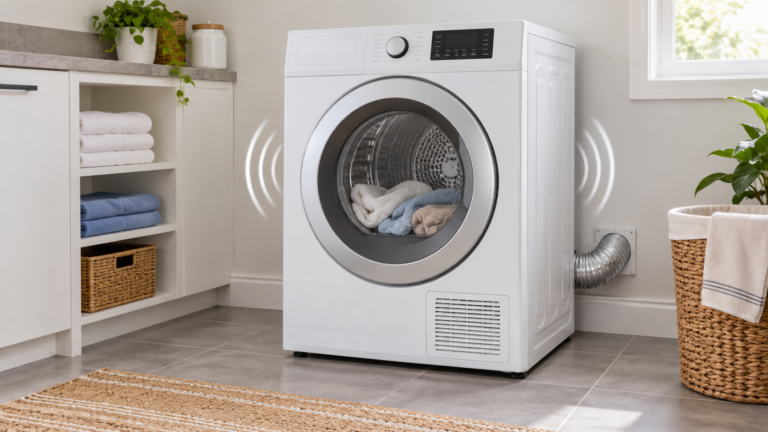
Describe the sound instead of naming a part. A zipper or coin can rattle differently from a repeated thump, high squeal, grinding sound, or strained hum. Record whether the noise follows drum speed, starts only with a heavy load, or continues on an empty drum. Stop for metal-on-metal scraping, a harsh grind, burning odor, or a drum that no longer turns normally.
The focused noise guide helps separate a load or installation clue from a service-level motor, roller, bearing, belt, pulley, or blower problem without asking you to open the cabinet.
If the dryer smells like burning
End the cycle and keep the dryer off. A hot-dust smell, hot rubber, melting plastic, sharp electrical odor, scorched fabric, and true gas odor do not share one safe response. Note the exact smell, when it began, whether the drum was turning, and whether the dryer or clothes felt unusually hot.
Do not move a gas dryer to inspect behind it, spray cleaner into the appliance, or run an air-only cycle to see whether the odor returns. Use the burning-smell guide and stop at its service boundary.
If the dryer stops before the cycle ends
First decide what actually stopped. Did the whole panel go dark, did the display show END, did the controls remain on while the drum stopped, or would the dryer restart only after cooling? Those patterns point toward different paths: power, sensor-cycle behavior, door movement, airflow and heat, or an internal motor or control problem.
Do not keep restarting a machine that becomes hot, shuts down repeatedly, trips a breaker, or will run again only after cooling. The shutdown guide explains which observations are safe and when a normal sensor-cycle ending is more likely than a sudden failure.
Record these details before service
A short record can help a technician choose the right manual and service path. Note:
- brand, full model number, and whether the dryer is gas or electric;
- the first failed function, selected cycle and settings, and exact display or error code;
- when the problem begins and what still works;
- load size and fabric mix, including whether clothes were unusually wet when removed from the washer;
- any odor, unusual heat, weak airflow, new noise, vibration, door behavior, or breaker trip; and
- recent installation, movement, vent work, outage, or other change.
Photograph an error code only if safe, before a model-approved reset. Meanings and reset sequences vary by model. Do not recreate a dangerous symptom to record it.
Keep owner checks outside the cabinet
Only continue with a cool, dry dryer and no stop signs. Limit checks to the controls, lint screen, and visible duct sections the model manual identifies as user-accessible. Do not remove panels, defeat an interlock, move a gas appliance, disconnect gas fittings, reach behind a hot or energized dryer, or test live voltage; those are service tasks.
When to call which professional
| What you found | Best next contact |
|---|---|
| Gas odor or suspected gas leak | Leave first; call 911 or the gas utility from a safe location |
| Smoke, flame, or active fire | Leave and call 911 |
| Damaged, hot, loose, scorched, or repeatedly tripping electrical connection | Licensed electrician or qualified appliance service, depending on where the damage is found |
| Weak airflow in a long, concealed, roof-terminating, or inaccessible duct | Qualified dryer-vent professional |
| Repeated shutdown, no heat, no spin, abnormal noise, or recurring code after safe external checks | Manufacturer-authorized or qualified appliance technician |
| Door, belt, motor, bearing, pulley, control, burner, or internal wiring diagnosis | Qualified appliance technician |