How to Clean a Range-Hood Filter—or Know When to Replace It
Quick answer: With dry, safe access, turn off the cooktop, fan, and lights, let everything cool, and isolate hood power as the owner’s manual directs before handling the filter. Identify the exact filter before adding water: reusable metal mesh or baffles are usually washable; ordinary charcoal and some metal-and-carbon combination filters are replace-only. Wash only the approved reusable part with warm water and detergent, or use the dishwasher only if permitted. Dry fully and secure every required filter before restoring power. If electrical parts are wet or damaged, keep away and get qualified help.
The most expensive mistake is washing the wrong filter. Some hoods stack a charcoal filter behind a metal grease filter, while others use a specialty long-life charcoal filter that the manual says can be cleaned and heat-reactivated. Appearance helps, but the model’s parts diagram decides.
Updated October 22, 2026: clarified power isolation, combination-filter identification, model-specific refitting, and the next step when airflow or noise is still abnormal. Added a filter-form comparison and kept the October 20 care guidance.
Choose wash or replace · Clean the removable metal filter · Check the result safely
Is the filter washable or replace-only?
| Filter type | Where it is used | Normal care | Do not assume |
|---|---|---|---|
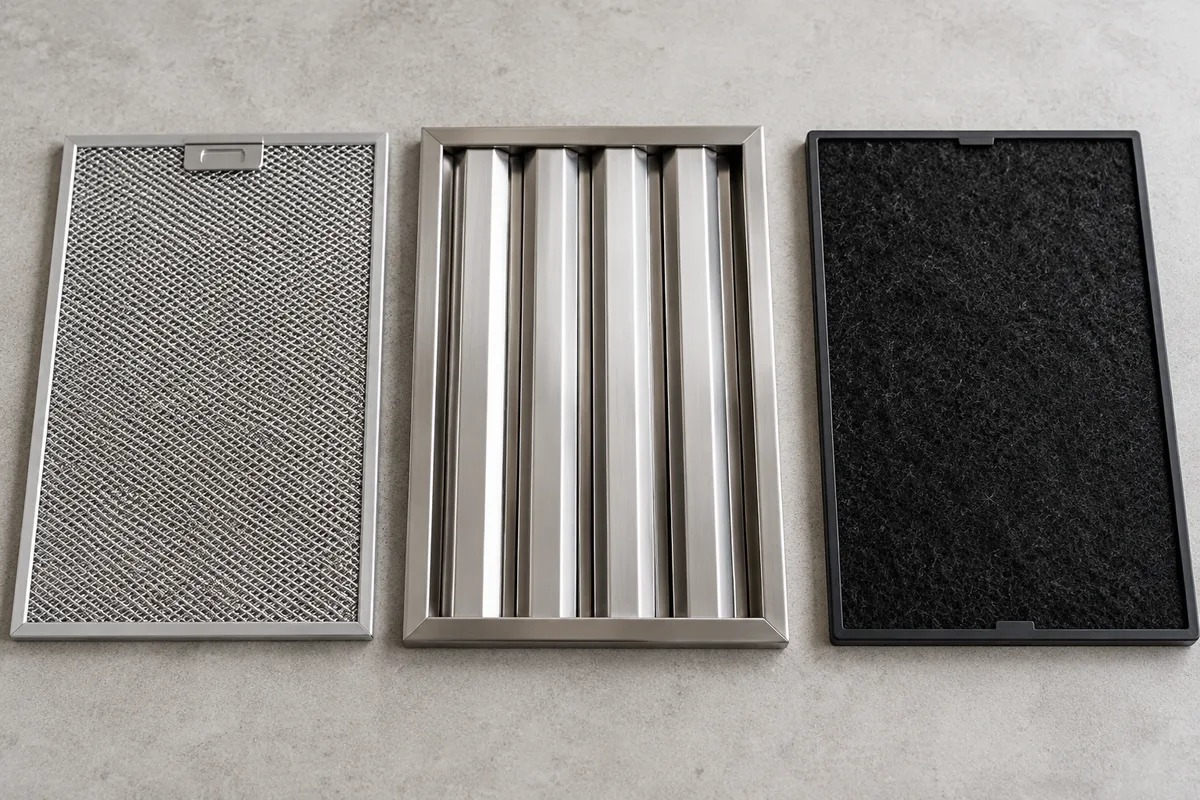
| Aluminum or stainless mesh | Captures airborne grease | Wash and reuse if the manual permits | Dishwasher heat and detergent can discolor some aluminum |
| Metal baffle | Channels grease into troughs | Wash by hand or approved dishwasher route | Sharp edges and trapped grease require gloves and drying |
| Standard charcoal/carbon pad | Reduces odor in recirculating hoods | Replace at the manual’s interval | Do not wash, vacuum, or heat unless the exact part is specifically reusable |
| Long-life/rechargeable charcoal | Selected recirculating models | Use the exact wash and reactivation cycle in the manual | Do not apply that process to an ordinary charcoal filter |
| Combined metal-and-carbon assembly | Grease and odor filtration in one assembly | Follow the exact part’s replace/wash instructions | A metal-looking face does not make the whole assembly washable; do not peel layers apart |
| Unknown or unlabeled | Unclear | Find the hood model and filter part number first | Color alone is not proof |
Time estimate: 20–35 minutes plus the required soaking and full drying. Difficulty: easy. Supplies: gloves, warm water, dish detergent, soft brush, lint-free towels, and a protected sink or basin.
Safety boundary: Controls off is not proof that the hood cannot start. Before filter removal or cleaning, follow the manual’s power-disconnection method and precautions against someone restoring power. Use only a dry, safely accessible plug or an identified disconnect; do not open electrical covers, disconnect wiring, or handle wet electrical parts. If you cannot isolate power safely, stop and get qualified help. Let the cooktop, lamps, and metal cool. Support the slippery filter with both hands and protect against sharp edges. Keep hands and tools out of blower openings; broken glass, damaged wiring, or water inside powered parts requires service, not more cleaning.
The Broan 40000/41000/42000-series manual requires disconnection at the service panel before cleaning and measures to prevent accidental restart. Use the safety instructions for your actual hood, not a switch position or this article as proof of electrical isolation.
How to find the filter type and airflow mode
- Start with the owner’s manual, installation record, or a safely visible model label. If the label is behind an owner-removable filter, complete the power-isolation and cooling check before removing it. Do not remove electrical or motor covers to find a number.
- Confirm the installed airflow mode from the manual and installation: ducted air goes outdoors; recirculating air returns through a room grille and commonly needs carbon filtration as well as grease filtration. An unused grille or convertible hood casing alone does not prove which mode is installed.
- Open the manual’s “filters,” “range hood care,” or parts section. Record the filter part number and orientation before removal.
- Photograph the tab, spring handle, clips, and any charcoal layer attached behind the metal filter.
Do not peel bonded layers apart to make a combination filter “washable.” If the manual does not identify a detachable reusable metal section, keep the assembly dry until the manufacturer confirms its care or replacement part. PNNL’s illustrated filter guide also distinguishes disposable mesh/carbon filters from washable metal mesh. Likewise, a long-life carbon label is not permission to copy an oven-reactivation recipe from another model. Beko’s UK care guide illustrates why washable and non-washable carbon filters need different instructions; its temperatures and intervals are not generic US-hood directions.
Wash a reusable metal grease filter
- Isolate, cool, and support before release. Complete the safety check above, protect the cool cooktop below, and support the filter with both hands while using the exact latch or retainer motion in the manual. Stop if the frame is stuck, damaged, or too awkward to support; do not force it or reach into the blower. Lower it without dripping grease into controls.
- Separate only the parts the manual allows. Remove a clipped-on charcoal layer only when the parts diagram describes that removal. Keep replace-only carbon and inseparable combination assemblies out of the wash water.
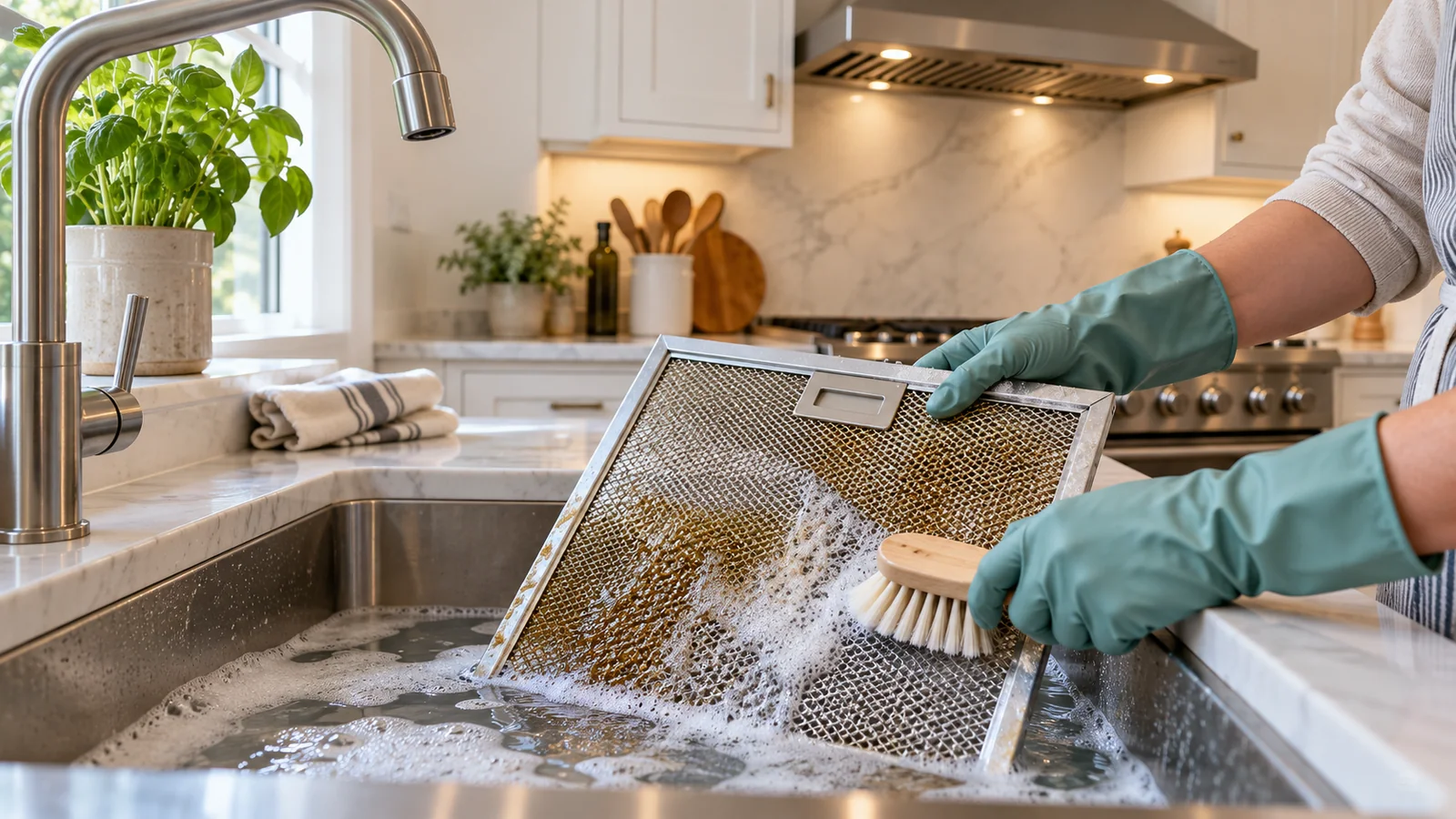
- Use a compatible detergent soak. Support the washable metal filter in a basin of warm water and detergent, following the filter and cleaner labels for concentration and soak time. Do not pour boiling water over it or assume that oven cleaner, ammonia, or a homemade chemical mixture is compatible. GE’s metal-filter guidance specifically excludes ammonia products.
- Brush with the mesh, not against it. Use a soft dish brush on both faces and around the frame. Avoid pressure that stretches mesh or bends baffles.
- Rinse until water runs clear. Soap and loosened grease left in the mesh can reduce airflow and produce odor.
- Dry completely. Stand the filter on a protected towel so water drains from the frame. Do not reinstall a dripping filter above electrical controls or a hot cooktop.
- Refit using the exact model’s diagram. With power still isolated, put back every required filter, retainer, and owner-removable cover in the specified orientation. Mesh handles, baffle troughs, and carbon attachments do not all fit the same way. Check that the filter sits flat and its latch is fully engaged without forcing it; replace a bent frame or broken latch instead of improvising a support.
Dishwasher or hand wash?
Whirlpool permits a sink or dishwasher wash for the reusable metal filters covered by its support page; your exact part’s instructions still control. Check detergent, rack position, temperature, and whether the cycle must run without dishes. Do not invent a cycle for an unknown or combination filter. Some aluminum can discolor even with an allowed machine wash; that alone does not prove failure. Bent mesh, loose seams, flaking, or a latch that no longer holds needs assessment rather than polishing.
Replace a standard charcoal filter
- Confirm the exact replacement part number and airflow direction.
- Remove the metal grease filter first if it blocks access.
- Release the clips, frame, or twist-lock without dropping debris into the blower opening.
- Bag and discard the used filter; do not vacuum, rinse, or bake it unless the manual explicitly describes a reusable type.
- Install the new filter in the orientation shown by the manual, then reinstall the clean dry grease filter.
- Reset the filter indicator only after maintenance is complete.
Whirlpool gives up to six months as a normal-use interval for many replace-only charcoal filters. Heavy frying, smoke, or a small recirculating kitchen can shorten useful life. A persistent cooking odor after the metal filter is clean is a practical reason to inspect the charcoal filter rather than masking the smell.
When cleaning is not enough
| What you find | Decision | Reason |
|---|---|---|
| Torn mesh or open seam | Replace | Grease can bypass the filter |
| Bent frame that will not latch | Replace with the correct part | A loose filter can fall or contact the fan |
| Filter remains sticky after the allowed cleaning process | Ask the maker about the approved next method or correct replacement | No universal “two washes” replacement rule; do not escalate to harsher chemicals on an unknown assembly |
| Clean filter but weak airflow | Check only safely accessible visible openings; use service for persistent weak airflow or inaccessible ducts | The blockage may be beyond the filter |
| Rattling or scraping after reinstalling | Stop, isolate power again, and check the manual’s refitting instructions; do not repeat a scraping fault or open the motor housing | The filter or fan path may be misaligned |
Clean the hood surfaces without pushing grease inward
- Wipe the underside and filter channel with mild detergent on a cloth, not a direct spray.
- Keep liquid out of switches, display seams, lamp sockets, and blower openings.
- Use a finish-approved stainless product on stainless steel and wipe with the grain.
- Avoid oven cleaner, chlorine-containing cleaner, steel wool, and abrasive pads unless the exact manual allows them.
- Dry every surface to reduce water marks and prevent drips onto the cooktop. For greasy cabinet fronts nearby, use the cabinet-finish cleaning route rather than applying the hood’s cleaner or method to a different finish.
The airflow check after reassembly
Before restoring power, confirm that the filter and channels are fully dry, no cleaner remains, every required part is back, and all latches are secure. Water that entered a switch, motor, or wiring compartment needs professional assessment; letting the filter dry is not clearance to energize wet electrical parts. Do not run the hood with filters removed, and never press or bypass an interlock to make it run.
With the cooktop off and everything correctly reassembled, follow the manual’s normal operation check. Listen for normal running and observe airflow only at a safely accessible grille or outlet. Do not create smoke, put objects into the fan opening, climb onto the cooktop, or go onto a roof to test it. Keep these outcomes separate:
- Quiet but still weak: check the documented fan setting, filter fit, and any plainly visible obstruction you can inspect safely. If those are correct, a duct, damper, installation, or blower issue needs service—not another chemical soak.
- Rattling or scraping: stop; isolate power before checking only owner-removable parts. Persistent noise or damage means service.
- Will not start after refitting: some downdraft models have a filter-position interlock; consult the manual rather than reaching behind the filter or repeatedly resetting power.
Frequently asked questions
Why does the hood still smell after the metal filter is clean?
A recirculating charcoal filter may be saturated, grease may remain in accessible channels, or duct airflow may be poor. Inspect the filter type and service path rather than adding fragrance.
How often should I clean the filter?
Use the exact manual’s schedule or filter indicator, with earlier attention for heavy cooking; do not wait for dripping grease or noticeably weak airflow. Intervals are not universal: Broan’s linked 40000/42000-series guidance calls for monthly aluminum-filter washing, while GE’s general metal-filter page gives about six months or as needed for normal use. Those examples are not competing rules for the same part. Record your model, filter part number, cleaning date, and its next maintenance reminder. Reset an indicator only after doing the required work.
Related kitchen ventilation guides
- Clean over-the-range microwave grease and charcoal filters
- Choose a safe oven-cleaning cycle and reduce smoke
- Trace kitchen odors that are not coming from the hood
Sources
- Whirlpool — Clean or replace vent-hood filters
- Whirlpool — Range hood maintenance checklist
- Whirlpool — Downdraft grease-filter care
- GE — Metal grease-filter cleaning and model limits
- Broan — 40000/41000/42000-series safety and filter instructions (PDF)
- Beko UK — Washable versus non-washable carbon filters; model-specific example
- PNNL — Identify washable and disposable filter assemblies
Filter-care guidance checked October 20, 2026; safety, refitting, and completion decisions rechecked October 22, 2026. Filter construction, dishwasher compatibility, replacement intervals, and reactivation procedures vary by model and part number.