How to Clean a Velvet Couch Without Flattening the Pile
Quick answer: Check the couch tag and exact fabric name before adding any cleaner. Remove loose dry soil only with the maker-approved upholstery attachment or brush. For a fresh spill, press a clean, dry white cloth onto the area and blot—do not rub. Then decide whether you are seeing soil, a liquid mark, a ring, or only a change in the direction of the velvet pile. Do not use water, solvent, vinegar, steam, heat, or an extraction machine unless the care instructions allow that specific route.
Velvet is a pile fabric, not one universal fiber or finish. Two couches can look similar while their care instructions conflict. The safe method is therefore not “use the gentlest homemade cleaner.” It is identify the fabric, read the code, and diagnose what changed before cleaning.
If your couch is not velvet, use our complete couch-cleaning guide to choose the correct material route.
Start with the tag, not a cleaning recipe
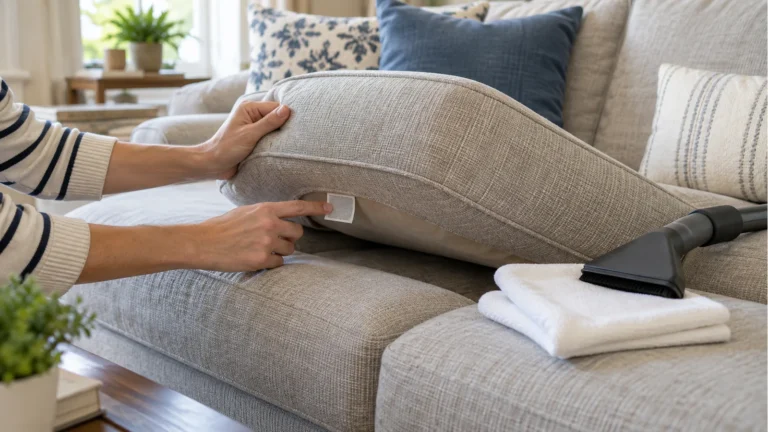
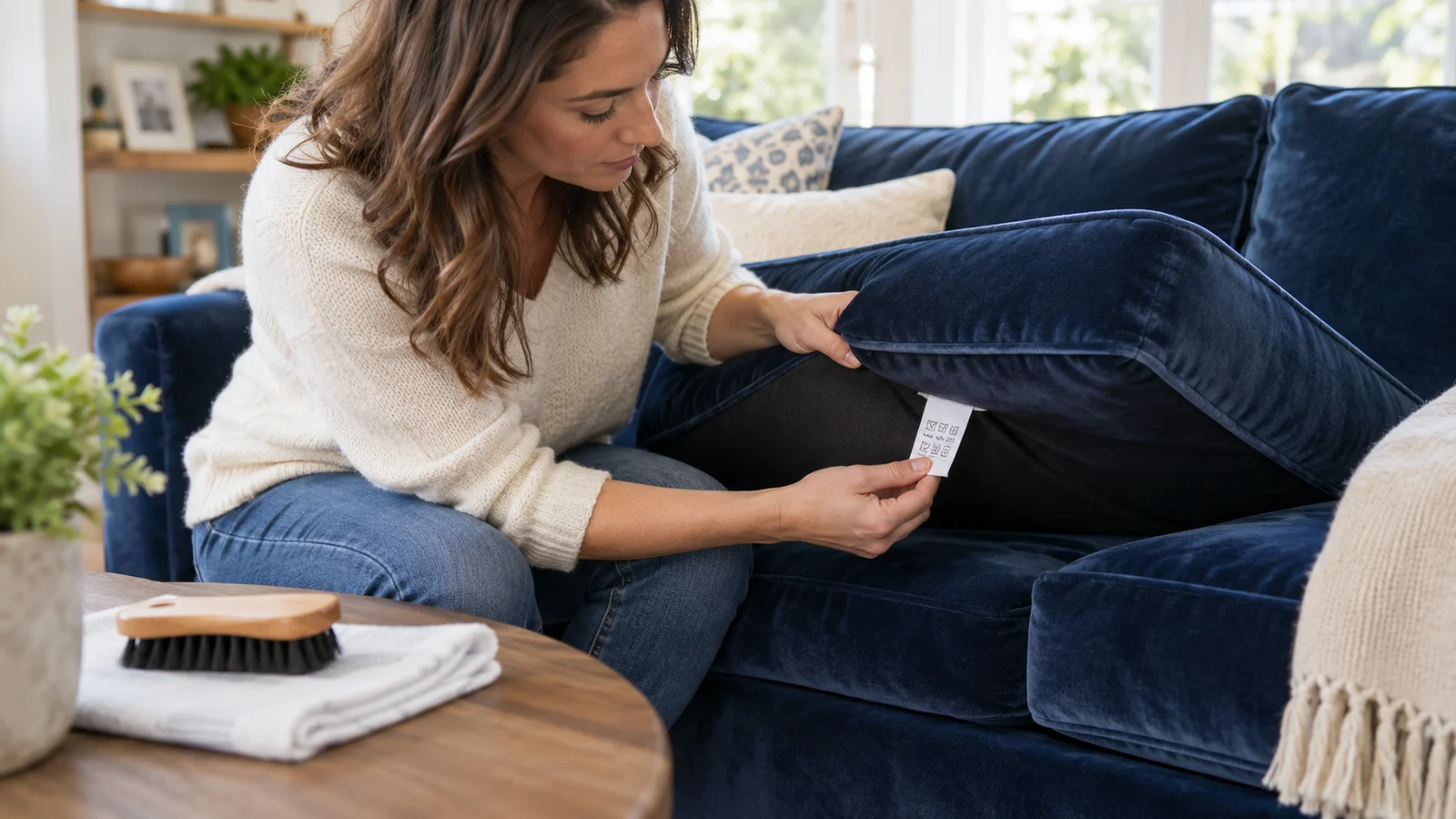
Look beneath a seat cushion or under the couch for the care label. Photograph the label and note the manufacturer, model, fabric name, fiber content, and cleaning code. If the label is missing, search the exact model or ask the manufacturer. Do not identify velvet care from appearance alone.
Ashley’s upholstery guidance summarizes the common codes this way:
| Code | What the code permits | What it does not automatically permit |
|---|---|---|
| W | A water-based upholstery-cleaning route | Saturation, steam, machine washing, or every household water-based cleaner |
| S | A water-free dry-cleaning-solvent route | Water, water-based shampoo, or a DIY solvent experiment |
| WS / SW | A specified water-based or solvent route | Mixing products or using any cleaner without checking its label |
| X | Vacuuming or light brushing only | Liquid spot cleaner, steam, extraction, or solvent |
| DC / maker-specific wording | The exact dry-cleaning or manufacturer route stated on the label | Translating a generic online method to the couch |
| Unknown | Dry spill control while you identify the couch | Guessing from color, softness, or the word “velvet” |
A code describes a category of care. It does not make every product in that category safe, and it does not override stricter manufacturer instructions. A zipper also does not prove that a cushion cover is removable or washable. If construction is part of the problem, use our couch-cushion guide before opening or laundering anything.
Safety boundary: Stop before adding liquid when the code is S, X, unknown, dry-clean-only, or more restrictive than the method you planned to use. Never combine cleaners or add a second product over unknown residue. Do not use bleach, ammonia, vinegar, peroxide, alcohol, solvent, steam, heat, or an extraction machine unless the couch instructions and product label both allow that exact use.
Decide whether you have dirt, a stain, or changed pile
Velvet can look darker or lighter when its upright fibers—the pile or nap—point in a different direction. That change in sheen can resemble a stain even when no residue is present. Inspect the area in side light and from more than one viewing direction before treating it.
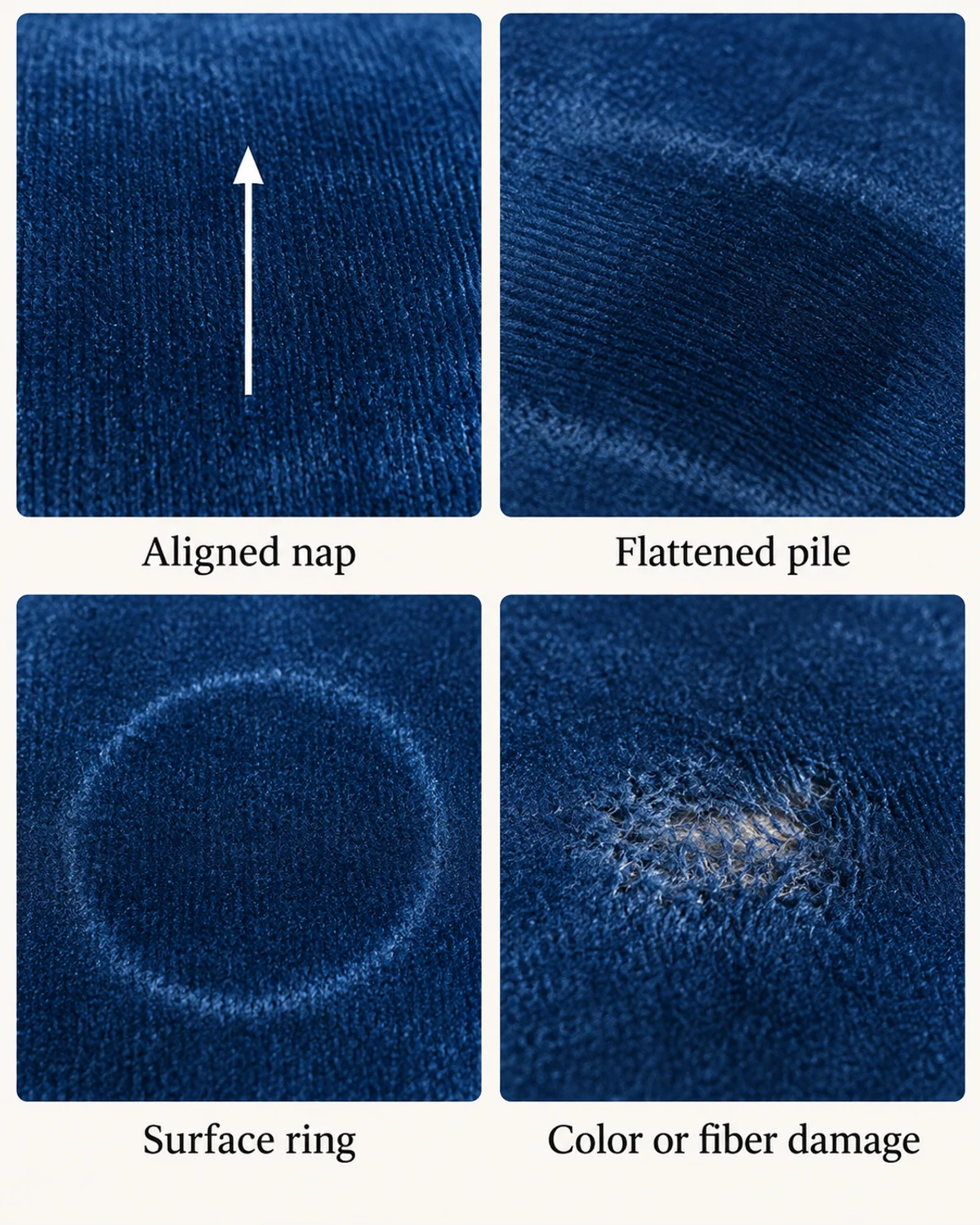
| What you see | First low-risk action | Stop and reassess when |
|---|---|---|
| Loose dust, crumbs, lint, or pet hair | Use only the maker-approved upholstery attachment or soft brush; finish in the nap direction if the instructions say to | The nozzle drags, the pile snags, or color/fibers transfer |
| A fresh liquid spill | Press with a clean, dry white cloth; move to a dry section and repeat without rubbing | You see dye transfer, spreading, or liquid has reached the cushion interior |
| A dried spot, residue, or water-ring boundary | Read the code and exact fabric instructions before selecting a product | The code is S, X, unknown, or the mark grows after a hidden-area test |
| Uneven sheen or a flattened patch | Compare the area from several directions; use only the brush, steam, or heat method named by the manufacturer | Fibers look abraded, matted, shiny, or discolored rather than simply redirected |
| Fixed color loss, rough fibers, bald pile, or a large recurring ring | Stop DIY cleaning and document the damage | More cleaning would add moisture or friction without identifying the cause |
Dry care for loose surface soil
Use this route only if the couch instructions permit vacuuming or brushing.
- Remove loose cushions only as the couch is designed to be used. Do not unzip covers or pull inserts out unless the care instructions permit it.
- Check the attachment. Use only the upholstery tool, fabric brush, or soft clothes brush named by the manufacturer.
- Lift loose soil without scrubbing. Work methodically over the surface, seams, and accessible cushion edges. Stop if the tool catches fibers or creates a new shiny track.
- Finish the pile as directed. Some velvet instructions say to finish brushing in the direction of the pile. If your couch does not give that instruction, do not assume a stiff brush or repeated brushing is harmless.
Routine dry care can remove surface debris. It will not remove a fixed liquid ring, dye change, or contamination that has entered batting or foam.
What to do with a fresh spill
1. Blot before the liquid spreads
Place a clean, dry white cloth over the wet area and press straight down. Lift the cloth, move to a dry section, and repeat. White cloth makes color transfer easier to see. Do not scrub, twist the pile, or press liquid toward a seam.
If a removable cushion is wet, check the underside and the deck below it without opening a sealed cushion. A surface-cleaning method will not address liquid that has entered the insert.
2. Read the permitted cleaning route
- W: Select only a water-based upholstery product allowed by the couch maker and suitable for the exact fabric. W does not mean “washable.”
- WS/SW: Choose one compatible route—water-based or solvent-based—using the maker’s directions. Do not mix the two.
- S: Do not add water. For a visible velvet stain, the safer route is the manufacturer’s solvent procedure or a qualified upholstery cleaner rather than improvising with a consumer solvent.
- X: Continue with dry blotting only. Liquid spot cleaning is outside the code.
- Unknown or dry-clean-only: Stop after removing accessible excess liquid and contact the manufacturer or a cleaner experienced with velvet.
3. Patch-test the exact product
When both the care code and manufacturer allow a product, test it in an inconspicuous area for the full drying time stated on its label. Check after the area is completely dry, not while it is still damp.
Do not continue if the test produces color transfer, a darker boundary, stiffness, flattening, a change in sheen that does not shift with the nap, or visible fiber damage.
4. Follow the product and couch directions exactly
Use the amount, application method, removal step, ventilation, and drying method stated for the product and couch. Do not increase the concentration or soak the cushion because a mark is stubborn. Ashley’s code guidance repeatedly warns against saturation, and current RH guidance for one performance velvet warns that excess water can flatten the pile.
Allow the treated area to dry fully before judging the result or brushing it. A damp patch can look darker and feel different even when permanent damage has not occurred.
A dried ring is not permission to wet the whole cushion
A fixed outline may be residue, a water boundary, altered dye, damaged fiber, or changed pile. Appearance alone cannot confirm which one. Repeated spot treatment can enlarge the ring or leave more residue.
- View the mark from two directions and under side light.
- Check whether the sheen changes when the surrounding pile changes direction naturally.
- Review the tag and exact manufacturer instructions.
- If the permitted route includes a compatible cleaner, patch-test it and treat only as directed.
- Let the area dry completely before deciding whether another action is justified.
- Stop if the boundary expands, the cloth picks up dye, the pile feels rough or matted, or the instructions do not explain the next step.
Do not clean an entire cushion “seam to seam” unless the manufacturer specifically instructs that method for your fabric. A broad wet pass can create a larger problem on S, X, delicate, vintage, cotton, silk, wool, or unlabelled velvet.
Can you steam velvet to lift crushed pile?
Only when the instructions for the exact velvet say you can.
Official RH care sheets show why a universal answer is unsafe. Its 2023 instructions for named Lustrous Velvet and Vintage Velvet lines allow limited steam held at a stated distance and warm-air drying under specific conditions. A current RH sheet for Italian Performance Lustrous Velvet—identified as a 100% polyester pile—says not to steam or iron directly and warns against excess water.
That is not a contradiction to solve with a compromise method. It is evidence that the fabric name and current product instructions control the decision. Do not hover a garment steamer over an unknown velvet couch, place an iron on the fabric, or use a hair dryer because another velvet owner’s instructions allowed it.
If the maker permits brushing but not steam, use only the specified brush and direction. If it permits neither, leave a crushed or shiny area for a cleaner experienced with the fabric. Treat fixed color loss or visibly abraded fibers as possible damage, not merely a pile-direction problem.
What not to use as a universal velvet cleaner
Avoid treating these as default methods:
- vinegar-and-water sprays;
- baking soda or powdered deodorizer worked into the pile;
- dish soap or laundry detergent without item-specific permission;
- rubbing alcohol or consumer dry-cleaning solvent on a W, X, or unknown code;
- steam, an iron, or a hair dryer;
- a carpet extractor or upholstery machine;
- a stiff brush; or
- machine washing a zippered cover.
Some of these products or tools may appear in instructions for a particular velvet. Their presence in one manufacturer’s care sheet does not transfer that permission to another couch.
When to call an upholstery cleaner
Arrange professional assessment when:
- the tag is missing and the manufacturer cannot identify the fabric;
- the velvet is vintage, silk, cotton, wool, delicate, or dry-clean-only;
- the code is S or X and the problem needs more than permitted dry soil removal;
- a large area is soiled or liquid has reached batting, foam, seams, or the couch deck;
- a hidden-area test causes dye transfer, stiffness, a ring, or changed texture;
- the mark is fixed color loss, abrasion, bald pile, or rough fiber damage;
- a ring returns or grows after complete drying;
- the couch instructions recommend professional cleaning; or
- previous products are already on the fabric and their residues are unknown.
Ask whether the cleaner has experience with the exact fiber and finish, what code they will follow, and whether they expect cleaning to change the appearance. Professional cleaning is an escalation route, not a guarantee that color or fiber damage can be reversed.
If the fabric may actually be microsuede rather than velvet, use our suede and microsuede identification guide before selecting a method.
Keep the couch easier to assess next time
- Save a photo of the care label, fabric name, and model number.
- Remove loose surface debris with the method and frequency given by the manufacturer.
- Blot spills immediately with dry white cloths rather than waiting for a recipe.
- Keep unapproved liquids, powders, steam, and heat off the pile.
- Record any product used, so a future cleaner does not have to guess what residue is present.
- Recheck the care sheet when the manufacturer updates it; current item-specific instructions are more useful than a generic velvet tip.
The decision that protects velvet
The safest way to clean a velvet couch is to begin with identification, not moisture. Separate loose soil from a fresh spill, a dried ring, and a pile-direction change. Then use only the route allowed by the couch tag and exact manufacturer instructions.
If the instructions are missing, the code excludes the needed method, or the mark looks like dye or fiber damage, stop. That boundary is more useful than another universal cleaning recipe because it prevents a removable problem from becoming a permanent one.