How to Clean a Couch: Start With the Care Code and Material
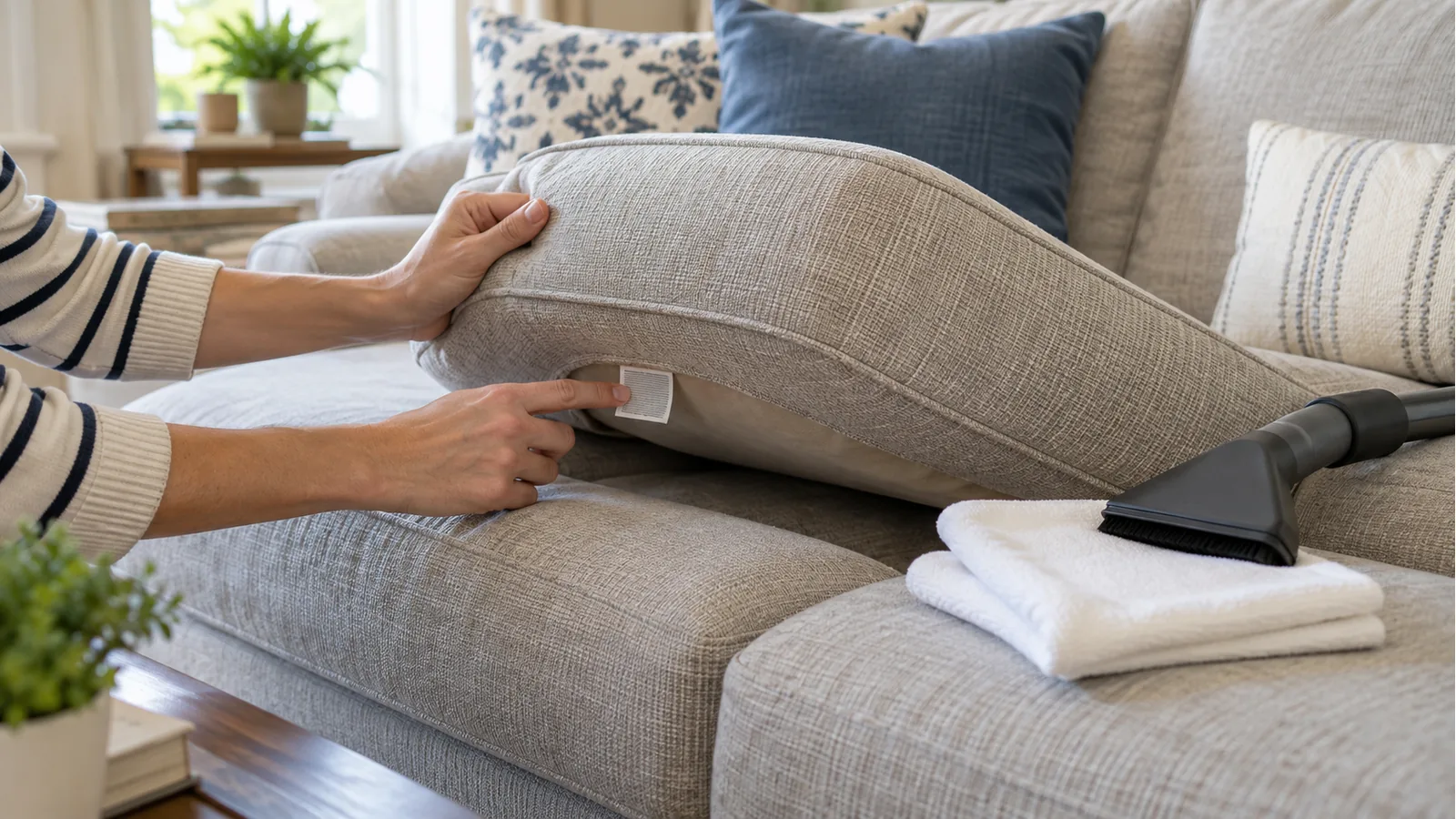
Quick answer: Find the couch care tag before adding water, steam, solvent, or a homemade mixture. It is commonly under a seat cushion or beneath the frame. Record the upholstery material and the cleaning code: W allows a water-based upholstery-cleaning route, S calls for a labeled solvent route, WS/SW permits either category, and X limits routine care to vacuuming or light brushing. The exact manufacturer instructions still control. Start with dry soil removal, blot spills instead of scrubbing, test any allowed product in a hidden area, and use as little moisture as the approved method requires.
Stop before deep cleaning: Do not steam, extract, machine-wash a zippered cover, or apply a second cleaner over an unknown residue unless the furniture maker explicitly permits it. Never mix household cleaners. If the couch contains mold, sewage or floodwater, bed-bug evidence, a strong chemical odor, wet electrical parts, or liquid that has soaked into thick foam, surface cleaning is not an adequate safety check.
Choose the cleaning route before adding a product
A couch is a layered object: the visible upholstery may cover batting, foam, adhesives, decking fabric, wood, metal, and sometimes motors or charging parts. The safest useful method depends on the label, the surface, and how deeply the problem traveled.
| What you find | First action | Route | Stop condition |
|---|---|---|---|
| Crumbs, hair, or dry dust | Inspect seams, then use a clean upholstery attachment if allowed | Follow the dry-maintenance steps below | Stop if suction pulls threads, pills the fabric, or disturbs a loose finish |
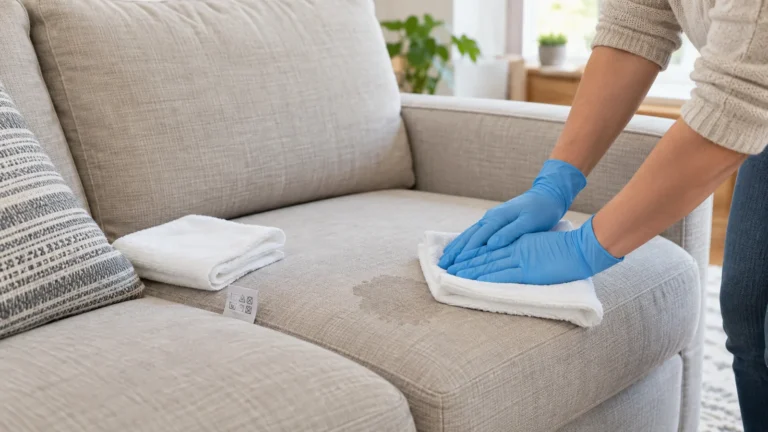
| Fresh surface spill on a W or WS/SW fabric | Press a dry white cloth straight down | Use the maker-approved water-based spot route | Stop if moisture reaches foam, seams, the underside, or electrical parts |
| S code | Remove only dry debris first | Use only a product labeled for the exact upholstery or hire a qualified cleaner | Do not improvise with water, vinegar, or a general carpet formula |
| X code or no readable instructions | Vacuum or lightly brush only | Ask the maker or a qualified upholstery cleaner before spot treatment | Do not test a wet or solvent product by guesswork |
| Removable cushion cover | Check whether the label explicitly says it is washable | Use the couch-cushion guide | A zipper alone is not washing permission |
| Suede, microsuede, velvet, chenille, leather, or a coated surface | Identify the exact material and finish | Use the material-specific instructions below | Stop if the material or finish is uncertain |
| Mold, sewage, floodwater, pests, or deep saturation | Isolate the couch and document the condition | Contact the maker, pest professional, restoration specialist, or replace the affected item | Do not treat a better smell or lighter stain as proof the inside is clean |
This decision table is the main cleaning tool. It prevents a dry-maintenance job from becoming a wet-cleaning problem.
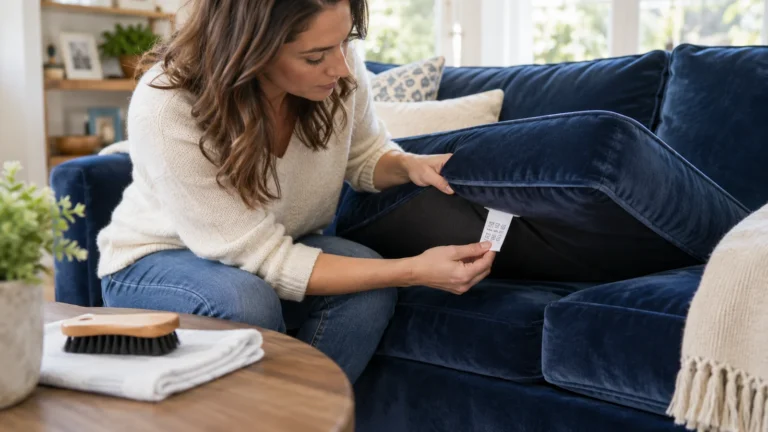
Find the care tag and record what matters
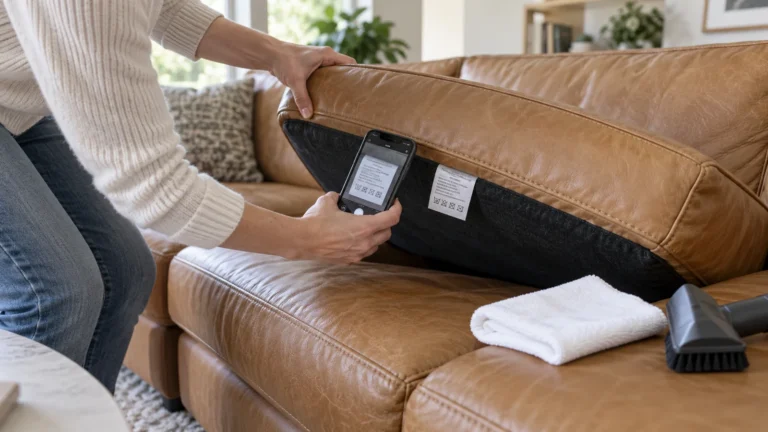
Remove loose cushions one at a time and look beneath them. If the tag is not there, inspect the platform under the cushions, the underside of the frame, the rear skirt, and any paperwork or model page from the manufacturer. Photograph the tag before it fades or is removed.

Record four details:
- The cleaning code: W, S, WS/SW, X, or another instruction written by the maker.
- The named surface: woven fabric, microfiber, suede, leather, faux leather, velvet, chenille, or another finish.
- The construction: fixed upholstery, loose cushion, removable cover, slipcover, recliner, sleeper sofa, or powered seating.
- The problem depth: dry surface soil, a small fresh spot, a broad dirty area, or liquid/contamination that entered seams and fill.
Ashley Furniture's current care guidance places W, S, SW/WS, and X on distinct routes and repeatedly warns against saturation. Crate & Barrel likewise tells owners to follow the cleaning code, test in a hidden area, blot rather than rub, and wash a slipcover only when its instructions allow it. Those are useful boundaries, but your own couch instructions remain the deciding source.
Routine cleaning for a couch with dry soil
Dry maintenance is the safest starting point because it does not push a product into the upholstery.
- Clear the area. Remove throws and washable covers, following their own labels. Keep small hardware, charging cables, and recliner controls visible.
- Inspect before vacuuming. Check seams, tufts, piping, zippers, the cushion deck, and the floor beneath the couch. Look for wet areas, loose threads, insect signs, mold, or torn upholstery.
- Test the attachment. Make one light pass on a hidden part of the same fabric. Stop if fibers lift, the finish changes, or the tool pulls at the weave.
- Work from high to low. Vacuum the back, arms, seat cushions, creases, and platform so dislodged debris is collected rather than moved around.
- Use crevice suction carefully. Keep the nozzle from scraping leather, coated fabric, piping, and fragile seams.
- Clean the surrounding floor separately. Do not replace cushions until the platform and any treated nearby surface are dry.
- Rotate only as designed. Some cushions are reversible; others have a single finished side. Follow the construction rather than forcing a rotation.
Vacuuming removes loose debris. It does not remove a deep odor source, confirm that allergens are gone, or make contaminated foam safe. If the source is a urine accident, use the couch urine-odor guide to check the care code and soak depth before treating it.
How to handle a fresh spill on W or WS/SW upholstery
Use this route only when the tag and maker permit a water-based upholstery product.
- Remove solid material without pressing it farther into the weave.
- Place a clean, dry white cloth over the liquid and press straight down. Move to a dry section and repeat. Do not rub.
- Read the approved product label, including ventilation, protective-equipment, dilution, and incompatibility instructions.
- Test the product on a hidden part of the same material. Let the test area dry completely before judging color, texture, or finish.
- Apply the permitted solution to a cloth or as foam if the instructions specify it. Do not pour cleaner onto the couch.
- Work from the outside of the spot toward the center so the affected area does not spread.
- Remove residue only as the product and furniture instructions direct. Avoid creating a wet rinse zone.
- Blot with a dry cloth and provide airflow. Keep people and pets off the treated area until it is fully dry.
If a ring appears, the color transfers, the fabric stiffens, or the spot returns while drying, stop adding product. Record what was used and consult the maker or an upholstery cleaner.
What S, X, and an unknown code mean in practice
S code
S does not mean “use any solvent.” It means the upholstery requires a solvent-based route specified for that material. Products in this category can have ventilation, ignition, residue, and finish risks. Dry-vacuum first if permitted, then use the exact maker-approved product and label directions or hire a qualified upholstery cleaner. Do not substitute water, dish soap, or vinegar.
X code
For routine owner care, stay with vacuuming or light brushing as the label allows. Do not interpret X as permission to test a small wet spot. A hidden test can still leave a permanent ring, texture change, or finish damage.
Missing or unreadable code
Treat the couch as dry-maintenance only until you identify the maker and model or receive qualified advice. A social-media recipe is not a replacement for missing material information.
Removable covers, cushions, and slipcovers
A zipper is often included for manufacturing or professional service. It does not prove that a cushion cover can be machine-washed. Washing one unapproved cover can shrink it, change its color, distort the backing, or make it impossible to reinstall.
When the label explicitly allows washing, check whether all matching covers should be cleaned together for color consistency and whether they must be reinstalled damp or fully dry. Follow the furniture instructions exactly. For cushion construction, foam wetness, drying, and zipper decisions, use the focused couch-cushion cleaning guide.
Change the method for the upholstery material
Suede and microsuede
Natural suede and synthetic microsuede are not interchangeable. Their allowed products and brushing directions can differ. Identify the material and code first, then use the suede-couch guide for the correct branch.
Velvet, chenille, and pile fabrics
Water, pressure, and brushing can change the direction or sheen of a pile. Do not assume that a product labeled for “fabric” is suitable. For velvet, use the velvet-couch cleaning guide to separate loose soil, a fixed mark, and changed pile before choosing a method. Use the maker's instructions or professional care when the finish is delicate or the code is unclear.
Leather and faux leather
Leather, bonded leather, polyurethane-coated fabric, and vinyl may look similar but respond differently to cleaners and conditioners. Dust gently, identify the surface, and use only products the furniture maker approves. Do not use the W-code fabric procedure as a leather-cleaning recipe. For smooth or leather-look upholstery, use the leather-couch guide to identify the finish, choose the maker-approved cleaning route, and recognize damage that needs repair instead of more cleaner.
Powered recliners and sleeper sofas
Keep moisture away from motors, switches, wiring, outlets, USB ports, and mechanisms. Disconnect power only from a dry, safe location. Do not reach into a mechanism that can move or pinch.
When the problem is deeper than the upholstery
Surface cleaning is the wrong endpoint when the source sits inside the couch or represents a wider hazard.
- Liquid reached foam or batting: Blotting the cover does not prove the fill is dry. Persistent dampness or odor needs maker or professional evaluation.
- Mold or a musty odor returns: Porous upholstery and fill can conceal growth and moisture. Use the home moisture and mold decision chart and do not keep spraying fragrance.
- Floodwater or sewage was involved: CDC guidance advises discarding upholstered furniture that cannot be cleaned and dried promptly after contaminated-water exposure. Do not rely on a home surface treatment.
- Bed-bug evidence appears: Stop moving cushions or carrying the couch through the home. EPA guidance recommends inspecting secondhand furniture before bringing it inside; seams and cushions are common hiding locations. Contact a pest professional for a confirmed or suspected infestation.
- A chemical odor is strong or causes symptoms: Leave the area, ventilate only when safe, and contact the product maker, Poison Control, or emergency services as appropriate. Do not neutralize an unknown chemical with another cleaner.
Avoid generic recipes and cover-ups
Do not treat baking soda, vinegar, dishwasher tablets, laundry pods, carpet cleaner, or leather conditioner as universal couch treatments. Use a product only when the exact furniture instructions permit it for that material. Never mix cleaners or layer a new product over unknown residue. Fragrance can hide a recurring odor without removing its source; stop and diagnose the cause instead.
Keep the couch cleaner without over-treating it
Vacuum dry debris on the schedule allowed by the maker, rotate reversible cushions, and wash removable throws on their own labels. Keep drinks on a stable surface, address fresh spills promptly, and avoid repeatedly applying cleaner to the whole couch when only a small area needs attention.
Once the couch is clean and dry, save a photograph of the tag, the model page, and the exact product approved for it. That record is more useful at the next spill than a generic cleaning kit.
Sources checked
- Ashley Furniture: Care and Cleaning
- Crate & Barrel: Furniture Care Guide
- IICRC: S300 Standard for Professional Upholstery Cleaning
- Poison Control: Spring Cleaning Safety
- EPA: Protecting Your Home from Bed Bugs
- CDC: Safety Guidelines After a Flood
Home Answer Desk reviewed this guide on November 3, 2026. It provides general household guidance; the furniture label, manufacturer instructions, and product label control for your exact couch.