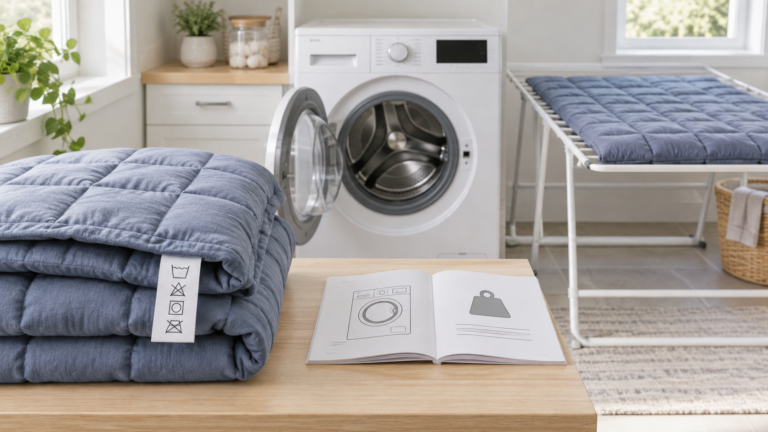
How to Wash a Comforter Without Clumping or Overloading
Quick answer: If the comforter’s care label allows machine washing, wash it by itself in a washer large enough for the dry comforter to sit loosely instead of being packed against the drum. Follow the label and the exact washer manual for the cycle, temperature, detergent, and load limit. Before adding water, confirm that you also have a label-approved way to dry the comforter completely. Use a suitable commercial-size machine when the comforter is cramped at home, and choose professional care when the label requires it or the shell and seams are damaged.
If the washer begins violent banging, repeatedly stops for imbalance, leaks, smells hot or burnt, smokes, or shows an electrical problem, stop the cycle through the controls only if you can reach them safely from a dry area. Do not touch wet controls, plugs, or cords, or approach smoke or sparking; keep away and get qualified help to isolate power. Keep your hands out of a moving drum and follow the appliance manual or arrange service.
Updated October 22, 2026: Added a recovery route for a water-filled or locked washer, safer handling of a saturated comforter, and clearer decisions for damp or displaced filling. The dry-access electrical precautions clarified on October 10 remain in place.
Already partway through a wash? Use the interrupted-cycle check. After washing, use the drying-result decisions before putting the comforter back on the bed.
Choose the cleaning route before the comforter gets wet
A comforter that barely fits while dry will be heavier and harder to reposition after it absorbs water. Decide where it belongs before starting a cycle.
| What you find | Best route | Why |
|---|---|---|
| The label permits machine washing, the shell and quilting are intact, the comforter fits loosely in the washer, and the approved drying method is available | Wash at home | The item can move through the wash and drying stages without being forced into undersized equipment |
| The label permits machine washing, but the comforter is cramped in the home washer or cannot tumble freely in the dryer | Use a suitable commercial-size washer and dryer | Larger equipment may provide the room the item needs; the comforter label and machine instructions still control the settings |
| The label says dry clean or professional clean, the care instructions are missing or unclear, the shell is torn, seams are opening, or the fill is migrating | Use professional textile care or contact the comforter manufacturer | A generic wash routine cannot resolve a label conflict, delicate construction, or existing damage |
| The label permits air drying, but there is no supported, ventilated place where the whole comforter can dry completely | Delay the wash or use professional care | Washing without a workable drying route can leave moisture trapped inside the fill |

This route check matters more than the printed bed size. Two king-size comforters can differ in loft, fill, construction, and wet weight, and two washers with similar-looking drums can have different approved loads and cycles.
Read the comforter label and the washer manual together
The care label answers what the bedding manufacturer permits. Look for the allowed wash method, water temperature, drying method, and any restriction on bleach, softener, or professional cleaning. If the label is unreadable, do not replace it with a rule from a different comforter.
The washer manual answers what the appliance can safely handle. Samsung notes that cycles and settings vary by model and directs owners to the exact manual. Its general cycle guidance identifies a Bedding cycle for blankets and comforters, but that does not mean every machine has the same cycle or load limit. A Delicate cycle is not automatically a substitute for a Bedding or Bulky cycle unless the comforter label and appliance manual support that choice.
Manufacturer capacity figures also need their original scope. Maytag and Whirlpool discuss large-capacity equipment in their comforter guides, while Samsung gives model-family load guidance. These numbers are useful examples, not a universal threshold for every washer. The reliable question is whether the exact machine manual allows the load and the comforter remains loose enough to move.
Inspect the comforter while it is dry
- Remove a detachable duvet cover. Wash the cover according to its own label. Its fabric and care instructions may differ from the insert.
- Check the outer shell. Look for tears, thinning fabric, holes, or areas where fill is escaping.
- Follow the quilting and seams. Loose stitching can open farther in a wash cycle. Maytag advises repairing tears or loose seams before washing.
- Feel for displaced fill. A section that is already empty, compacted, or badly clumped may not recover in a normal wash.
- Identify stains without inventing a treatment. Use only a pretreatment allowed by the comforter label and the treatment product’s directions. A product that is safe for a washable cotton shell may not be suitable for down, wool, silk, dye, or a special finish.
Do not put a visibly damaged comforter into a washer simply because the label once allowed machine washing. Professional care or manufacturer advice is the safer route when the construction is already failing.
Check the washer and dryer fit before loading
Place the dry comforter in the empty washer without pushing it down. It should not need to be compressed into the drum. Maytag and Whirlpool say bulky bedding needs room to move, and Samsung warns that crowding or overloading can reduce performance and cause other problems.
Then check the dryer. A comforter that fits in the washer may still be too large for the home dryer to tumble freely. If the label permits machine drying but the item fills the dryer with little room to move, plan to use a suitable commercial dryer instead. If the label requires air drying, identify a supported, ventilated surface or rack before washing.
Do not use the wash cycle as a test of whether the machine is big enough. Once the comforter is wet, it is heavier and more difficult to move to another machine.
How to machine-wash a machine-safe comforter
These steps apply only when the comforter label and washer manual both permit the load.
1. Load it by itself
Place the comforter loosely and as evenly as the washer design allows. Do not add sheets, towels, pillows, or another bulky item just to fill empty space. Samsung’s bedding guidance recommends washing a comforter separately, and a separate load leaves more room for the item to move.
For a top-loader with a center agitator, use only the loading method allowed in that model’s manual. Do not wrap, knot, or force the comforter around the post.
2. Use only label-compatible laundry products
Use the detergent type and amount supported by the comforter label, detergent directions, and appliance manual. Maytag, Whirlpool, and Samsung generally recommend a mild detergent for washable comforters, but none of that overrides a specific product label.
Skip improvised chemical mixtures. Do not add chlorine bleach, oxygen bleach, fabric softener, scent boosters, stain removers, or dryer sheets unless the comforter instructions and the product label permit that use. Never mix bleach with ammonia, acids, vinegar, alcohol, or an unknown residue.
3. Select the supported cycle and temperature
Choose the comforter label’s temperature and the closest appliance-manual cycle intended for the material and bulky load. Depending on the machine, that may be called Bedding, Bulky, Bulky Items, or something else. Do not assume the Normal or Delicate cycle uses the water level, motion, spin, or load sensing that the machine manufacturer intends for a comforter.
An extra rinse can help remove detergent when the care label and machine allow it; Maytag, Whirlpool, and Samsung include additional rinsing in their general comforter guidance. It is an option, not permission to ignore an overloaded drum or use excessive detergent.
4. Pay attention to the first part of the cycle
Normal movement depends on the machine, so use the manual rather than comparing it with another washer. Stop through the controls only when access and controls are dry and safe if the machine bangs violently, walks, repeatedly pauses for imbalance, leaks, or gives a hot or burning odor. Do not approach a wet electrical area, smoke, or sparking; get qualified help instead. Wait for all movement to stop and for the door or lid to unlock normally before opening it. Never force the lock or bypass an interlock.
Attempt a redistribution only after normal, safe access is available and the manual permits it. If one careful redistribution does not resolve the imbalance, do not keep restarting the same bulky load. Use the recovery route below before considering a different machine. A leak, burning smell or electrical warning is not a reason to retry.
If the drum is full or the door stays locked
A stopped cycle does not mean the comforter is ready to lift out. LG identifies high water and high temperature as reasons its washer doors stay locked. That explains a possible safety lock, not the correct button sequence for every brand.
- Water remains or the lock is still engaged: use only the exact manual’s cancel/drain procedure, and only with dry, safe access and no leak, smoke, burning smell or electrical warning. Let hot water and the load cool as the manual requires. Do not tug the door, reach into a moving drum or open a filter cap to empty a full tub.
- It will not drain or unlock normally: stop repeating cycles. Use the full-tub and locked-door drainage guide for the safe next branch, or contact model-specific service. An emergency hose or filter exists on some machines, not all; this comforter guide does not authorize opening one.
- It has drained, stopped and unlocked normally: open only when it is safe to do so. Support the wet comforter across its body into a suitable nearby container rather than hauling on a corner or seam. If it is too heavy to handle safely, get assistance; do not drag it across a wet floor, wring it forcefully or keep restarting spin cycles to make lifting easier.
Contact the textile cleaner or laundry service before transporting a saturated item, and explain the fill, care label and interrupted cycle. Confirm that they can accept it and complete the approved drying route. A larger machine is a future route only after safe unloading—not permission to force the door or carry a waterlogged load by yourself.
5. Unload promptly and inspect
Support the wet comforter rather than pulling it by one corner or seam. Check for detergent residue, opened stitching, escaped fill, or an area that never became wet. Dry patches after a completed cycle can indicate that the item was too cramped to wash effectively; Samsung specifically notes that overstuffed bulky items may not tumble or receive water properly.
If the care label and washer allow another rinse, use it for remaining detergent. Do not add more detergent or a second cleaner to solve residue.
Drying is part of the wash decision
A clean shell does not mean the inner fill is dry. Whirlpool and Maytag both emphasize complete drying, while Samsung recommends low or cool drying for several washable comforter types and periodic repositioning. The comforter label remains the deciding instruction.
If the label permits machine drying
Use a dryer large enough for the comforter to tumble rather than remain wedged against the drum. Select only the heat level and cycle permitted by the care label and dryer manual. Maytag and Whirlpool generally recommend low or no heat in their comforter guides, but a general recommendation does not replace the tag.
Pause at intervals to redistribute the comforter if the label and dryer instructions allow it. Wait for the drum to stop and handle the load only when it is cool enough to do so safely; do not pull bedding from a turning drum. Optional wool dryer balls or clean tennis balls appear in several manufacturer guides, but they are not required for every comforter. Do not add them if the care instructions prohibit them, the shell is fragile, or the dryer manual advises otherwise.
When the cycle ends, check several parts of the comforter—not just the outer fabric. Feel along the center, corners, quilting channels, and any thicker clumps. If a section is damp, unusually heavy or difficult to assess inside a clump, do not assume a dry shell means dry filling. Use the approved drying route or ask the manufacturer or textile cleaner how to finish it safely; coolness or a clump alone is not a reliable moisture measurement. Do not put the comforter back on the bed or into storage until the fill is dry throughout.
If the label permits air drying
Use a clean, supported surface or comforter rack with airflow around as much of the item as possible. Reposition it as needed so folded layers do not stay damp. Do not suspend a waterlogged comforter from one narrow corner or weak seam.
If the item is too heavy to move safely when wet, or the weather and indoor conditions cannot dry the fill promptly, use professional care instead of leaving it damp for an extended period.
How fill and construction change the route
The fill name is a clue, not the complete instruction.
Down and feather
Some down comforters are machine washable; others have manufacturer-specific requirements. Samsung’s general down guidance uses a Bedding cycle, mild detergent, extra rinsing as needed, low-heat drying, and periodic repositioning. Sleep Foundation recommends a roomy front-loading washer and down-safe detergent for washable down products. Follow the actual tag, because shell fabric, stitching, treatments, and fill construction still vary.
Polyester or down alternative
Many polyester-filled comforters are washable, but the heat limit and detergent restrictions still come from the label. Crowding can prevent rinsing, and high heat can affect some shells or fills. Use the machine-fit and drying-route checks rather than treating “polyester” as automatic permission.
Cotton-filled comforters
Cotton fill and cotton shell fabric can shrink under conditions not permitted by the manufacturer. Samsung’s general cotton and linen bedding guidance calls for cool or cold water and a Bedding cycle, but that guidance does not override a different tag. Give the comforter enough room and follow its drying limit.
Wool, silk, decorative, or unknown construction
Maytag warns that wool or silk comforters can be damaged in a washer and are better left to professional care. Embroidery, glued decoration, delicate trim, unknown fill, and an unreadable label also remove the basis for a generic machine-wash recommendation. Ask the comforter manufacturer or a qualified textile cleaner before adding water.
When the result does not look right
- Detergent remains: Use only a rinse permitted by the care label and washer manual. Do not add another cleaning product.
- The fill is clumped and still damp: Gently reposition only if the shell and quilting are sound and the care instructions permit it. Continue only with an effective, label-approved drying route. If thick areas are not drying, stop repeating the same setup and ask the manufacturer or a textile cleaner for help. Do not increase the heat beyond the label.
- The shell is dry but you cannot confirm the filling is dry: Do not use or store it yet. Check the center, corners and thicker sections, not just the shell. Finish drying by an approved route or get textile-care advice; do not seal a damp comforter in storage.
- A seam opens or fill escapes: Stop handling the item by that area. Do not continue tumbling it while the construction is failing.
- The washer repeatedly loses balance: Stop repeating the cycle and follow the interrupted-cycle check above. Consider a larger suitable machine or professional service only after safe unloading.
- A musty odor remains after drying: Do not store or use the comforter until you confirm that the fill is completely dry. If the odor persists when dry, ask the manufacturer or a textile cleaner about the material-safe next step.
If the comforter is dry throughout but the filling remains displaced, a section is empty, or the quilting has broken, more heat is not a repair. Follow the maker’s approved fluffing or repair advice, or ask a textile professional. Do not pull hard on the shell or assume another wash will restore damaged construction.
Make the next cleaning easier
Use a removable duvet cover when the comforter design supports one, and wash the cover according to its separate label. Address spills before they spread through the shell, and store the comforter only when it is clean and fully dry. Keep the care label attached or photograph it before the printing fades.
For other bulky bedding, use the separate guides for washing a weighted blanket and washing pillows in a washing machine. If ordinary clothing loads—not only this bulky comforter—also take unusually long to dry, use the dryer airflow checks rather than repeatedly heating the comforter.