How to Fix a Washing Machine That Is Not Draining
If your washing machine is not draining, stop the cycle and start with the safest checks: confirm the cycle and error code, disconnect power before reaching behind the machine, inspect the external drain hose for a kink or crush point, and then follow your model’s instructions for any filter or emergency drain access. Do not assume every washer has the same filter, hose setup, or user-serviceable parts.
For more practical laundry troubleshooting, browse the Home Answer Desk library.
Last updated: September 13, 2026 — Added a symptom-based washer drainage diagnostic to help readers choose the safest next check.
START WITH WHAT THE WASHER DOES
What happens when the washer should drain?
Choose the closest symptom for a safe starting point. The exact drain path, filter access, and error codes depend on the model.
Choose a symptom to see the safest next step.
First, identify the symptom
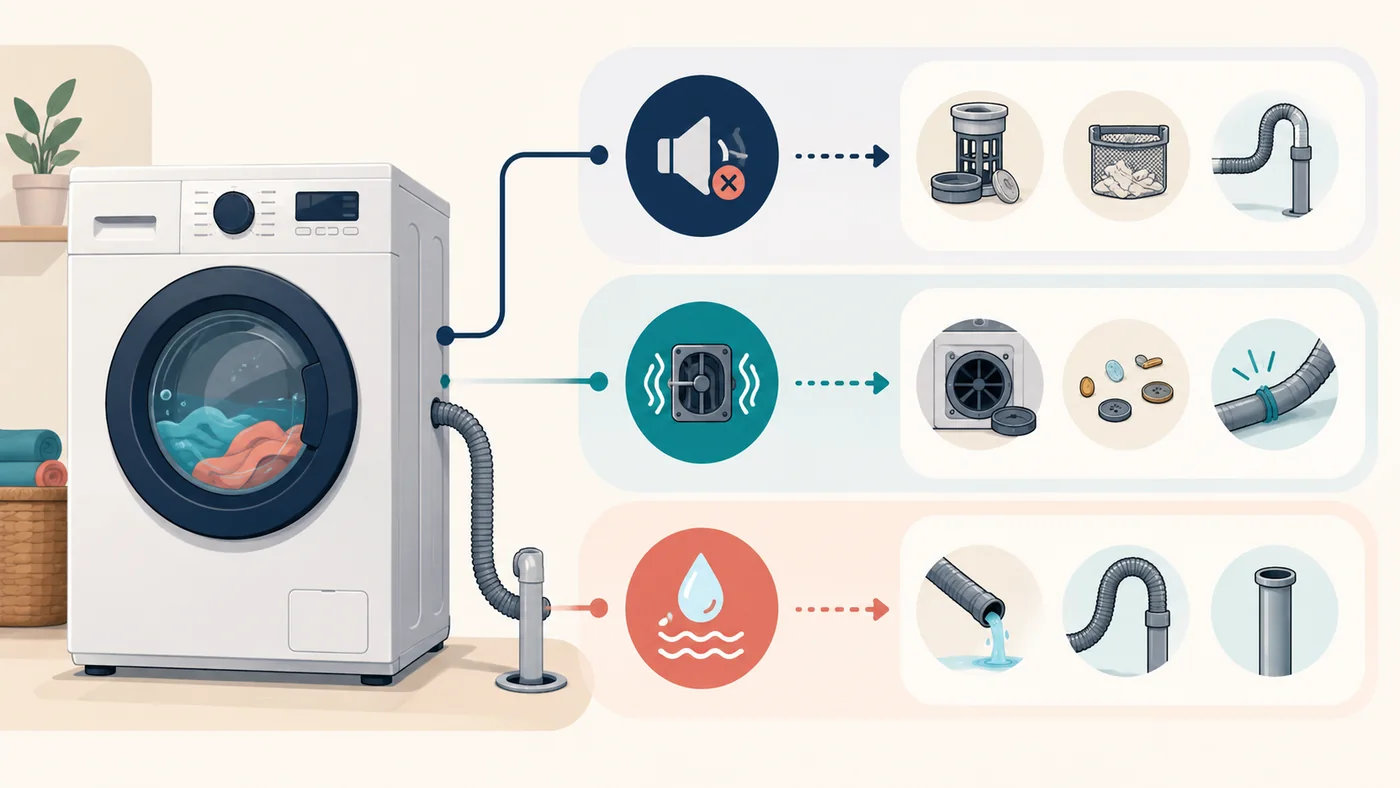
The sound and timing of the problem can point you toward the next safe check. Use this table as a guide, not as a diagnosis of a specific part.
| Symptom | Likely area | Next safe check |
|---|---|---|
| The tub is full and the pump is silent | A cycle, lid/door, control, or electrical issue | Confirm the cycle and error code; stop if wiring or power looks unsafe |
| The washer hums but water does not move | A restriction or a pump that is struggling | Isolate power and inspect only the model-approved drain path |
| Water leaves very slowly | A kink, blockage, filter, or standpipe problem | Check the external hose, then use the manual for filter instructions |
| The washer drains but clothes remain very wet | A spin, load-balance, or partial-drain problem | Check whether the machine completed drain and spin and whether the load is balanced |
| Water remains behind a locked front-load door | Residual water is still in the tub | Do not force the door; use the model’s emergency drain procedure if one is provided |
Before you touch the washer
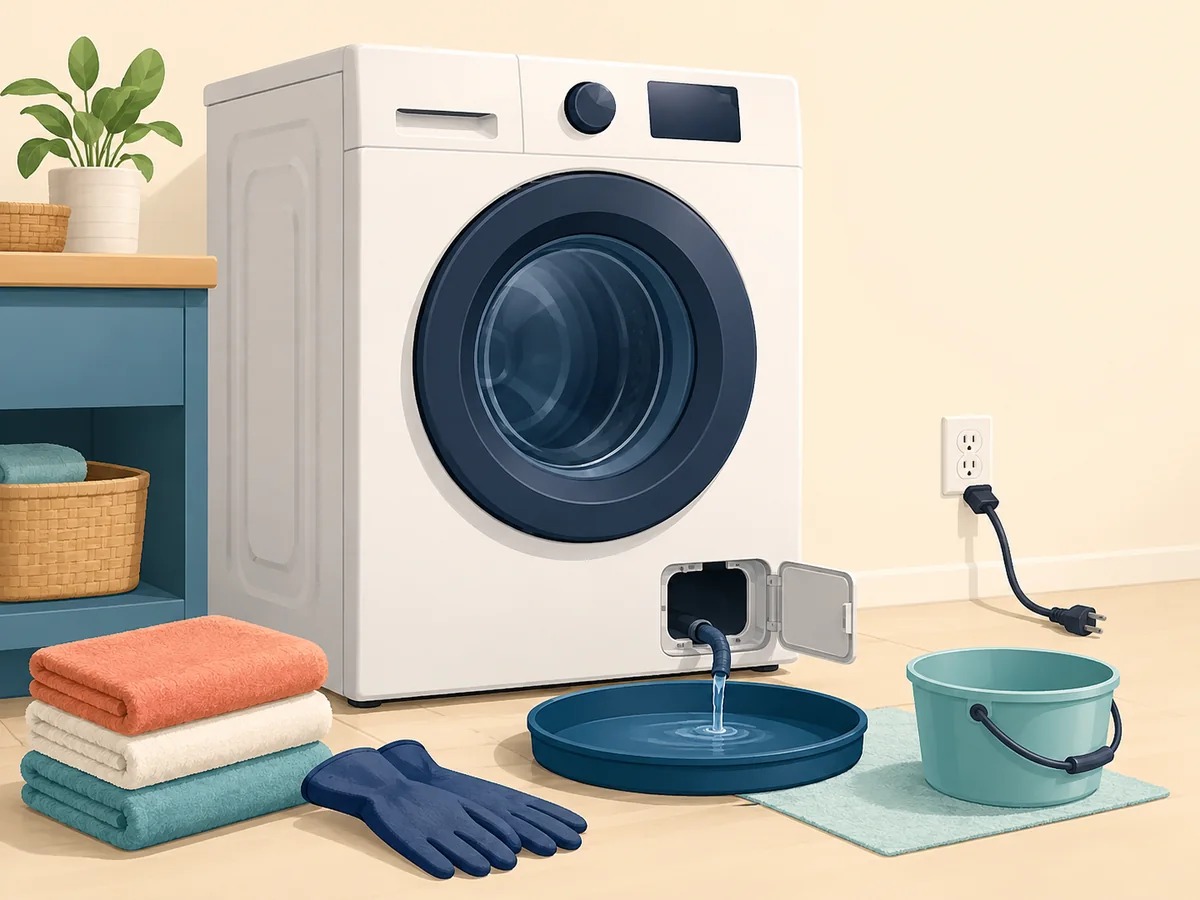
Take these precautions before opening an access flap or reaching behind the appliance:
- Stop the cycle and disconnect the washer from power. If you cannot safely reach the plug, turn off the appropriate circuit only if you know which circuit controls the appliance.
- Assume trapped water may be hot. Let it cool before draining it.
- Put towels on the floor and place a shallow pan or bucket where water can escape.
- Keep children and pets away from the work area.
- Record the model number and any error code. The correct filter location and drain procedure are model-specific.
If there is active flooding, a burning smell, sparking, damaged wiring, or water near an unsafe electrical connection, stop and arrange qualified service.
How to fix a washing machine that is not draining
1. Check the cycle, lid, and door
Before taking anything apart, check whether the washer is paused, waiting for a lid or door to close, or set to a soak or hold option. Look for a drain, pump, lid, door, or balance error. If the machine stopped with a full tub, do not repeatedly restart cycles until you have checked the safe drain path.
For a top-load washer, confirm that the lid closes and latches as the manual requires. For a front-load washer, do not pull on a locked door. A locked door may be protecting you from water still inside the drum.
2. Inspect the external drain hose
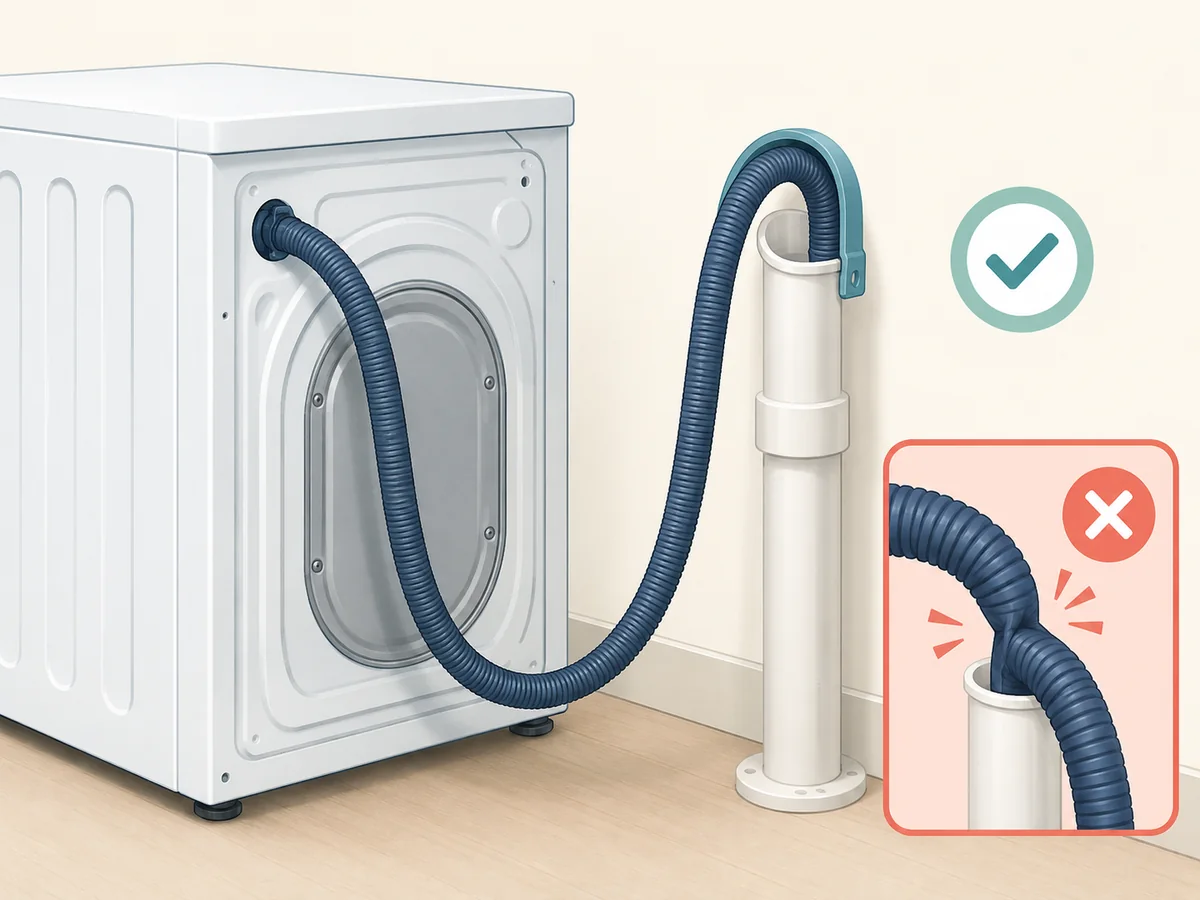
With power isolated, look at the hose behind the washer. Check for:
- a sharp kink;
- a crushed section where the washer is too close to the wall;
- a frozen section in an unheated area;
- a loose connection or visible leak; and
- a hose arrangement that does not match the installation instructions.
Hose insertion depth, standpipe height, and routing vary by model. Do not use a universal measurement from a different washer. Whirlpool’s product guidance, for example, treats hose placement as a model and installation question, while Samsung, LG, Bosch, and other manufacturers also direct owners to check for a kink or blockage in the drain path (Whirlpool, Samsung, LG, Bosch).
If the hose is visibly damaged, do not keep running the washer. A compatible replacement must match the appliance and connection type.
3. Follow the model manual for residual water and filter access
Some washing machines have a user-accessible pump filter or an emergency drain hose. Others do not, and the access point may be in a different location. Find the support page or manual for the exact model before opening a filter door or removing a hose.
If the manual identifies a user-accessible drain or filter:
- Keep the washer unplugged.
- Place towels and a shallow container below the access point.
- Open the emergency drain or filter gradually, following the manual’s sequence.
- Allow the water to drain into the container and move the container as needed.
- Inspect the approved filter area for lint, coins, buttons, or other visible debris.
- Refit the cap or filter exactly as the manual shows. A loose seal can cause a leak.
Electrolux and Beko both describe residual water handling and filter access as model-dependent steps, and both warn that water may escape when the drain or filter is opened (Electrolux, Beko).
Do not reach into an unknown opening, remove a pump cover that the manual does not identify, or force a filter that will not turn. Those actions can damage the appliance or expose you to water and moving parts.
4. Retry the drain or spin cycle only when the path is safe
After the hose or model-approved filter check, reconnect power only when the work area is dry and all covers, caps, and hoses are secure. Run the shortest drain or spin program allowed by the manual, and stay nearby.
Observe three things:
- Does water leave the tub at a normal rate?
- Does the pump sound normal, hum without moving water, or remain silent?
- Does the washer stop again with an error code, leak, or unusual smell?
If water drains normally but the clothes remain very wet, check whether the load was badly unbalanced or whether the washer completed the spin stage. Do not overload the drum while testing it.
5. Decide whether the problem needs service
A persistent humming sound, repeated failure after the hose and approved filter checks, a burning smell, damaged wiring, or a suspected control or pump fault is beyond a generic homeowner checklist. Use the manufacturer’s support route, especially if the appliance is under warranty.
Front-load and top-load differences
The basic decision path is similar, but the safe access points differ:
- Front-load washers: Water may remain behind a locked door. Do not force the door. Look for the model’s emergency drain and pump filter instructions, often behind a small lower access panel, but confirm the location for your exact model.
- Top-load washers: The drain path and lid interlock vary by design. Confirm that the lid closes and that the manual allows any user-accessible filter or hose check.
- Washer-dryer combinations: These may have additional residual water and drain instructions. Use the combination appliance’s manual instead of applying a standard washer procedure.
What not to do
- Do not assume every washing machine has a removable pump filter.
- Do not force a locked door or bypass a lid or door safety switch.
- Do not remove panels or reach into a pump without model-specific instructions.
- Do not work around exposed, wet, or damaged wiring.
- Do not pour drain chemicals into a washer to solve a mechanical blockage.
- Do not keep restarting a full washer when water is leaking or the pump is only humming.
When to call for service
Arrange qualified service when:
- water is actively flooding the floor or the leak returns;
- you smell burning or see sparks, melted insulation, or damaged wiring;
- the pump hums repeatedly but no water moves after the model-approved checks;
- the washer trips power or shows a recurring electrical or control error;
- the required panel or pump access is not explained in the manual; or
- the appliance is still under warranty and the problem persists.
If the drain hose disappears into a household standpipe and the washer’s hose is clear, the restriction may be in the household plumbing rather than the appliance. A plumber can assess that safely.
How to prevent another drainage problem
Follow the maintenance instructions for your exact washer. Useful habits may include keeping the drain hose correctly routed, avoiding loads that exceed the appliance’s capacity, checking an accessible filter at the interval the manual recommends, and responding to recurring error codes instead of repeatedly resetting the machine.
Do not use a generic filter-cleaning schedule or a universal hose measurement when the manufacturer gives different instructions.
Frequently asked questions
Why is my washing machine full of water but not draining?
The cause may be a kinked or blocked drain path, a filter or pump restriction, a cycle or lid/door issue, or a fault that needs service. Start with the cycle and external hose, then follow the exact model’s residual water and filter instructions.
Can I open a washing machine door when there is water inside?
Do not force a locked door. For a front-load washer, use the model’s emergency drain procedure if provided, or contact the manufacturer or a qualified technician.
Where is the washing machine drain filter?
There is no universal location, and some washers do not provide a user-accessible filter. Check the manual or manufacturer support page for the exact model before opening an access panel.
Why does my washer drain but leave clothes soaking wet?
The load may be unbalanced, the spin stage may not have completed, or the machine may still have a partial drainage restriction. Check the cycle result and load balance. If the symptom repeats, use the manufacturer’s troubleshooting path.
Should I replace the drain pump myself?
Only consider a pump replacement if the exact model’s service instructions, warranty status, and your skill level make that appropriate. Electrical testing and internal pump access are not universal homeowner steps. Service is safer when the cause has not been confirmed.
Sources
This article uses manufacturer support guidance for recurring causes, model-specific limitations, and safe residual water handling:
- Samsung: What to do when a washing machine does not fill or drain
- Whirlpool: How to fix a washing machine
- Whirlpool Product Help: Not draining — front-load washer
- Electrolux: How to drain a washing machine or washer dryer
- LG: Washing machine water not draining
- Bosch: Washing machine does not drain water
- Beko: How to fix a washing machine that will not drain