Dishwasher Not Draining? Find the Blockage Before You Call for Service
Quick answer
If your dishwasher has water left in the bottom, first look at the pattern. Water that remains immediately after a completed cycle often points to a blocked filter, debris in the sump, or a drain-pump problem. Water that returns later, or appears with a slow kitchen sink, can point to the sink connection, disposal, air gap, or drain hose instead. Do not pour drain-opening chemicals into the dishwasher, and do not remove a pump cover unless your owner’s manual specifically shows that procedure for your model.
If there is water near an outlet, damaged cord, or electrical parts, or if you notice heat, smoke, sparks, a burning odor, or a shock, stop using the appliance and arrange qualified service. Do not pull a hardwired dishwasher from the cabinet, open an electrical box, or test live wiring.
| What you notice | Safest first move | What that can point to |
|---|---|---|
| A small amount of water remains immediately after a completed cycle | Check the filter and visible sump area using your model manual | Food debris, labels, glass, or a restriction near the filter |
| A full pool stays after the cycle and you hear a hum | Stop after the safe filter check; do not force or dismantle the pump | A pump obstruction or pump failure that needs model-specific service |
| Water comes back after the dishwasher was empty | Check whether the sink, disposal, air gap, or hose route is also affected | A downstream drain or backflow problem |
| The issue began after a new disposal or dishwasher installation | Do not alter plumbing blindly | A missing disposal knockout-plug removal, hose-routing, or connection issue |
| The kitchen sink drains slowly too | Treat it as a sink/plumbing problem first | A shared drain restriction rather than only a dishwasher problem |
If the machine has a different primary symptom, use our Dishwasher Troubleshooting guide to choose the safest next check.
First, tell “water left behind†from water that returned
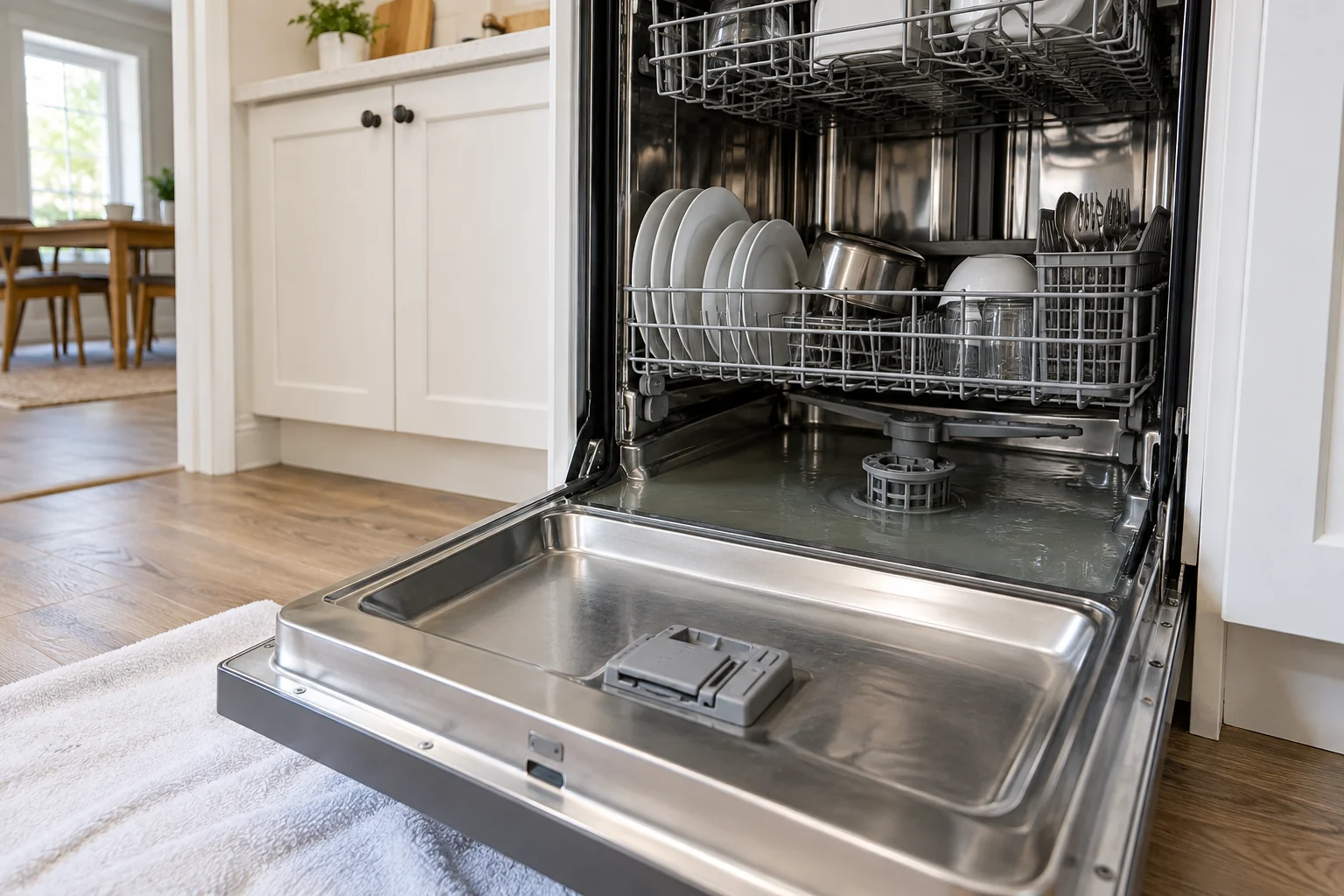
Open the dishwasher only after the cycle has stopped. If the machine never reached the end of its cycle, the water may be there because it did not get a chance to drain. Look for a displayed code, flashing light, or an interrupted cycle before you assume there is a clog. Use the reset or cancel-and-drain sequence in the owner’s manual for your exact model; button sequences vary by brand and model.
If a completed cycle leaves water in the tub every time, start inside the dishwasher with the filter. If the dishwasher seems empty at first but water later reappears, look beyond the tub. A blocked sink drain, a disposal connection, an air gap, or an incorrectly routed drain hose can allow wastewater to back up toward the dishwasher.
This distinction matters. Repeatedly running another cycle may not clear a downstream backup, and pulling the appliance apart will not fix a slow kitchen drain.
Make the area safe before inspecting it
Keep towels at the front of the appliance and remove standing water with a cup, small container, sponge, or hand pump if you need to see the filter area. Dispose of the wastewater in a working sink or toilet. Avoid drain-opening chemicals, dishwasher detergent, bleach, vinegar mixtures, and improvised cleaners in the drain path. Whirlpool specifically warns that drain-opening chemicals can damage dishwasher components and create safety hazards.
Before reaching into the tub, turn the dishwasher off at its controls. If you need to remove a filter, check the model manual first. Some filters twist out; others are self-cleaning or have a different access arrangement. Wear gloves if you are looking for broken glass, sharp plastic, bones, or other debris, and do not reach into an area you cannot see clearly.
Check the filter and the visible sump area
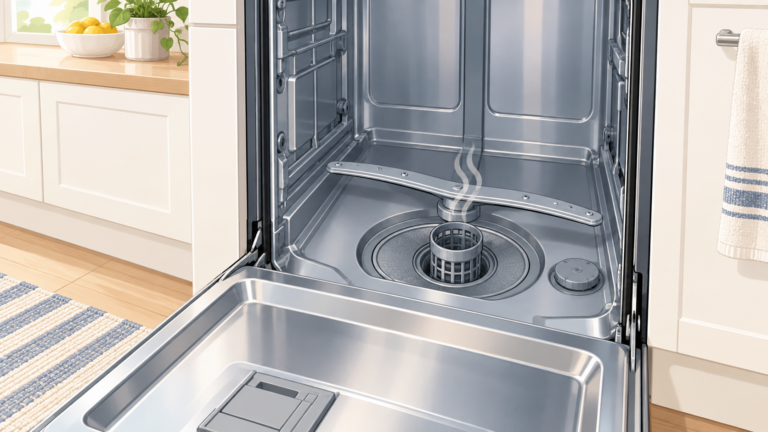
On many modern dishwashers, the filter sits near the bottom center of the tub, below the lower rack. Bosch and Whirlpool both direct owners to use their model-specific instructions, remove the accessible filter, rinse it with water, and clear visible debris before reinstalling it correctly.
- Remove the lower rack and locate the filter using the owner’s manual.
- Remove only the parts the manual identifies as owner-removable.
- Rinse the filter under warm running water and use a soft brush for residue. Do not use an abrasive pad on fine mesh.
- Shine a flashlight into the accessible area around the filter. Remove only loose, visible debris that you can safely reach.
- Reinstall and lock the filter exactly as the manual shows.
- Run one short, model-approved rinse or drain test and see whether the water clears.
If you find standing water but the filter is clean, do not assume the pump is bad. A restriction can also be in the hose, sink connection, or disposal. If the manual does not show a pump-cover removal procedure, leave that part in place.
For related cleaning symptoms, see our guide to a dishwasher not cleaning dishes. It covers filter care, spray-arm checks, loading, and detergent issues that can affect wash results without causing a drain failure.
Check the sink, disposal, air gap, and hose route
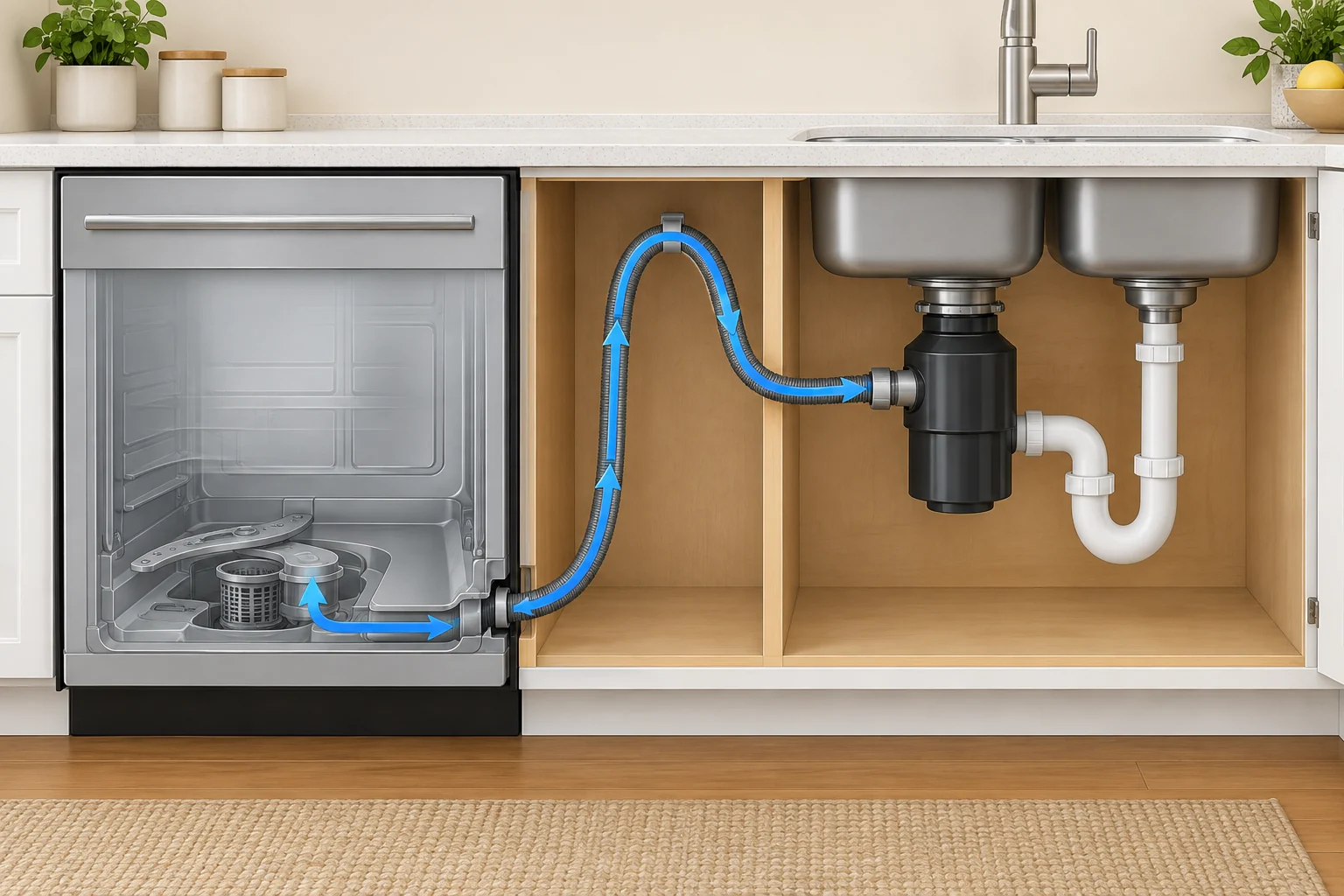
The dishwasher drain path usually runs from the sump through a hose to the sink plumbing or garbage disposal. The hose should rise high under the counter in a high loop, unless your installation uses a working air gap. That routing helps keep dirty sink water from flowing back toward the dishwasher.
Look under the sink without disconnecting anything. Check for a hose that is crushed by stored items, sharply kinked, loose, or hanging low. If you see an air-gap fitting near the faucet, check the manufacturer’s instructions for cleaning it; designs vary. If the hose is damaged, leaking, or its route is not clear, do not pull the dishwasher out to investigate. Schedule appliance or plumbing service.
If your dishwasher drains through a garbage disposal, make sure the sink and disposal drain normally. Do not put a hand or tool inside the disposal. A new disposal can also create a special problem: the installer may not have removed the knockout plug where the dishwasher hose connects. That is a common reason a newly installed dishwasher will not drain, but it is best handled by the installer, a plumber, or an appliance technician if you are not certain how the connection is configured.
If you find water under the dishwasher or around the hose connection, do not continue running cycles. Use our guide to a dishwasher leaking from the bottom to identify the leak location safely.
Use the water pattern to decide what comes next
| Pattern after you clean the accessible filter | What to check next | Do not do |
|---|---|---|
| Water drains after a filter clean | Return to regular filter care and watch the next few cycles | Treat one successful cycle as proof that every drain-path issue is solved |
| Water drains slowly, while the sink is normal | Look for a visibly kinked or compressed hose under the sink | Push sharp wire, hangers, or drain-opening chemicals into the hose |
| Water returns after the tub initially empties | Check for a slow sink, disposal connection issue, air-gap blockage, or poor hose route | Keep restarting the dishwasher to “flush†a shared drain backup |
| The pump hums but water does not move | Stop after the manual-supported filter/sump check | Force the impeller, dismantle the pump, or run repeated cycles |
| The problem began with a new disposal or remodel | Ask the installer to verify the dishwasher connection and knockout plug | Drill, pry, or disconnect plumbing unless you understand the installation |
When a drain problem needs service
Arrange qualified appliance service when the dishwasher still will not drain after the owner-manual filter check and the visible under-sink hose and sink checks. A technician can diagnose a blocked or failed pump, check valve, wiring, sensor, or control issue using the correct model information.
Call a plumber or the installer instead when the kitchen sink is also slow, water backs up from the disposal or drain, the dishwasher connection was recently changed, or you cannot verify the hose route. Those signs may be outside the dishwasher itself.
- A shock, hot outlet, damaged cord, smoke, sparks, or a burning smell.
- Water near electrical parts or a leaking connection you cannot safely isolate.
- A breaker that trips again after a single reset.
- A damaged hose, cracked fitting, or persistent water leak.
- A pump-cover, panel, or electrical test that the owner’s manual does not identify as an owner task.
Prevent another drainage problem
Scrape large food scraps and remove paper labels before loading dishes. Check the filter on the schedule in your owner’s manual, especially if the dishwasher runs daily. Keep the under-sink cabinet from pressing on the drain hose, and check the hose route after plumbing work or a disposal replacement.
If the dishwasher starts but does not wash, use our guide to a dishwasher not starting for power, door, control-lock, and code checks. Drainage is a separate symptom, and matching the page to what the appliance actually does saves time.