Dishwasher Not Filling With Water? Start With What the Cycle Actually Does
Quick answer
If your dishwasher seems to run but the tub stays dry, do not begin by assuming the inlet valve has failed. First decide what the machine actually does: it may not be starting, it may be unable to refill because water is still inside, or it may be taking in water and then losing it through the drain path. Check only the accessible basics that match the pattern—door/start status, the water supply valve, and visible hose condition. Stop if the next step would mean opening panels, testing wiring, or changing plumbing.
If water is near an outlet, cord, or electrical part, or you notice heat, smoke, sparks, a burning odor, or a shock, stop using the dishwasher and arrange qualified service. Do not pull out a hardwired appliance or test live electrical parts.
First, identify the water pattern
| What you notice | Safest next step | Likely direction |
|---|---|---|
| Nothing happens when you start a cycle | Check power, door, lock, delay, and model-specific controls | This is a start problem, not yet a fill problem |
| The cycle begins, but the tub stays dry | Check the door/start-resume state, accessible supply valve, and visible hose condition | Water may not be reaching the dishwasher |
| Water appears and then disappears | Check the installation manual or installer for the drain-route setup | The tub may be siphoning or reacting to a model-specific fault |
| Water from a prior cycle remains in the bottom | Start with the drain path and filter guidance | A drainage problem can prevent a new fill |
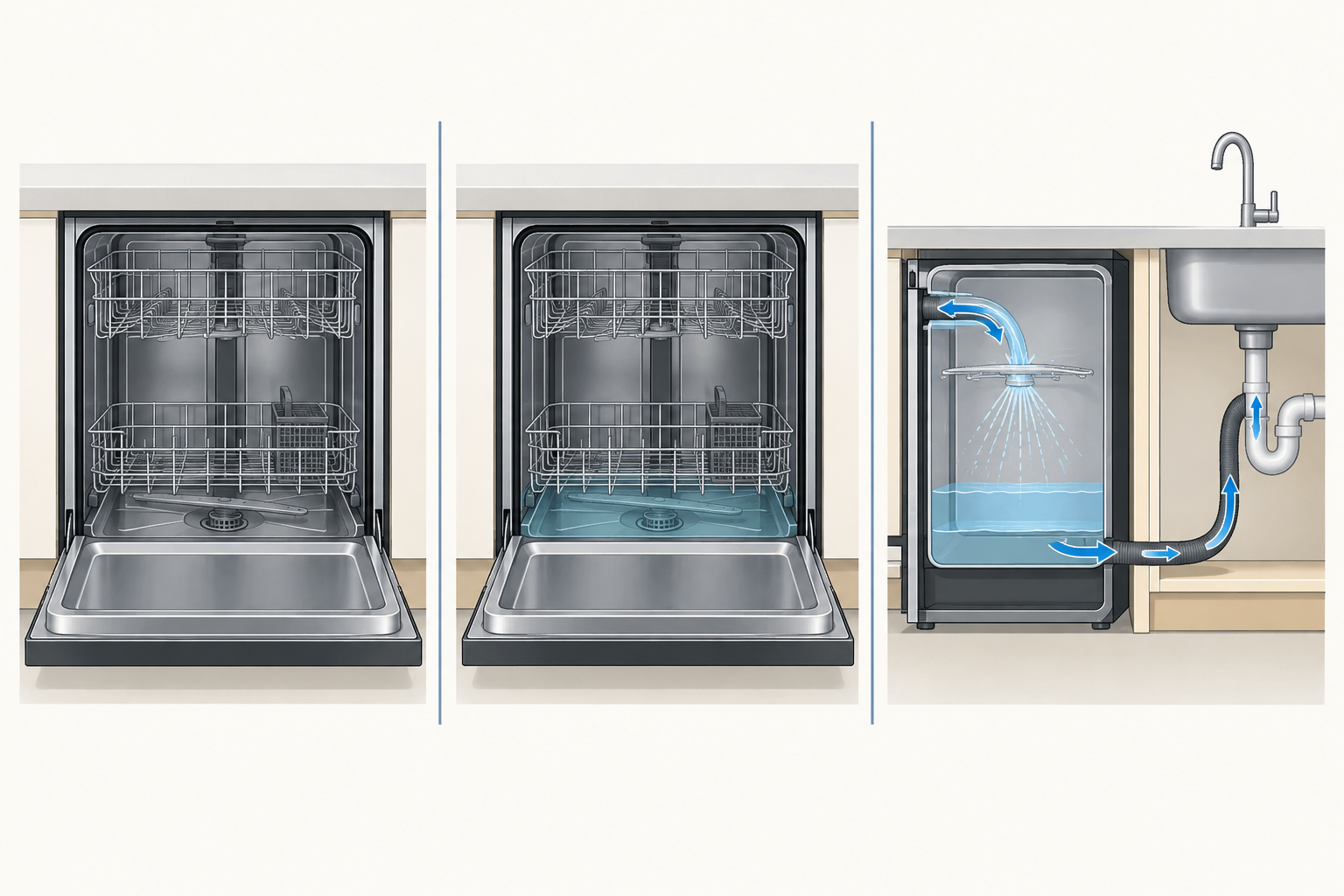
The key detail is whether water is absent from the beginning or whether it was there and has gone somewhere. Whirlpool lists a closed supply valve, an interrupted door/start-resume state, and an improperly routed drain hose as possible no-fill causes. GE also notes that poor drainage can prevent a dishwasher from refilling. Whirlpool Product Help | GE Appliances
If the dishwasher does not start, use the right guide first
A dark control panel, a cycle that never begins, a lock indicator, a delayed start, or a door that will not latch can make a dishwasher look like it has a water problem when it has not tried to fill at all. Use our guide to a dishwasher not starting for those checks. It is safer and more useful than searching for a water valve or moving the appliance before you know the cycle is actually running.
If the control panel is on and the machine begins a cycle but no water enters, continue below.
Check the door and start/resume state
Some dishwashers pause if the door is opened or does not latch fully. A flashing start/resume light can also mean the model is waiting for its documented resume step. Close the door firmly, remove any item blocking it, and follow the exact start or resume instructions in your owner’s manual.
Do not bypass a door latch, tape down a switch, or remove the door panel. A latch, wiring, or control problem needs model-specific service when the manual-supported check does not restore normal operation.
Check the accessible water supply valve
The dishwasher’s supply shutoff is often under the kitchen sink. Without moving anything that is hard to reach, look for a valve that is visibly turned off, a supply line that is obviously pinched, or water around a fitting. Turn a valve only if you can identify it confidently and it moves normally; do not force a stiff or corroded valve.
Bosch and Maytag both list the supply valve and visible hose condition as early checks. A weak kitchen-faucet stream can also be a reason to stop and have the water supply assessed rather than trying to diagnose the dishwasher from inside the cabinet. Bosch support | Maytag
If a connection is wet, damaged, or inaccessible, do not run another cycle. Dry the exterior area without touching electrical parts and arrange appliance or plumbing service as appropriate.
Do not confuse a no-fill symptom with water left in the tub
If there is standing water at the bottom before a new cycle begins, the dishwasher may be unable to start its next fill as expected. GE identifies drain issues as one reason this can happen, and its advice varies by model. Use our dishwasher not draining guide for safe filter, sink-connection, and visible-hose checks.
Do not pour drain-opening chemicals into the dishwasher. Do not force a pump, remove a pump cover, or push wire into a hose unless your exact manual explicitly identifies that as an owner procedure.
If water enters and then disappears
If you see water enter but the tub does not keep it, the drain arrangement may need to be checked against the dishwasher’s installation instructions. Whirlpool says a drain hose that is not routed as required can let a dishwasher siphon water away. The correct route depends on the model and the existing sink or disposal installation, so this is not a good place for a universal plumbing instruction. Whirlpool Product Help
Look under the sink only for an obvious crushed, loose, or damaged hose. Do not pull out the dishwasher, disconnect plumbing, or change the hose route blindly. If the symptom began after installation, a disposal replacement, or other plumbing work, ask the installer, a plumber, or an appliance technician to verify the connection.
What about the float, inlet valve, and control board?
These parts can be involved, but they are not safe first guesses. The float location and owner-access level vary by model. GE says some newer models have a flood float an owner can check, while other models require service for a float concern. A blocked or failed inlet valve, door wiring fault, sensor issue, or control issue also needs model-specific diagnosis. GE Appliances
Use the owner’s manual only if it specifically shows a check that is intended for the owner. Stop before removing toe-kick panels, disconnecting hoses, measuring electricity, or attempting to clean a hidden inlet screen. If the dishwasher still does not fill after the external checks, service is the sensible next step.
When the real issue is wash quality, not filling
If water enters and the cycle completes but dishes remain dirty, gritty, or covered in detergent residue, that is a different diagnosis. Start with our dishwasher not cleaning dishes guide for the filter, spray arms, loading, detergent, and cycle selection. Replacing a water-related part will not solve every cleaning problem.
Get service now if any of these apply
- Water is near an electrical outlet, cord, or wiring.
- You notice heat, smoke, sparks, a burning smell, or a shock.
- A supply connection leaks or the shutoff valve will not move normally.
- The dishwasher needs a panel removed, wiring tested, or a valve/float component serviced.
- A new installation or recent plumbing change appears to be involved.
- The dishwasher has a model-specific error code that the manual directs to service.
Sources
- Whirlpool Product Help: Not Filling With Water – Dishwasher
- GE Appliances: Dishwasher – Not Filling with Water
- Bosch support: My dishwasher is not filling with water
- Maytag: How to Fix a Dishwasher That’s Not Filling With Water
If the water behavior is confusing or more than one symptom is present, return to the Dishwasher Troubleshooting guide for the safest starting route.