Dryer Smells Like Burning? Stop First, Then Match the Clue
Quick answer
If your dryer smells like burning, stop the cycle. Do not keep it running to see whether the odor clears. Smoke, flame, a gas odor, a sharp electrical smell, scorching at the plug or outlet, or a breaker that trips all require an immediate stop and professional help. When none of those danger signs is present, the safest clues are what the odor resembles, when it starts, and what changed in the same cycle.
If you see smoke or flame, leave the home and call 911 from outside. If a gas dryer is smoking or you smell gas, get everyone outside and do not operate switches, plugs, breakers, appliances, or phones inside the building.
Match the burning smell before you touch anything
Let the dryer cool while it remains off. Do not pull it away from the wall, reach behind it, open a panel, or touch a hot cord, plug, outlet, cabinet, or vent. If the power connection is dry, undamaged, cool, and safely reachable, follow the manual’s shutdown instructions. Otherwise, keep your distance and call qualified help.
| What you notice | What it may point to | Safest next step | Do not restart when |
|---|---|---|---|
| Smoke, flame, or a strong worsening burnt odor | Active fire or severe overheating | Leave and call 911 from outside | Always; the dryer needs professional inspection after the emergency |
| Rotten-egg or sulfur-like gas odor near a gas dryer | Possible fuel-gas leak, not an ordinary dryer odor | Leave without operating anything electrical; call emergency services or the gas utility from outside | Always, until the gas system is declared safe |
| Sharp electrical or melting-plastic odor | Cord, outlet, connection, wiring, motor, control, or heating fault | Leave the dryer off; arrange appliance service and possibly an electrician | The plug, outlet, cord, cabinet, or breaker shows heat, damage, sparking, or repeated tripping |
| Hot lint, singed fabric, or dusty burnt odor with slow drying or very hot clothes | Restricted airflow, lint buildup, a blocked vent, or an unsuitable load/setting | After cooling, clean the normal lint screen and inspect only the visible exterior vent route described below | The odor was strong, airflow is weak, the cabinet or load became unusually hot, or the smell returns |
| Rubber-like odor with squealing, scraping, humming, or a drum that stops | Belt, pulley, roller, motor, or another moving part may be overheating | Stop and arrange model-specific service | The noise or smell repeats, the drum struggles, or access requires opening the cabinet |
| Odor appears with one item or one load | Melted pocket item, rubber-backed article, synthetic fabric on excessive heat, or oily/chemical contamination | Remove the load after cooling and inspect the drum and items in good light | Anything is melted, scorched, oily, chemically contaminated, or stuck beyond safe reach |
| Mild oily smell only on the first use of a new dryer | Shipping or manufacturing residue on some models | Check the exact manual or manufacturer support before following a break-in procedure | Smoke appears, the odor is electrical, it worsens, or it continues beyond the manufacturer’s stated period |
These clues narrow the next action; they do not confirm an internal failed part. A belt, motor, thermostat, wire, or heating component cannot be diagnosed safely from odor alone.
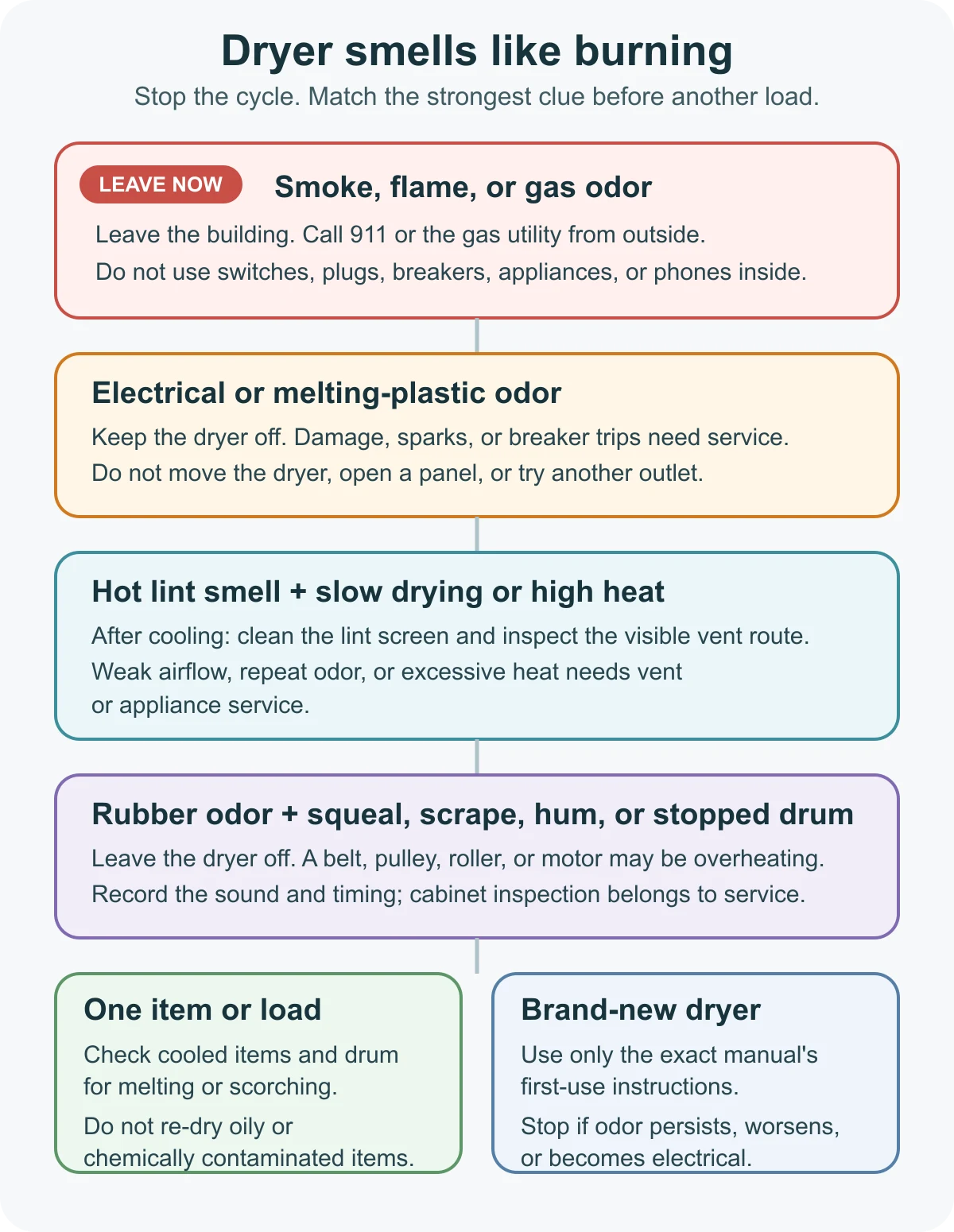
Smoke, flame, gas odor, or electrical odor: stop here
Samsung’s dryer guidance separates visible smoke, gas odor, burning odor, and electrical odor because they do not share the same response. It tells users to clear the building and contact emergency services when a gas dryer is smoking or gas is smelled. It also directs users to turn an electric dryer off and request service when there is visible smoke, and to shut off power and request service for an electrical odor.
Do not open the dryer door during a suspected active fire merely to investigate. Do not throw water on an electrical appliance fire. Once outside, give emergency responders the appliance type and tell them whether you smelled gas or saw smoke or flame.
If there is no smoke or gas odor but you see a darkened outlet, melted plug, damaged cord, sparks, or repeated breaker trips, leave the dryer off. Do not substitute an extension cord, power strip, adapter, or another outlet. The U.S. Fire Administration advises plugging major appliances directly into wall outlets and replacing equipment with cracked, damaged, or loose cords.
If the smell comes with slow drying or excessive heat
Restricted airflow is the first external route to consider when the burning odor appears with loads taking longer than normal, clothes coming out unusually hot, or weak exhaust at the outside hood. The U.S. Consumer Product Safety Commission explains that lint can block airflow, cause excessive heat buildup, and contribute to a dryer fire. Its guidance calls for regular cleaning of the lint screen, vent, and exhaust duct, plus a check that exhaust air reaches the outside.
After the dryer is off and cool:
- Remove the load. Look for a scorched item, melted pocket object, rubber-backed article, or fabric that was dried above its care-label temperature.
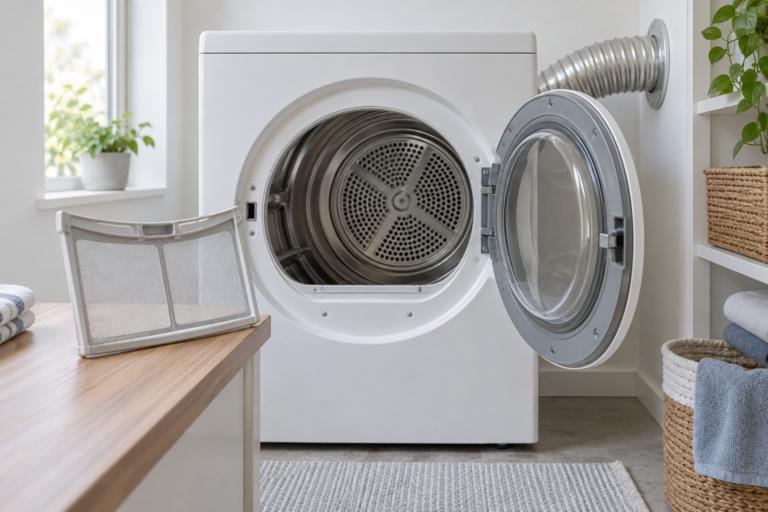
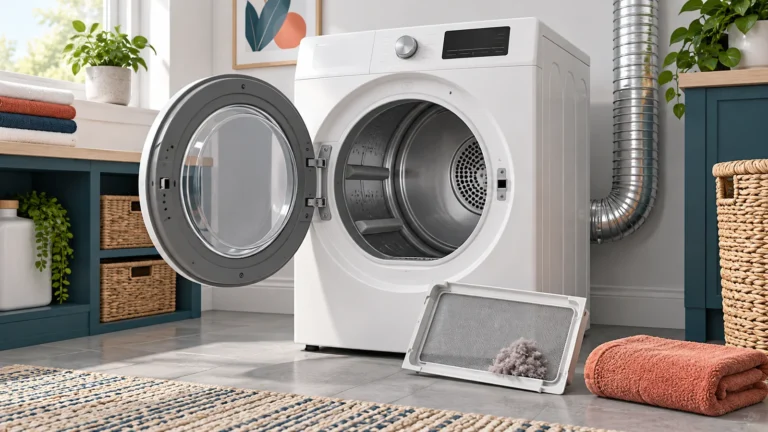
- Clean the normal lint screen. Use the model’s routine cleaning method. Do not run the dryer without the screen installed.
- Look at the accessible vent route. From outside the appliance, check for a crushed or sharply kinked transition duct and a visibly blocked exterior hood. Do not disconnect a gas line, move a heavy dryer alone, or reach behind a hot machine.
- Review the last few cycles. Longer drying time, repeated overheating, or an exterior flap that no longer opens normally strengthens the case for a restricted exhaust path.
Our dryer takes too long to dry guide explains the airflow clues in more detail. A clean lint screen does not prove the full exhaust route is clear. Long, concealed, roof-terminating, damaged, or inaccessible ducts should be inspected and cleaned by a qualified dryer-vent professional.
Do not run a test cycle merely to feel the outside airflow if the original odor was strong, electrical, worsening, or accompanied by smoke, damage, or unusual heat. A model-approved test makes sense only after the source has been identified, the dryer and area are safe, and the correction does not require cabinet or gas-system work.
If the odor resembles rubber and there is a new noise
A rubber-like smell paired with squealing, scraping, thumping, humming, or a drum that slows or stops points away from a simple lint-screen problem. A belt can slip, and a pulley, roller, bearing, or motor can create friction or strain. The sound and the point in the cycle are useful service clues, but confirming the part usually requires opening the cabinet.
Leave the dryer off. Do not turn the drum by force, bypass the door switch, or remove a panel to watch the belt. Note whether the sound begins immediately, only with a heavy load, or just before the drum stops. Our dryer making a loud noise guide helps classify the sound, while the dryer not spinning guide covers the separate no-tumble symptom. Neither guide authorizes another test if a burning odor is still present.
If the smell follows one item or one load
Sometimes the source is in the drum rather than inside the dryer. Pens, crayons, lighters, rubber pieces, synthetic trim, foam-backed items, and objects left in pockets can melt or scorch. High heat can also be unsuitable for some fabrics; Samsung specifically cautions that rayon or other synthetic material on high heat may burn.
Wait for the drum and load to cool. Inspect without reaching into any opening beyond the drum. Follow the dryer’s manual for cleaning residue from the drum, and check each garment’s care label before treating or drying it again. If plastic has entered a gap, residue remains near a heater opening, the drum surface is damaged, or the odor persists when the load is removed, arrange service.
Treat oil- or solvent-contaminated laundry as a separate fire risk. CPSC guidance calls for special care with clothing soiled by gasoline, cooking oils, cleaning agents, finishing oils, or stains. Do not place a chemically contaminated item back in the dryer simply because its surface looks dry; follow the product label, garment instructions, and authoritative laundering guidance.
A new dryer can smell different, but the exception is narrow
Maytag and Samsung both state that a new dryer may release a mild oily or semi-burning odor during its first use as manufacturing or shipping residue heats. Their support pages describe an empty run of about 15 minutes for certain models.
Use that exception only when all of these are true:
- the dryer is new and correctly installed;
- there is no smoke, gas odor, electrical smell, sparking, damaged connection, or excessive exterior heat;
- the installation and venting match the manual;
- the exact manufacturer guidance permits the break-in run; and
- the odor is mild and fades rather than intensifies.
If the smell persists, returns on later loads, becomes sharp or electrical, or appears with poor drying, unusual heat, or noise, stop using the dryer and request service. Do not label an older dryer’s new burning smell as harmless “dust burn-off.”
Paint, varnish, and nearby fumes can enter the dryer
A dryer draws in room air. Maytag notes that recent paint, stain, or varnish fumes in the laundry area can be pulled through the appliance and transferred to a load. Turn the dryer off, remove the fume source, and ventilate the space according to the product’s safety instructions. Do not run the dryer while flammable or strong finishing vapors remain in the area.
Rewash the affected laundry only after the room air is clear. If the odor stays concentrated at the dryer, resembles overheated plastic or wiring, or appears without a recent room-air source, treat it as an appliance problem rather than masking it with fragrance.
When the dryer needs service before another load
Arrange qualified appliance service when:
- the burning odor continues after a model-approved external correction;
- the odor is electrical, plastic-like, rubber-like, or concentrated at the cord, outlet, controls, or cabinet;
- the dryer smokes, sparks, trips a breaker, shuts off unexpectedly, or loses power;
- the drum squeals, scrapes, hums, slows, or stops;
- clothes show scorch marks or emerge far hotter than normal;
- the exterior vent route is clear but airflow remains weak or drying stays slow;
- any inspection would require moving a gas dryer, disconnecting a duct, removing a panel, or testing an electrical component; or
- the exact model appears in a CPSC recall involving heat, fire, wiring, gas, lint, or venting.
If the dryer has stopped heating after the burning odor is resolved and the appliance has been declared safe, the dryer not heating guide covers that different symptom. If it will not start at all, use the dryer won’t start guide only after the original heat, odor, electrical, or gas concern has been cleared.
Record these details before you call
Write down the brand, full model number, whether the dryer is gas or electric, the cycle and heat setting, the load contents, when the odor started, what it resembled, whether drying had become slower, and any smoke, heat, noise, power loss, breaker trip, or drum problem. Photograph visible scorch marks or damage only from a safe distance after the situation is stable.
That information helps a technician separate an exhaust-path problem from a load, installation, moving-part, electrical, or gas-system problem without asking you to repeat a risky cycle.
After you have stopped use for a genuine burning, gas, or electrical odor, do not use the hub as permission to restart. If you confirm there is no hazardous odor and another symptom is primary, use our dryer troubleshooting guide to choose that route.
Sources
- U.S. Fire Administration: Appliance and Electrical Fire Safety
- U.S. Consumer Product Safety Commission: Overheated Clothes Dryers Can Cause Fires
- Samsung: Dryer Smells or Smokes
- Maytag Product Help: Removing Odors or Smells From a Dryer
- Maytag: How Hot Does a Dryer Get?
- iFixit: Dryer Smells Like It’s Burning