Toilet Keeps Running? Identify Where the Water Is Going Before You Replace a Part
Quick answer: A toilet that keeps running usually has one of two water paths: water is leaving the tank and making the toilet refill, or the fill valve is not shutting off before water reaches the overflow tube. Start by looking inside the tank rather than buying a part. If water is on the floor, porcelain is cracked, or the supply valve leaks, stop and arrange plumbing help.
A running toilet can be noisy all the time, or it can refill briefly every few minutes. Those two patterns can point to different parts of a typical gravity toilet. The safest first step is to observe where the water is going, without disassembling anything.
Stop before a water-damage problem grows: Do not keep flushing a toilet with a high bowl, cracked porcelain, or water outside the fixture. Turn the supply valve clockwise only if it moves easily and it is necessary to stop an outside leak. Do not force an old valve.
CHOOSE THE FIRST SAFE CHECK
Where does the water seem to be going?
Choose the closest pattern. This tool cannot identify a failed part; it helps you choose a visible, no-disassembly next step.
Start with the water path. Choose the closest pattern for the safest next step.
Start with the tank, not the parts aisle
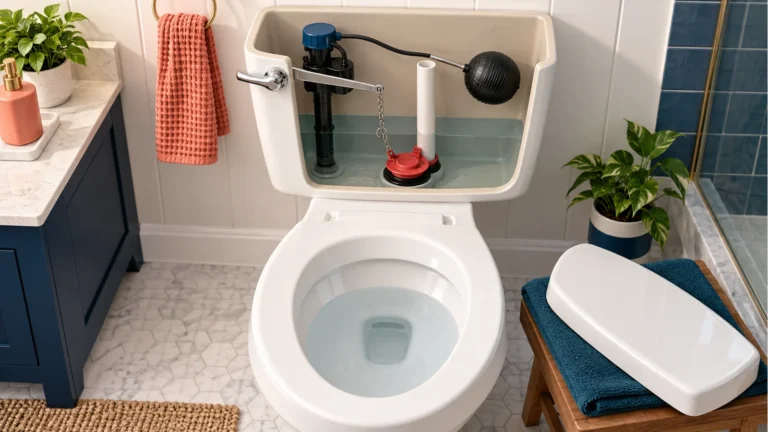
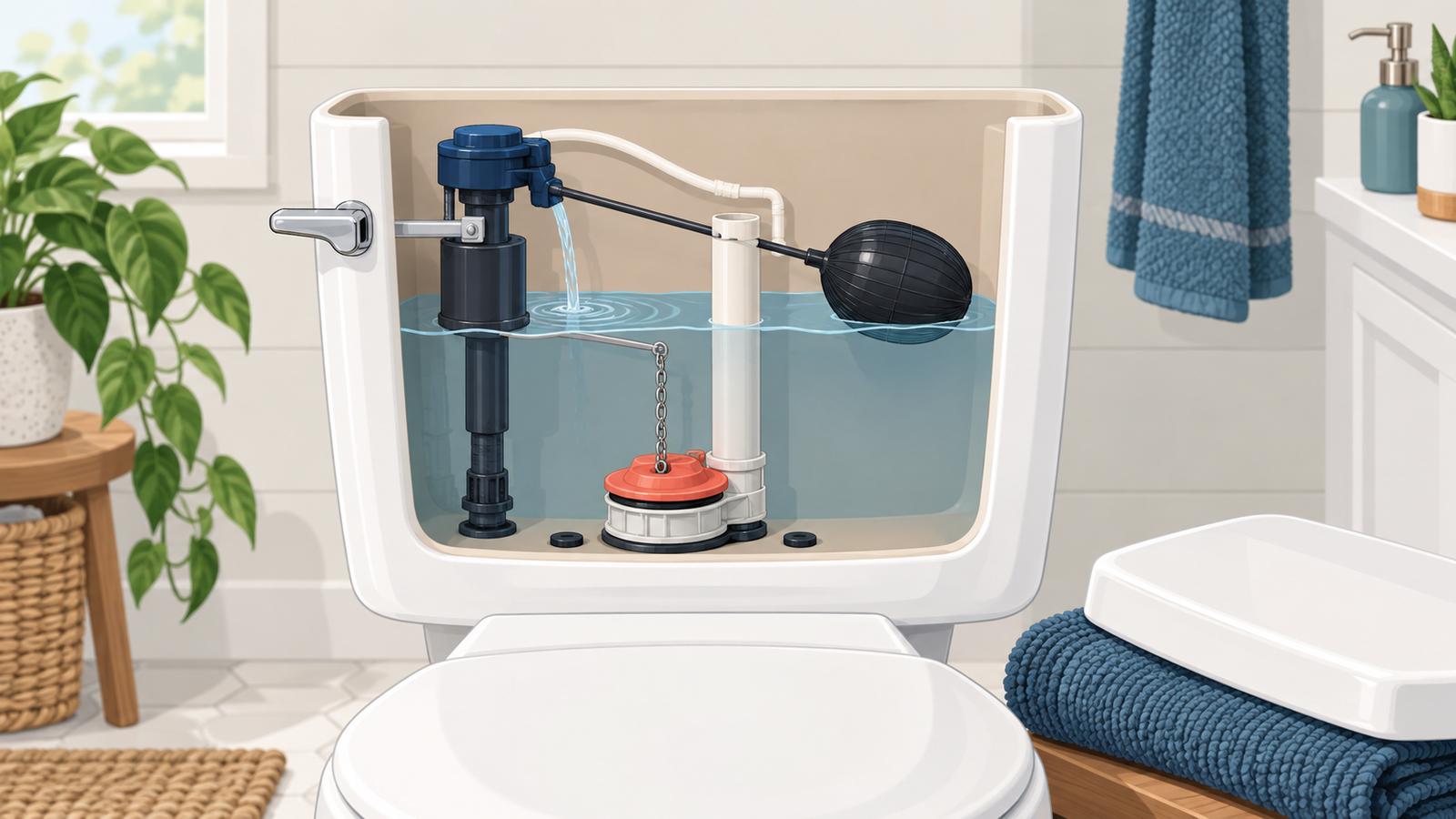
Lift the tank lid carefully and set it on a folded towel. Then watch the tank for a minute without flushing. The key question is simple: Is water entering the overflow tube, or is the tank level staying below it while the toilet refills? Those patterns lead to different checks.
| What you see or hear | What it can point to | Safest next move |
|---|---|---|
| Water continuously enters the overflow tube | The water level is too high or the fill valve is not shutting off | Check the marked tank waterline and use the model’s fill-valve guidance |
| Tank level sits below the overflow tube, then the toilet refills every few minutes | Water may be leaking past the flapper, canister seal, chain, or flush-valve seat | Do a dye test before choosing a replacement part |
| Handle stays down or chain is tight/caught | The flush seal may be held open | Check that the linkage moves freely and has model-appropriate slack |
| Water appears outside the tank, bowl, supply line, or base | This is not a normal running-toilet diagnosis | Stop use, protect the area, and arrange plumbing help if the leak continues |
First, rule out the conditions that need help
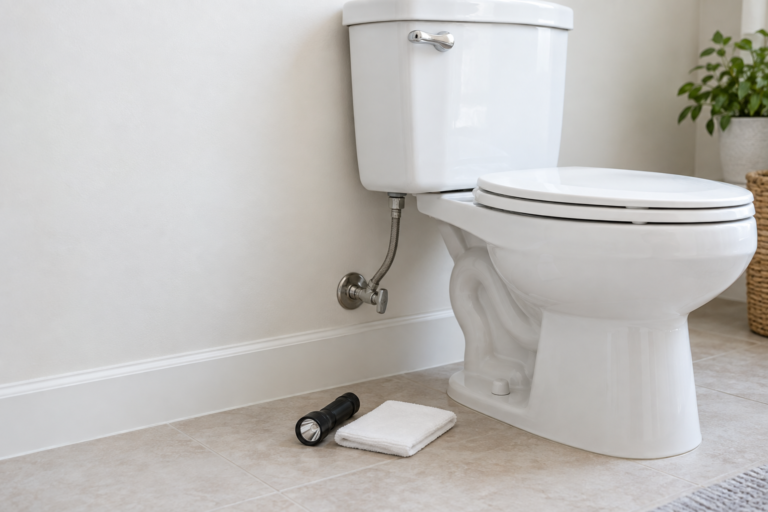
Turn the toilet’s supply valve clockwise only if it turns easily and water is escaping outside the fixture. Do not force an old valve. Do not keep flushing a toilet with a rising bowl, a cracked tank or bowl, or a leak from the supply connection. A running tank is usually an internal water-waste problem; a leak onto the floor can cause damage quickly.
Pressure-assisted toilets have a sealed pressure vessel inside the porcelain tank. Do not open or alter that vessel. Use the manufacturer’s instructions or a qualified technician. The checks below are for a typical gravity toilet with a tank, fill valve, overflow tube, and flapper or canister-style seal.
The two water paths that matter
Path 1: Water enters the overflow tube
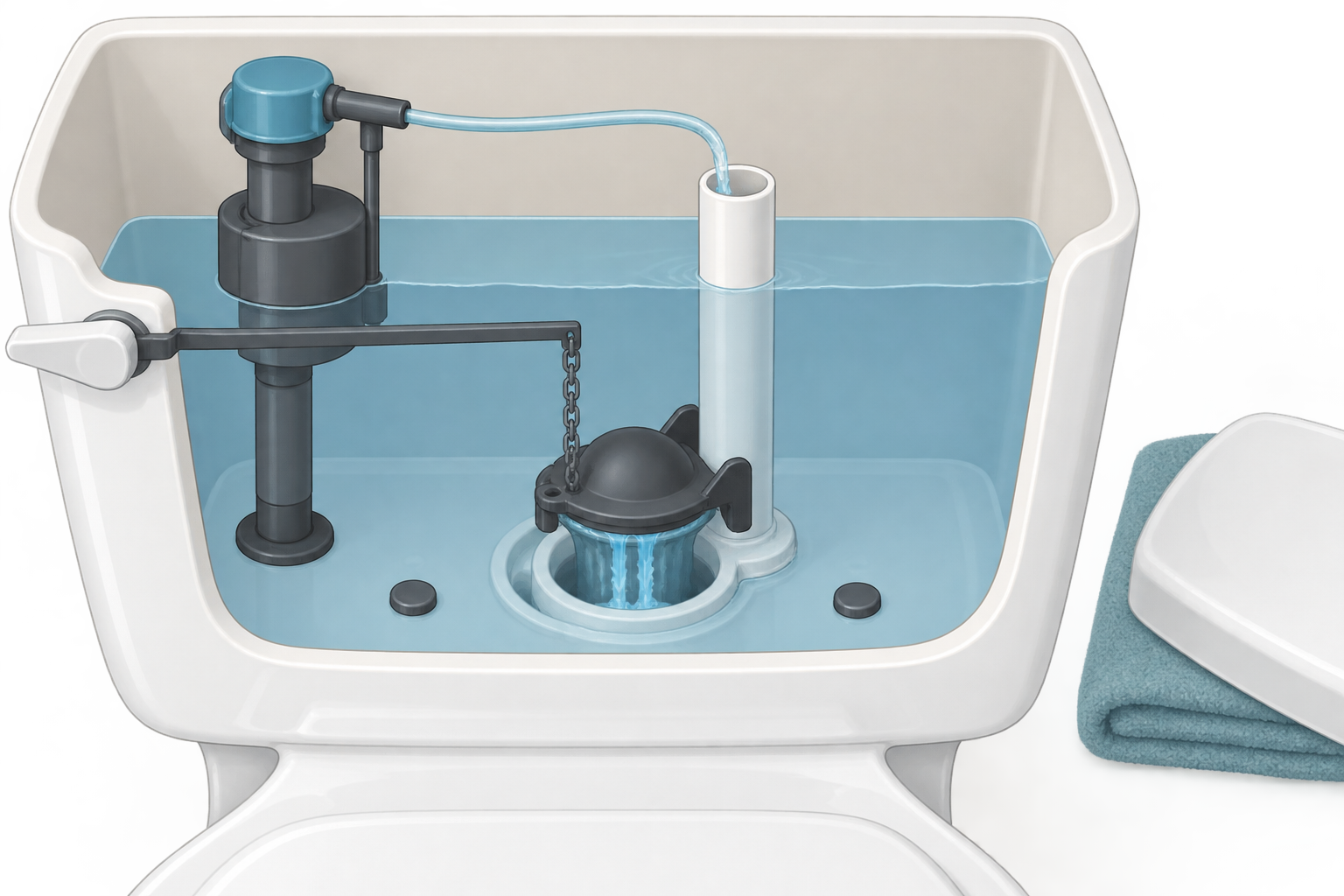
If you see water continually entering the open tube in the middle of the tank, the fill valve is not stopping the incoming water soon enough. EPA guidance says the water level should remain below the overflow tube, and Kohler lists a high water level, a binding trip lever, or debris affecting a fill valve among possible reasons a toilet may keep running.
First, look for the waterline marked inside the tank. Use that mark or the owner manual rather than a universal measurement. Check whether the float moves freely and whether the handle arm or chain is caught on it. If the line is too high, use the adjustment procedure for your exact fill valve or toilet model. Do not disassemble a pressurized valve or substitute a setting from a different toilet.
If water still flows into the overflow after the model-approved check, the fill valve may need cleaning, adjustment, or replacement. Match replacement parts to the toilet model rather than assuming any universal valve or seal will fit.
Path 2: The tank refills even though the water level is below the overflow tube
An intermittent hiss, a brief refill every few minutes, or a small ripple in the bowl can mean water is slowly escaping from the tank into the bowl. That commonly involves the flapper or canister seal, but the chain, the sealing surface, and the correct part also matter.
Before removing parts, run a dye test. EPA recommends putting a few drops of food coloring or a dye tablet in the tank, waiting 10 minutes without flushing, and checking whether color appears in the bowl. Flush afterward so the dye does not stain the porcelain. Color in the bowl confirms a leak path from the tank, but it does not by itself prove which part needs replacement.
Check the linkage before replacing anything
With the tank lid off, press the handle once and watch the movement. The handle arm should lift the chain or linkage, the flapper or canister should open for the flush, and the seal should return fully to its seat afterward.
- A chain caught under the flapper or wrapped around another component.
- A chain that appears to hold the seal up when the handle is released.
- A handle arm that binds or does not return freely.
- A flapper or canister seal that looks warped, dirty, torn, or out of place.
Kohler notes that many flapper systems need a little slack in the chain so it does not catch on the trip lever arm. The exact setting varies by model. Do not cut a chain, bend parts, or buy a replacement based only on a similar-looking tank; check the model number and the manufacturer’s parts information.
Use the test result to choose the next action
The dye reaches the bowl
Start with the visible seal and linkage. Make sure the seal can sit flat and that nothing holds it open. If it is visibly worn or the model documentation identifies the correct replacement, turn off the water supply, flush to empty the tank, and follow the model-specific part instructions. EPA advises using a flapper that fits the toilet model; a photo of the existing part and the model number can help avoid an incorrect purchase.
If a new, correct seal does not stop the leak, the sealing surface or flush-valve assembly may need service. Do not keep replacing seals without identifying why the seal will not seat.
The tank keeps filling into the overflow tube
Use the waterline and fill-valve instructions for the exact toilet. A correctly adjusted water level should stop below the top of the overflow tube. If the float moves freely but water still does not shut off, or if the valve body is unfamiliar, stop at the diagnosis and use manufacturer support or a plumber.
The toilet runs only after the handle sticks
The trip lever arm or linkage may bind and hold the seal open. Check for a visibly caught chain or an obstruction. Avoid lubricants or makeshift modifications inside the tank unless the manufacturer specifies them. A damaged handle, cable, or dual-flush mechanism should be replaced with the matching part.
What not to do
- Do not pour chemical drain opener into a toilet for a running-tank problem.
- Do not use boiling water in the bowl or tank.
- Do not put cleaner tablets in the tank unless the toilet and replacement-part manufacturer permits them.
- Do not force a shutoff valve, overtighten plastic parts, or lean on the porcelain tank.
- Do not attempt a repair inside a pressure-assisted tank.
When to call a plumber
Arrange help when water leaks outside the tank or bowl, porcelain is cracked, the supply valve or line leaks, the toilet has an unfamiliar pressure-assisted system, or the correct replacement part does not solve the problem. Call sooner if the bowl is high, wastewater is involved, or several drains gurgle or back up together; that can point beyond the toilet tank.
For a toilet that will not flush at all, use our toilet-not-flushing guide. If the bowl is high or draining slowly, follow the toilet-clogged guide instead. For routine bathroom care after the repair, see the bathroom cleaning checklist.
Frequently asked questions
Why does my toilet keep refilling by itself?
When tank water slowly escapes into the bowl, the fill valve eventually turns on to restore the tank level. A dye test can confirm that water is leaking from the tank to the bowl. If water is instead visibly flowing into the overflow tube, the fill valve or water-level control needs model-specific attention.
Can a running toilet increase my water bill?
Yes. EPA identifies toilet leaks as a common source of household water waste. It is worth diagnosing a running toilet promptly, even if the sound stops between refills.
Is every running toilet caused by a flapper?
No. A flapper or canister seal is a common cause, but a tight or caught chain, a faulty fill valve, incorrect water level, binding handle, or a worn flush-valve surface can also keep a toilet running.