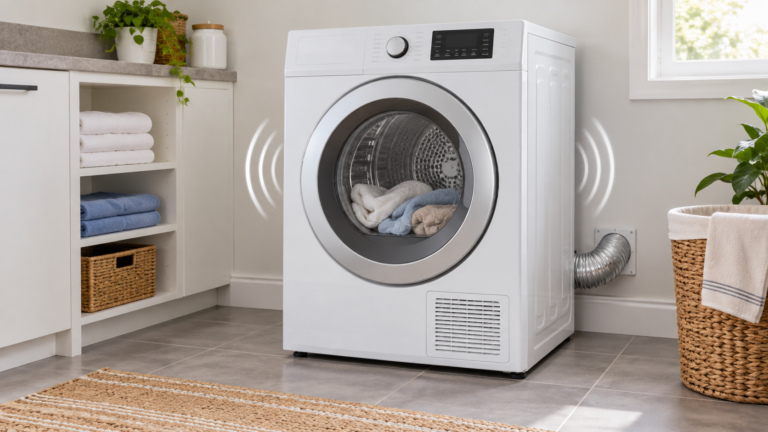
Dryer Won’t Start? Match the Response Before You Call for Service
Quick answer: A dryer that will not start is not one single problem. First notice what happens when you press Start: nothing at all, lights but no cycle, a click, a hum, or a cycle that starts and immediately stops. That response tells you which safe checks make sense. Stop instead of troubleshooting if you smell gas, see a damaged cord or burn marks, notice smoke or a burning odor, or the breaker trips again.
Start with the response, not a guessed part
Write down the dryer brand and model number, the selected cycle, and exactly what the display, drum light, and dryer do after you press Start. If there is an error code, photograph it and check the owner’s manual before trying a reset. Model controls, latches, and reset options vary.
| What happens when you press Start? | What it can narrow down | Safe check before service | Do not assume |
|---|---|---|---|
| No lights, no sound, no display response | Power supply, plug, cord, breaker, or a control issue | Check for an outage; look at the plug and cord without handling damage; check the breaker once | A working wall outlet proves the dryer is safe to use |
| The display is on, but the cycle will not begin | Control lock, cycle selection, Start-button use, or door latch | Read the manual; make sure the door is fully latched, laundry is not caught, and controls are unlocked | The Start button or door switch has failed |
| A click or hum, but the drum does not move | A model-specific internal drive or safety issue | Stop repeated starts; unplug only if there is no gas odor or electrical damage, then arrange qualified service | A belt, fuse, motor, or switch is definitely the cause |
| It starts, then stops or gives an error | Door sensing, heat/airflow protection, controls, or another model-specific fault | Record the code and timing; check the manual and visible lint filter | Resetting it repeatedly will fix the cause |
Stop before you continue if a safety warning is present
If you smell natural gas or hear a gas-like hiss near a gas dryer, leave the area. Do not operate light switches, use a phone in the area, smoke, or try to restart the appliance. Call 911 or your gas utility from a safe location. The U.S. Pipeline and Hazardous Materials Safety Administration gives the same leave-first, avoid-spark guidance for a suspected gas leak.
For either gas or electric dryers, stop and get qualified help if you see a damaged or loose cord, scorch marks, smoke, a burning smell, water near electrical parts, or a breaker that trips again. Those signs are not a normal no-start setting problem.
If the dryer has no lights or makes no sound
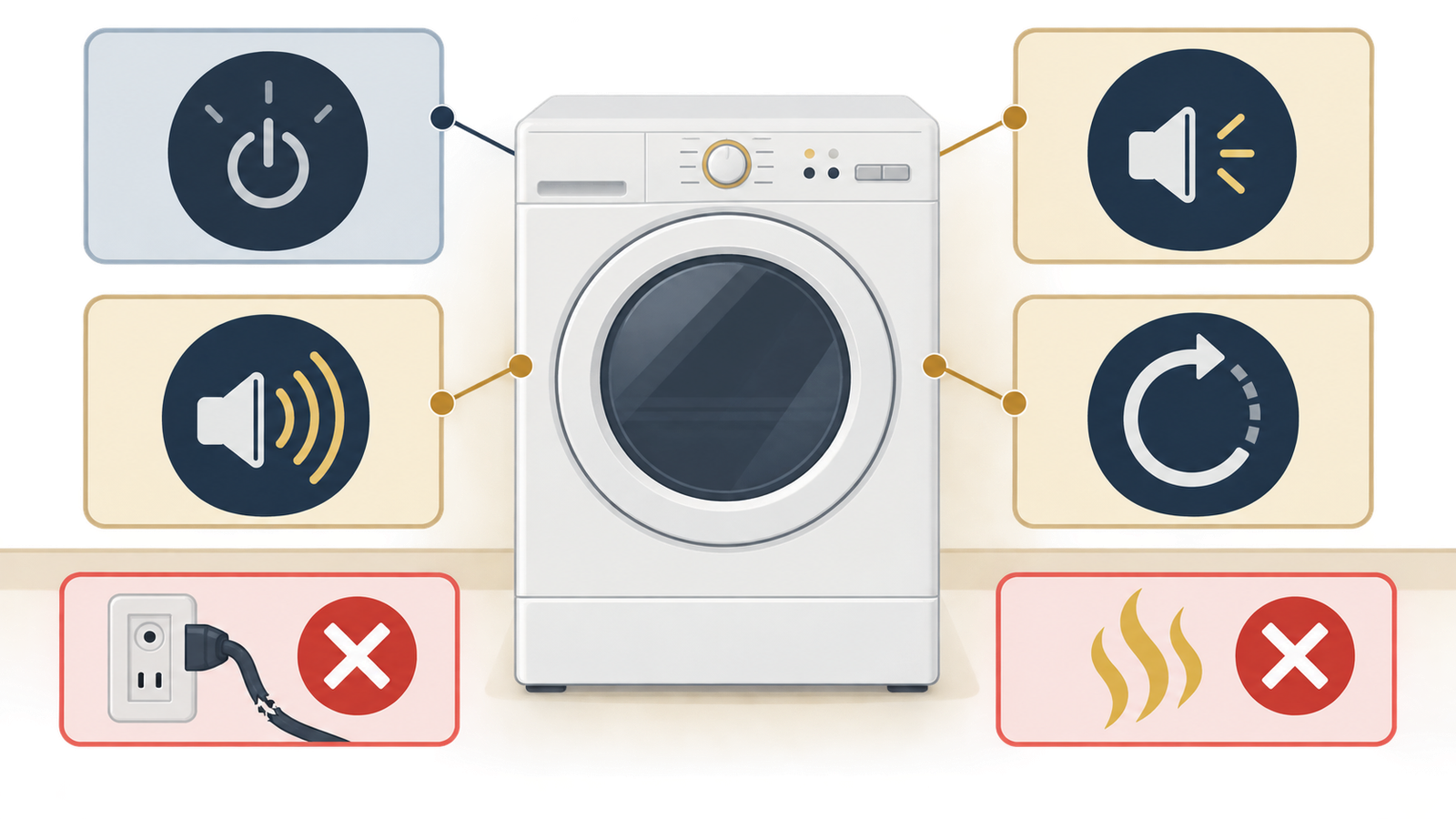
Start outside the appliance. Check whether the home has a power outage and whether the dryer breaker is clearly tripped. Some electric dryers use a two-part circuit; Whirlpool notes that both breakers or fuses need to be intact for its electric dryers. A gas dryer has a different electrical setup, so do not apply an electric-dryer outlet rule to a gas model.
If you need to inspect the plug or cord closely, turn the breaker off first. Samsung advises stopping and contacting an electrician if the cord or outlet shows burn marks or damage, if the power-cord installation looks loose or incorrect, or if a dryer has never heated at that location. Do not use an extension cord or power strip for a major appliance.
One careful breaker reset can be a reasonable check when the breaker is visibly tripped and there is no damage or odor. If it trips again, do not keep resetting it. That is the point to arrange an electrician rather than testing the outlet or opening the dryer.
If the display works but pressing Start does nothing
This is the branch where simple, model-aware checks are most useful.
- Read the Start instruction for your model. Some controls need a firm press or hold. Whirlpool and Maytag both describe Start, Push to Start, or Hold to Start controls that may need to be held for about two to five seconds on applicable models. A touch panel may also fail to register a wet finger.
- Check the selected cycle and Control Lock. A locked control panel, an unsuitable option, or a model-specific setting can prevent a cycle from beginning. Use the manual to unlock the controls rather than guessing at a button combination.
- Close the door deliberately. Move clothing away from the door opening, then close it firmly. A door can look closed without engaging its latch. Some models use more than one latch.
- Try once more and note the result. If the display stays on but the dryer remains silent after the correct Start action, do not bypass the door switch or repeatedly force the button. The next step may require model-specific diagnosis.
This branch is different from a dryer that tumbles but does not heat. If the drum runs normally and the load stays cold, use our Dryer Not Heating guide instead of treating it as a no-start problem.
If you hear a click or hum but the drum does not turn
A click or hum is useful information, but it does not identify a failed part from across the room. It can occur with a drive-system problem, an obstruction, a safety device, or another model-specific fault. Repair sites often move quickly to belt, motor, thermal-fuse, or switch testing. Those tests can require cabinet removal, wiring access, and a model wiring diagram, so they do not belong in a universal first-step guide.
Stop pressing Start repeatedly. If there is no gas odor, smoke, heat, damaged cord, or water risk, disconnect power according to your manual before moving the dryer or looking behind it. Do not remove panels, defeat a door switch, bridge a fuse, or reach into a blower area. Record whether the drum moves freely only if your manual says that external observation is appropriate; otherwise leave the inspection to a qualified technician.
If the symptom includes unusual scraping, thumping, or a loud hum, our Dryer Making a Loud Noise guide can help you describe the sound safely before arranging service.
If it starts and then stops
An immediate stop can be related to a door that is not staying latched, a displayed error, a control or sensor issue, or a protective response. Check the manual’s meaning for the exact code or blinking pattern. Do not assume that unplugging the dryer clears the cause.
After the dryer has cooled and only if there is no electrical or gas warning, clean the lint filter according to the manual. The U.S. Consumer Product Safety Commission advises cleaning the lint filter before or after each load and keeping the exhaust path unobstructed. A blocked vent can contribute to overheating, but a clean lint filter does not prove that the vent is clear or explain every no-start symptom.
If drying had recently taken much longer than normal, lint was accumulating, or the outside vent flap did not open while the dryer previously ran, treat airflow maintenance as important. Do not run the dryer again until an accessible, properly reconnected exhaust path and manufacturer guidance support it. Internal dryer cleaning and difficult vent blockages are service work.
What not to do
- Do not keep resetting a breaker that trips again.
- Do not use an extension cord, power strip, damaged cord, or loose outlet for the dryer.
- Do not bypass a door switch, thermal fuse, or any other safety device to make a cycle start.
- Do not test voltage at the outlet, remove a panel, or disconnect wires unless you are qualified and following the exact service documentation for that model.
- Do not use the dryer if there is smoke, a burning odor, gas odor, water at electrical parts, or visible heat damage.
- Do not treat a generic online repair video as instructions for your model.
What to have ready when you call for help
Good notes make service more efficient and reduce guesswork. Have the model number, fuel type (gas or electric), the exact response when Start is pressed, any code or flashing pattern, whether the breaker was tripped, and whether there were earlier warning signs such as long dry times, noise, burning odor, or a damaged cord. A photo of the display or damaged exterior area can help, but do not move the appliance or remove panels just to get one.
Sources
- Whirlpool: Dryer Not Starting or No Operation
- Maytag: How To Fix a Dryer That Won’t Start
- Samsung: Dryer loses power or won’t turn on
- U.S. Consumer Product Safety Commission: Overheated Clothes Dryers Can Cause Fires
- PHMSA: Pipeline Leak Recognition and What to Do
Editorial source ledger
| Consequential statement | Source | Scope or limitation |
|---|---|---|
| Some models need Start held two to five seconds; model-specific Control Lock, door, cycle, and breaker checks may prevent a cycle from beginning. | Whirlpool and Maytag manufacturer support | Follow the owner’s manual for the exact model and control layout. |
| Electric dryers can use a two-part circuit; cord/outlet damage and recurring breaker issues need an electrician rather than continued testing. | Whirlpool Product Help; Samsung support | Electrical setup varies by fuel type and installation. |
| Lint-filter and exhaust-path maintenance reduce dryer-fire risk; visible airflow symptoms need attention. | CPSC safety alert | Does not diagnose a no-start fault or authorize internal cleaning. |
| With a suspected gas leak, leave and avoid ignition sources before calling from a safe location. | PHMSA | Applies to gas-odor or suspected-leak conditions, not ordinary laundry odors. |