Sink Gurgling? Check What Triggers It Before You Clear the Drain
Quick answer
A sink gurgles when air is being pushed or pulled through water in the drain system instead of moving through the normal air path. A partial local clog can cause it, but so can a shared drain restriction, a venting problem, or a developing sewer backup.
Do not start by pouring cleaner into the sink. First note what was draining when the sound began and whether any other fixture is slow, bubbling, or backing up. If several fixtures develop new slow drainage or bubbling, water rises in a shower or floor drain, or wastewater appears, stop using water and call the appropriate plumber, drain professional, or local sewer utility.
Updated October 22, 2026: aligned the stop-water instructions for shared backup warnings, separated observing a trigger from recreating it, and added local-check outcomes and mobile table labels. The existing trigger-first diagnosis is retained.
Check the stop-use warnings · Read the isolated-sink checks · Choose the next step after a local check
Stop using water if the gurgle comes with a backup warning
- Water rises in a shower, tub, floor drain, or another sink.
- Several fixtures suddenly drain slowly or gurgle.
- A toilet bowl rises, bubbles strongly, or will not clear.
- Wastewater or sewage appears indoors.
- A septic property also has sewage odor, wet ground, surfacing wastewater, or an alarm.
Do not run the dishwasher, washing machine, shower, or faucets to keep testing, and do not flush toilets into a suspected backed-up system. Municipal sewer guidance treats multiple backups, gurgling drains, water from floor drains, and sewage in tubs or showers as warning signs; the immediate step is to stop adding water. Keep children and pets away from wastewater. If water reaches outlets, cords, or appliances, stay out of the affected area and get qualified help. Do not walk through wastewater or touch a wet plug to stop an appliance. Use an ordinary stop control only if you can reach it from a safe, dry position.
For suspected sewer backup, “stop water use” means stop adding wastewater from household fixtures and water-using appliances—not just skip a large laundry load. Middleton’s utility guidance also calls for stopping all water use while the problem is assessed. Use your own utility’s emergency contact, not another city’s number; its response area and public/private responsibilities may differ.
Why the sink makes that sound
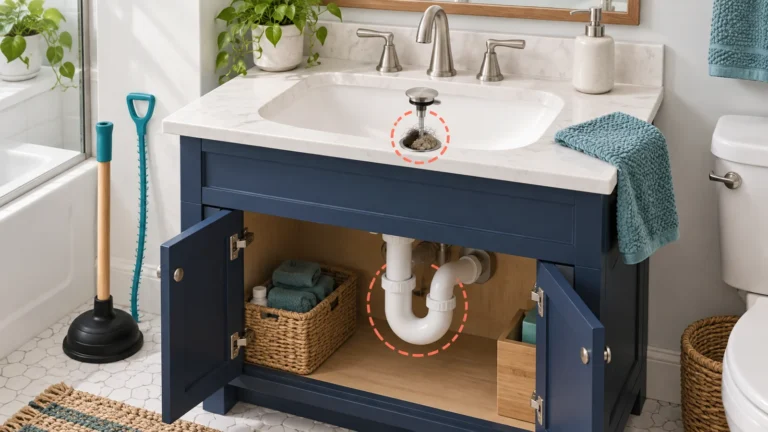
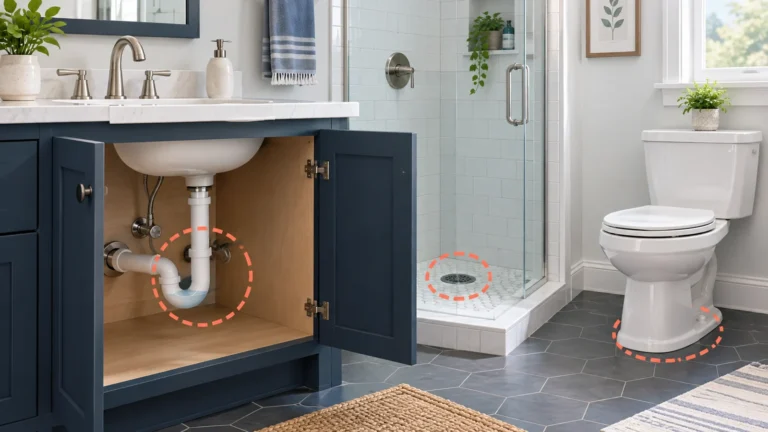
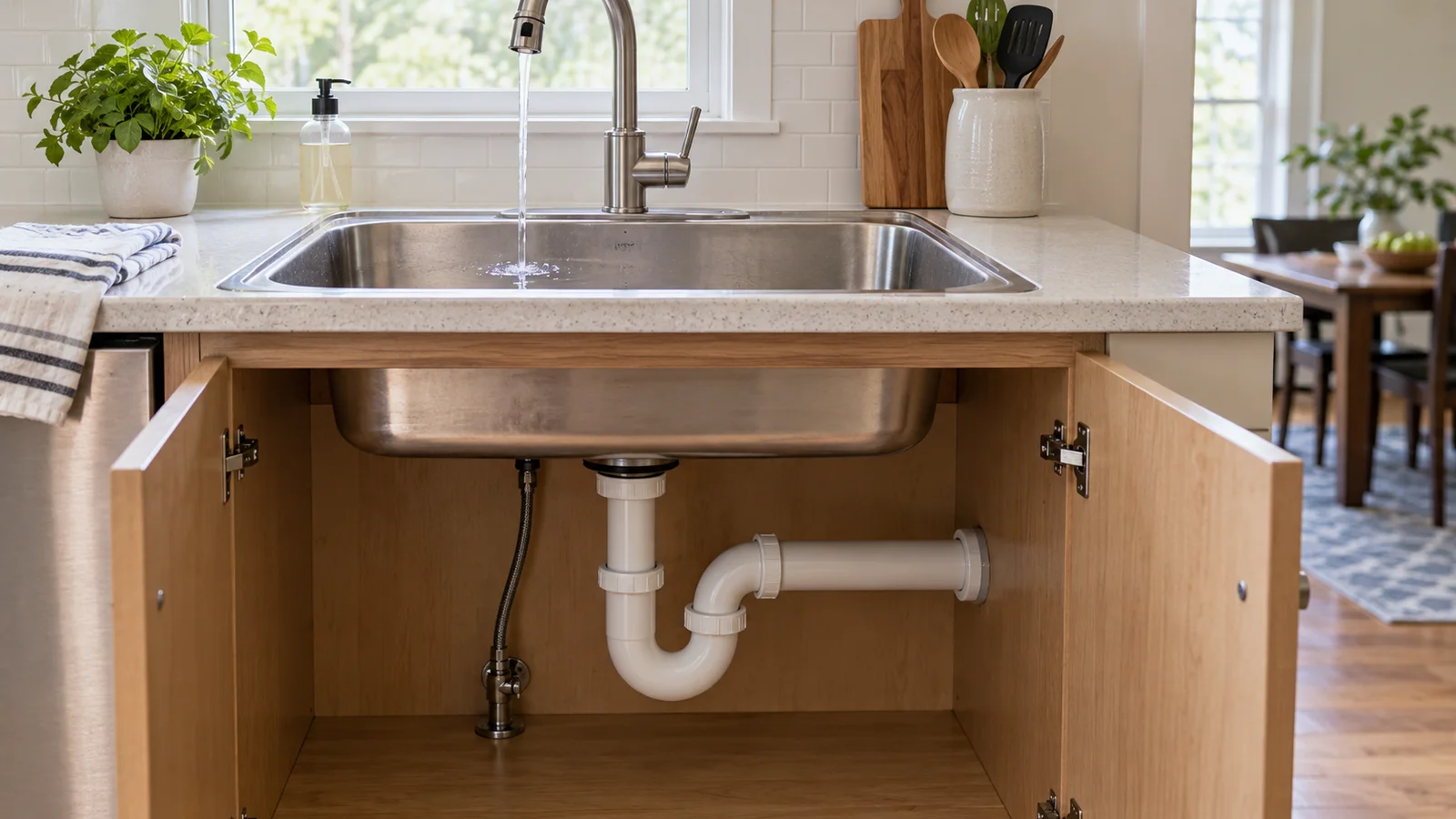
The curved trap below a sink holds water that helps block sewer gases. The drainage system also needs an air path so water can move without creating disruptive pressure changes. The University of Minnesota’s onsite sewage program explains that roof vents equalize pressure as wastewater flows; without effective venting, sinks, tubs, and toilets can gurgle, traps can lose water, and odors can enter the home.
That does not mean every gurgle proves the roof vent is blocked. A partial clog can disturb air and water in a similar way. The most useful clues are the trigger, the sink’s drainage speed, and whether another fixture reacts. If odor is the main symptom and water drains normally without gurgling or backups, the kitchen sink smell guide separates drain, faucet-water, and cabinet sources.
Match the trigger to the safest next step
| What makes the sink gurgle? | What the pattern may point to | Safest next step | Stop and call when |
|---|---|---|---|
| The same sink drains, and it is also slow | Debris at the stopper, trap, or nearby branch is more likely | Check the accessible stopper area. Use the local unclogging route only if no chemical cleaner was added | Water stops draining, a leak appears, or clearing does not hold |
| A toilet flushes | The fixtures may share a restricted branch or have a venting problem | Record what already happened; do not flush again to make a comparison | The toilet rises, the shower backs up, several fixtures slow down, or the pattern repeats |
| A dishwasher or washing machine pumps out | A shared drain or air path may be struggling with the larger discharge | Keep the appliance off; record any other fixture that already reacted, without running another cycle | Water rises elsewhere, several rooms are affected, or wastewater appears |
| Several fixtures gurgle or drain slowly | A downstream building drain or sewer restriction becomes more concerning | Stop adding wastewater from fixtures and appliances; contact a drain professional or your local utility | Any backup, sewage, or electrical exposure is present |
| The sound began after a remodel or new sink installation | Trap or vent configuration may need code-aware inspection | Ask a licensed plumber to inspect the visible and concealed configuration | The trap loses water, odors appear, or drainage is unreliable |
| A septic home has added odors, wet ground, surfacing water, or an alarm | The onsite wastewater system may be malfunctioning | Stop adding wastewater while suspected failure is assessed; contact a septic professional or local authority | Sewage backs up indoors or surfaces where people or pets can contact it |
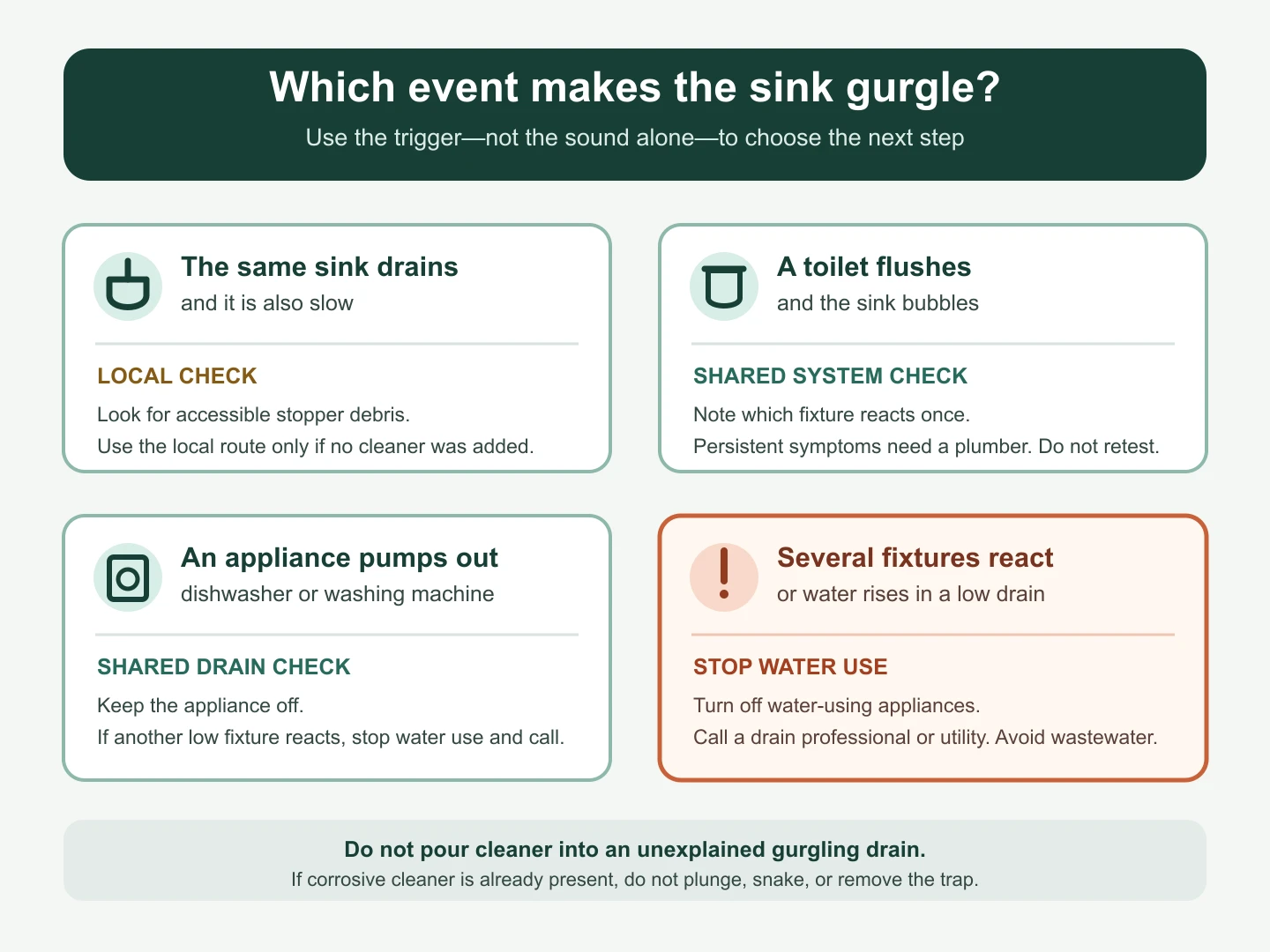
These patterns narrow the next move; they do not identify a hidden defect from sound alone. A dishwasher pumping normally is a trigger, not a second faulty fixture by itself. Count new abnormal behavior—such as slow drainage, bubbling, or water-level changes—in other fixtures. Do not create that evidence by running more water.
When the sink gurgles after its own water drains
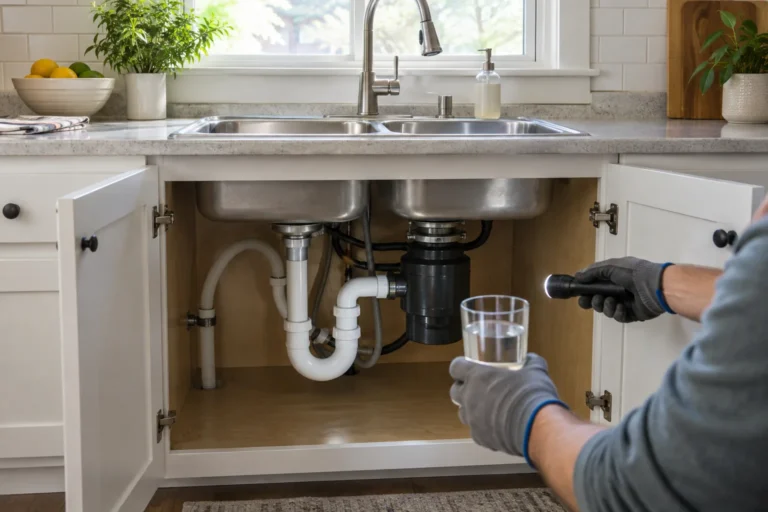
An isolated sink that gurgles while draining slowly is the best fit for a local check. Hair and soap residue commonly collect around a bathroom pop-up stopper. Food residue and grease can restrict a kitchen drain. A partial restriction can still pass water while disturbing the air behind it.
- Stop using the sink if water is no longer moving or the cabinet is wet.
- Look from above at the visible stopper or strainer. Remove only loose surface debris by the fixture’s documented method; do not reach into a garbage disposal or insert improvised tools to investigate the sound. If cleaner was added, the water’s contents are uncertain, or the cabinet is wet, stop hands-on work.
- Review what nearby fixtures already did during ordinary use; do not run or flush them for comparison. If another fixture has new abnormal drainage, bubbling, or rising water, leave the local-clog route and use the stop-use guidance above.
- If this is an isolated bathroom sink and no chemical cleaner has been used, follow the mechanical steps in How to Unclog a Bathroom Sink Safely.
Do not assume that a clear-looking stopper proves the problem is in the roof vent. The restriction could be in the trap or branch, and the configuration may need inspection. If the gurgle returns soon after a local clearing attempt, arrange service instead of repeating treatments.
A disposal opening is not an accessible stopper. GE Appliances warns never to put a hand or any part of the body in a disposer. This gurgling check does not authorize an unjamming procedure, electrical test, or trap removal; use the exact unit’s instructions or service help for a separate disposal problem.
After an allowed local check: what does the result mean?
| What you already observe | What it does not prove | Next step |
|---|---|---|
| The isolated sink clears normally after permitted surface-debris removal, with no recurring noise or leak during ordinary use | A quiet drain does not certify the hidden vent or branch is clear | Leave it alone and watch for recurrence. Do not fill the basin or start an appliance to stress-test the repair. |
| The sink remains slow, gurgles again, or a simple local clearing does not hold | A clear-looking stopper does not identify a roof-vent blockage | Arrange plumbing evaluation rather than repeating cleaners or increasingly forceful mechanical attempts. |
| Another fixture becomes abnormally slow or bubbles, water rises elsewhere, wastewater appears, or a new leak develops | The original sink is not established as the only problem | Stop adding wastewater, avoid wet or contaminated areas, and get the appropriate drain, utility, septic, or plumbing help. |
When the sink gurgles as a toilet flushes
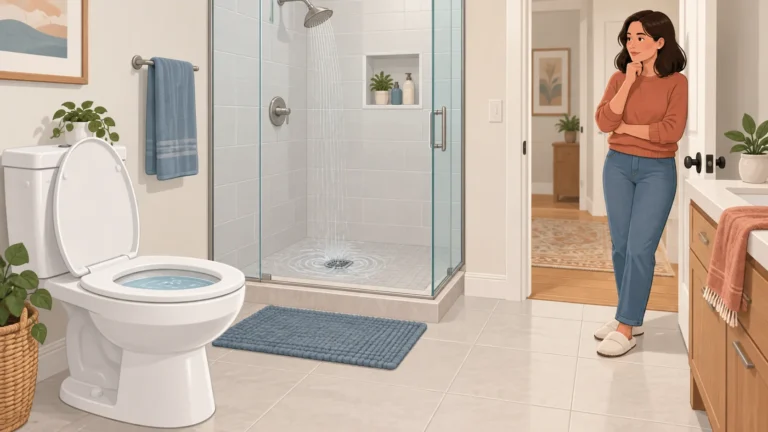
A toilet releases more water at once than a faucet. If that flush makes the sink bubble, the two fixtures may share part of the drain or air path. The reaction can fit a restricted shared branch, inadequate venting, or a downstream obstruction. It does not prove which one is responsible.
Use the history of normal use, not another deliberate flush. A single past sink sound with otherwise normal drainage is not proof of a sewer blockage, but persistent or recurring cross-fixture gurgling needs plumbing evaluation. If backup warnings are present, use the stop-water route instead of observing more use. If the toilet itself bubbles, rises, drains slowly, or changes water level, use the toilet-gurgling diagnostic guide because the toilet behavior now matters to the decision.
Do not repeatedly flush to reproduce the sound. Stop immediately if the bowl rises or a shower or tub receives water. Those are no longer isolated sound symptoms.
When a dishwasher or washing machine triggers the sink
An appliance pump can reveal a problem that a slowly running faucet does not. If the kitchen sink gurgles only when the dishwasher drains, record whether the sink was also slow in use before that event; do not run water now just to confirm it. If a washing machine makes a sink in another room gurgle, the affected fixtures may share a branch farther downstream.
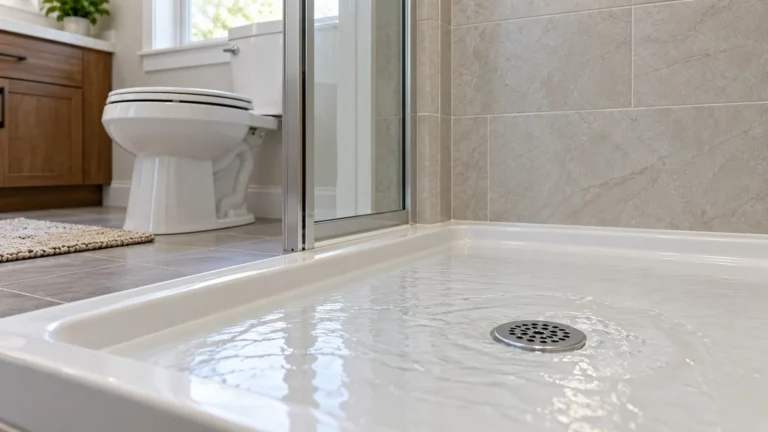
Do not run another cycle as a test. Check whether a nearby toilet, shower, tub, or floor drain changed at the same time. New abnormal behavior in more than one fixture is a reason to stop adding wastewater from sinks, toilets, and appliances and call a drain professional. If water backs up into a shower, follow Water Backing Up in Your Shower? Check Which Fixture Triggers It and keep the triggering appliance off.
When several drains gurgle or water rises somewhere else
Multiple fixtures change the urgency. The City of Roseville lists several drains backing up at once, gurgling toilets or drains, water from floor drains, and sewage in tubs or showers as sewer-problem indicators. Its advice is to stop using washing machines, dishwashers, showers, and sinks while the problem is assessed.
Call your local sewer utility first if your municipality offers a sewer-response service, particularly when neighbors report similar symptoms. Otherwise, call a drain or sewer professional. Responsibility for the public main, service connection, and private lateral varies by location, so do not open a cleanout to investigate on your own.
If wastewater enters the home, keep people and pets away. Do not touch wet electrical equipment or enter standing water that may contact an electrical source.
If the gurgling began after plumbing work
A new sink, replaced trap, moved fixture, or recent remodel is an important clue. The drain or vent configuration may not be working as intended, or an air-admittance valve may be missing, incorrectly placed, stuck, or not permitted for that installation. Those possibilities cannot be confirmed from a sound alone.
Ask the installer or a licensed plumber to inspect the work against the local plumbing code. Stay off the roof and do not remove a vent cap, alter a valve, or open concealed plumbing to investigate this sound. Do not copy a generic vent diagram or add a valve based only on an online article. Vent size, location, height, accessibility, and permitted fittings depend on the actual system and local requirements.
If your property uses septic
A single gurgle does not prove septic failure. The concern rises when slow drains or gurgling come with sewage backing up, wastewater surfacing in the yard, strong sewage odor, or a system alarm. The University of Minnesota identifies backup, surfacing sewage, odors, and alarms as possible failure indicators.
For suspected system failure, stop adding wastewater while you contact a septic professional or local authority and follow its instructions. Do not open the tank, enter the area around an unsecured lid, or add an unverified treatment. Surfacing sewage is a contact hazard for people and animals.
Why drain cleaner is the wrong first response
A gurgle can come from a vent or shared drain problem that liquid cleaner cannot fix. Many non-enzymatic drain cleaners contain highly concentrated corrosive acids or alkalis. Poison Control warns that these products can cause serious burns and that splashback from the drain is an exposure risk.
Do not mix cleaners. If someone has already poured a corrosive cleaner into the sink, do not plunge, snake, or remove the trap through the chemical. Keep others away, follow the product label, and tell the plumber exactly what was used. For a splash, fume exposure, or ingestion, contact Poison Control at 1-800-222-1222 or use webPOISONCONTROL.
Baking soda and vinegar are not a dependable substitute for diagnosis. Poison Control notes that an open drain generally lets the carbon dioxide escape, so the mixture is unlikely to build enough pressure to dislodge debris and is unlikely to clear a tough grease or oil clog.
What to tell the plumber or utility
The trigger history can shorten the diagnosis. Record:
- which sink makes the sound;
- whether it drains slowly or at normal speed;
- what fixture or appliance was draining at the time;
- whether another drain rose, bubbled, or smelled;
- whether the problem affects one room or several;
- whether plumbing work happened recently;
- whether the home uses septic; and
- the name of any drain product already used.
If odor is the main symptom and drainage remains normal, use Bathroom Smells Like Sewage? Find the Source Safely rather than adding cleaners to the drain.