How to Clean Carpet Without a Machine: Know the Limits of Hand Cleaning
You can remove loose dry soil, refresh the pile, and treat a small surface spot without a carpet-cleaning machine. You cannot reliably deep-clean embedded soil, rinse a whole room, or pull liquid out of the backing and pad by hand. Use extraction or qualified professional cleaning when soil is widespread, a spill soaked below the pile, odor returns, or the material is sensitive or unknown.
Stop before routine cleaning if the carpet is wet or contaminated
If the carpet is wet from a leak, flood, sewage, or an unknown liquid, stop. Do not vacuum or brush the area. Control the source safely and use the appropriate restoration or professional route.
Do not promise disinfection from a home mixture or ordinary spot clean. A disinfectant must be labeled for the surface and used exactly as directed, and many carpets cannot remain wet for the required contact time without creating other problems. For contamination rather than ordinary soil, use material-specific professional guidance.
Safety boundary: Do not turn several household ingredients into a carpet recipe. Never layer a cleaner over bleach, ammonia, vinegar, peroxide, disinfectant, or an unknown residue. Do not scrub installed carpet with a stiff brush or saturate it because you have no extractor to remove the liquid.
Here, “without a machine” means without a carpet shampooer or extractor. A vacuum is still useful for permitted dry-soil care. If you also have no vacuum, the limited loose-debris route below does not replace removal of embedded grit or dust.
Choose the cleaning job before choosing a product
Choose one job, not a sequence of products. The spot route below is only for an identified, nonhazardous spill on a compatible material. For blood, other body fluids, or an uncertain substance, use the stain-specific safety limits before touching the area. For a known vomiting incident, use the vomit-on-carpet guide instead of this routine-cleaning route.
| What you are trying to fix | What hand cleaning can do | Best first route | Stop or change methods when |
|---|---|---|---|
| Loose crumbs, grit, hair, or dry soil | Remove material that is not bonded to the fibers | Vacuum slowly with the correct setting; use the edge tool around walls | The carpet pulls, fuzzes, or the vacuum setting is wrong for the pile |
| One small fresh spill | Absorb liquid and treat a pile-level spot | Lift solids, blot with white towels, then use the stain-specific route | The spill reached a seam or edge, covers a broad area, or keeps transferring from below |
| A light dull traffic path on known synthetic carpet | Improve the surface only when the maker permits a low-moisture interim product | Follow the carpet and product instructions; work a small section and remove residue | The product cannot be removed as directed, the area stays damp, or appearance changes |
| Broad grayness, oily soil, or a room that needs deep cleaning | Hand methods cannot rinse and extract the carpet evenly | Use a suitable extractor or qualified cleaner under the carpet-care requirements | Do not keep adding shampoo or water by hand |
| Odor or a mark that returns after drying | Surface treatment may help only if the source is in the pile | Diagnose depth before adding more liquid | Odor, a ring, or dampness returns after the surface is dry |
| Wool, viscose, sisal, seagrass, antique, hand-dyed, warranty-covered, or unknown carpet | Only limited blotting of a known, nonhazardous spill may be appropriate; follow the care instructions | Use the maker, retailer, or a cleaner qualified for that construction | You cannot verify the fiber, dye, backing, or compatible method |
If the problem is one identifiable mark, start with the carpet stain decision guide instead of using a whole-room recipe. Coffee, urine, wax, gum, nail polish, blood, and mold do not share one safe treatment.
Check the construction and what has already been used
Installed carpet and removable rugs are not interchangeable
Do not treat those as the same object. A rug may have fringe, dyes, latex or fabric backing, and a care label that prohibits wet cleaning. Installed carpet has seams, backing, padding, and an attachment system you should not disturb just to inspect a spot.
For an Oriental, Persian, Turkish, antique, or otherwise valuable rug, use its maker or a qualified rug specialist. The Carpet and Rug Institute advises following the manufacturer’s specifications for imported rugs and using professional service for heirloom pieces.
The fiber and warranty set the cleaning limits
Check the purchase record, warranty, retailer information, or label. A hidden-area test may reveal immediate dye transfer or texture change, but it cannot prove long-term compatibility with every backing, adhesive, treatment, or warranty.
Treat a blend according to its most sensitive fiber. WoolSafe identifies sisal, seagrass, coir, viscose, Tencel, and bamboo as moisture-sensitive fine fibers and recommends low-moisture methods rather than generic wet cleaning.
Unknown residue is a reason to pause
Write down every cleaner, deodorizer, powder, disinfectant, or home mixture used. If you do not know what is in the carpet, stop adding chemicals and obtain material-specific guidance before further cleaning. A dry-looking carpet can still contain residue.
What hand cleaning can—and cannot—reach
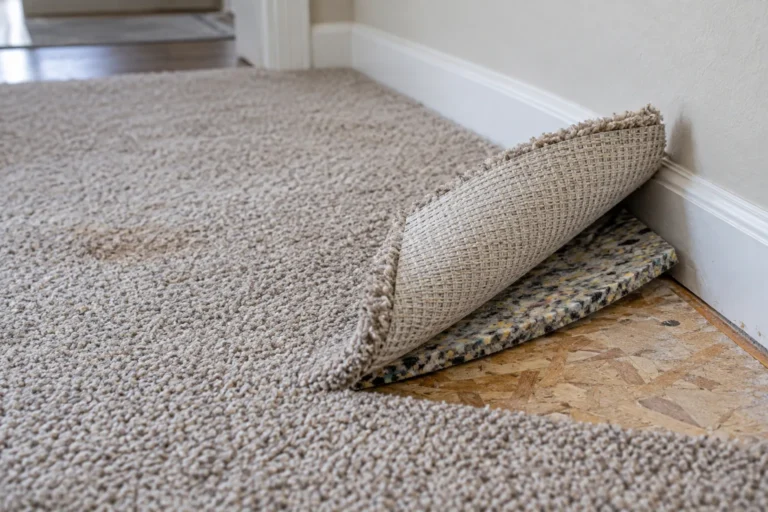
Installed carpet is layered. The visible pile sits over backing, a cushion or pad, and the subfloor. Loose soil may stay in the pile. A small fresh spill may also be contained there if it is blotted quickly. A large spill can move into the backing or pad even while the top begins to look dry.
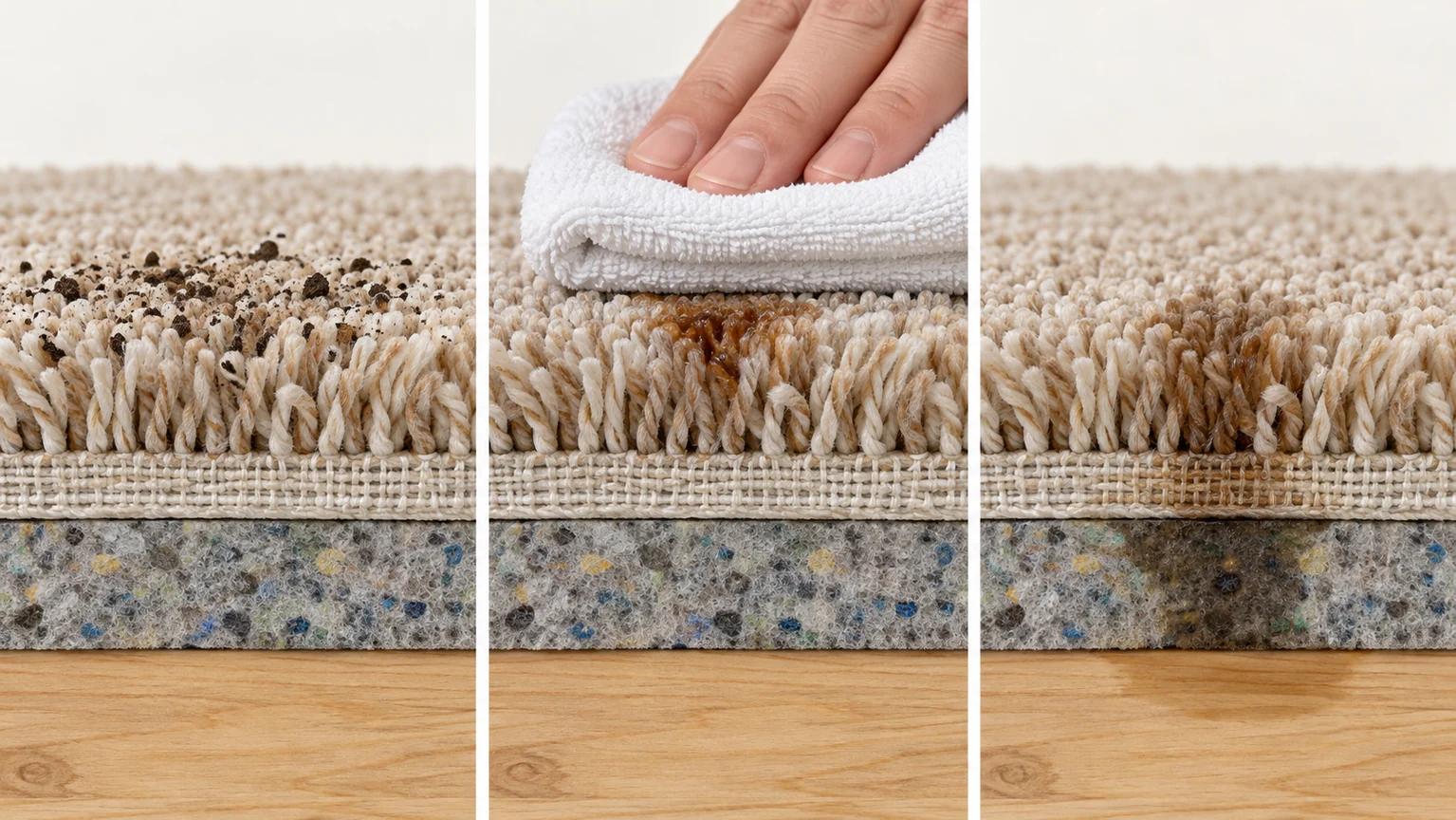
Hand cleaning has no recovery tank. Any water or solution you add must be removed with towels, evaporation, or a permitted low-moisture system. That is why broad hand shampooing can leave detergent behind or push moisture below the surface. The Carpet and Rug Institute treats vacuuming and spot removal as routine care, while periodic deep cleaning addresses embedded soil that those steps miss.
You usually cannot prove pad condition from the top. A large spill, slow drying, a returning ring, persistent odor, or moisture at a seam or edge are reasons to suspect deeper involvement. Do not pull up installed carpet unless a flooring or restoration professional directs the inspection.
A cool feel alone cannot locate moisture, and a dry-looking or dry-feeling top does not establish dry backing or padding. Do not lift installed carpet or pull a seam to check.
How to clean carpet without a carpet-cleaning machine
These steps are for ordinary installed carpet whose material and care instructions permit routine vacuuming and spot cleaning. They are not permission to wet-clean a sensitive or unknown rug.
Move light items without dragging them across the carpet. Look for active leaks, damp edges, dye transfer, loose seams, fraying, mold, or a sewage-like or strong chemical odor. Those are not normal surface-cleaning problems.
If the permitted dry-soil route finishes the job, do not add a cleaner or water. Continue to the spot route only for a remaining known spill, and follow its complete residue-removal and drying requirements. This is not a whole-room hand-shampooing sequence.
Remove dry soil; stop here if that is the whole job
Empty or replace the vacuum bag or bin as its instructions require, set the head for the pile, and vacuum slowly. Use overlapping paths rather than a quick pass. Clean edges and accessible crevices with the correct attachment.
For loop pile, fringe, or a delicate rug, use only the method allowed by its care instructions. A rotating brush can catch some loops or fringe.
Do not add water while loose grit remains. Wet grit is harder to recover and can spread into a muddy residue.
If you have no vacuum, limit the job to loose surface debris
A manual carpet sweeper or carpet-approved gentle broom can collect some visible debris from suitable low-pile carpet. It will not remove deeply held grit, fine dust, or sticky soil. Avoid stiff brushing on loops, fringe, delicate fibers, or any carpet whose care instructions do not permit it.
Treat a known spot only when needed
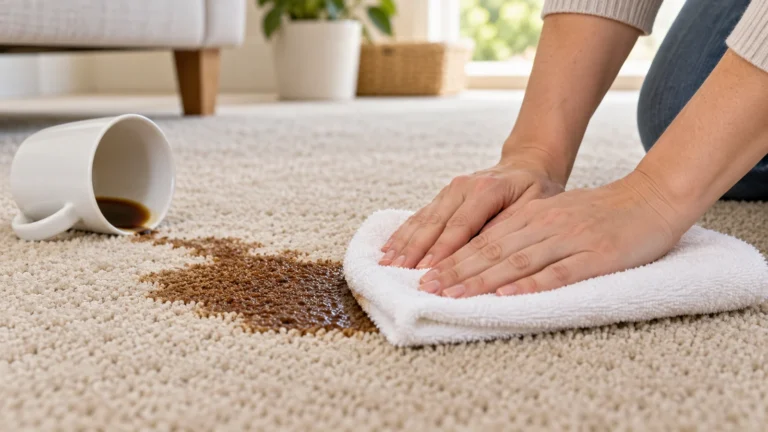
For a known spill, use the specific route. For example, coffee on carpet needs a different sequence from urine that may have reached the pad.
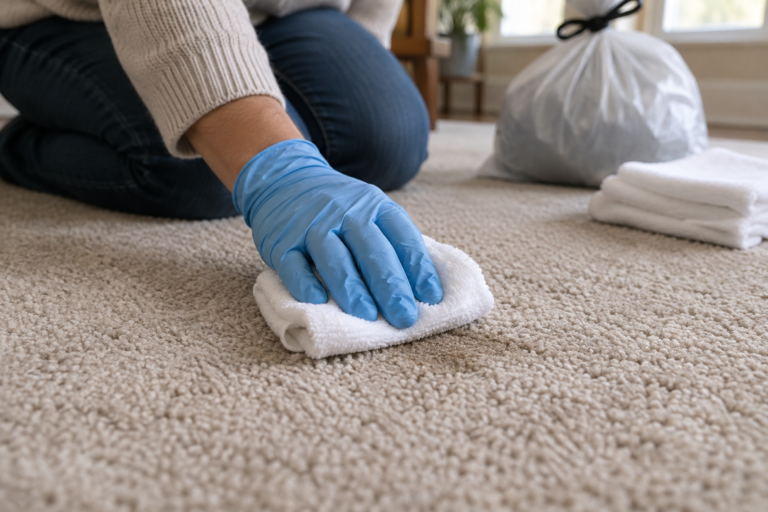
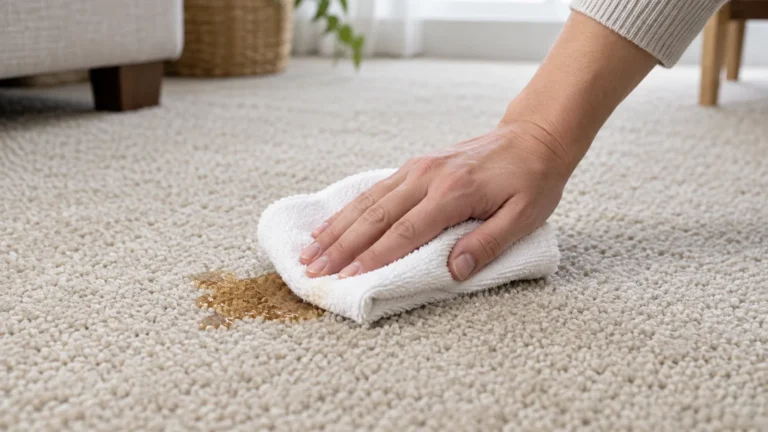
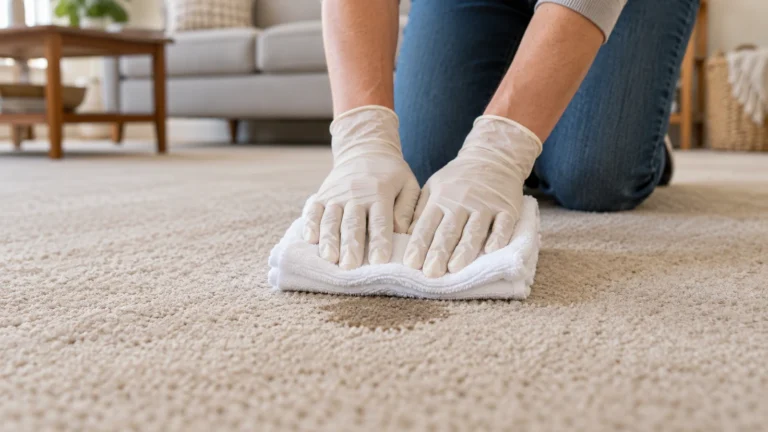
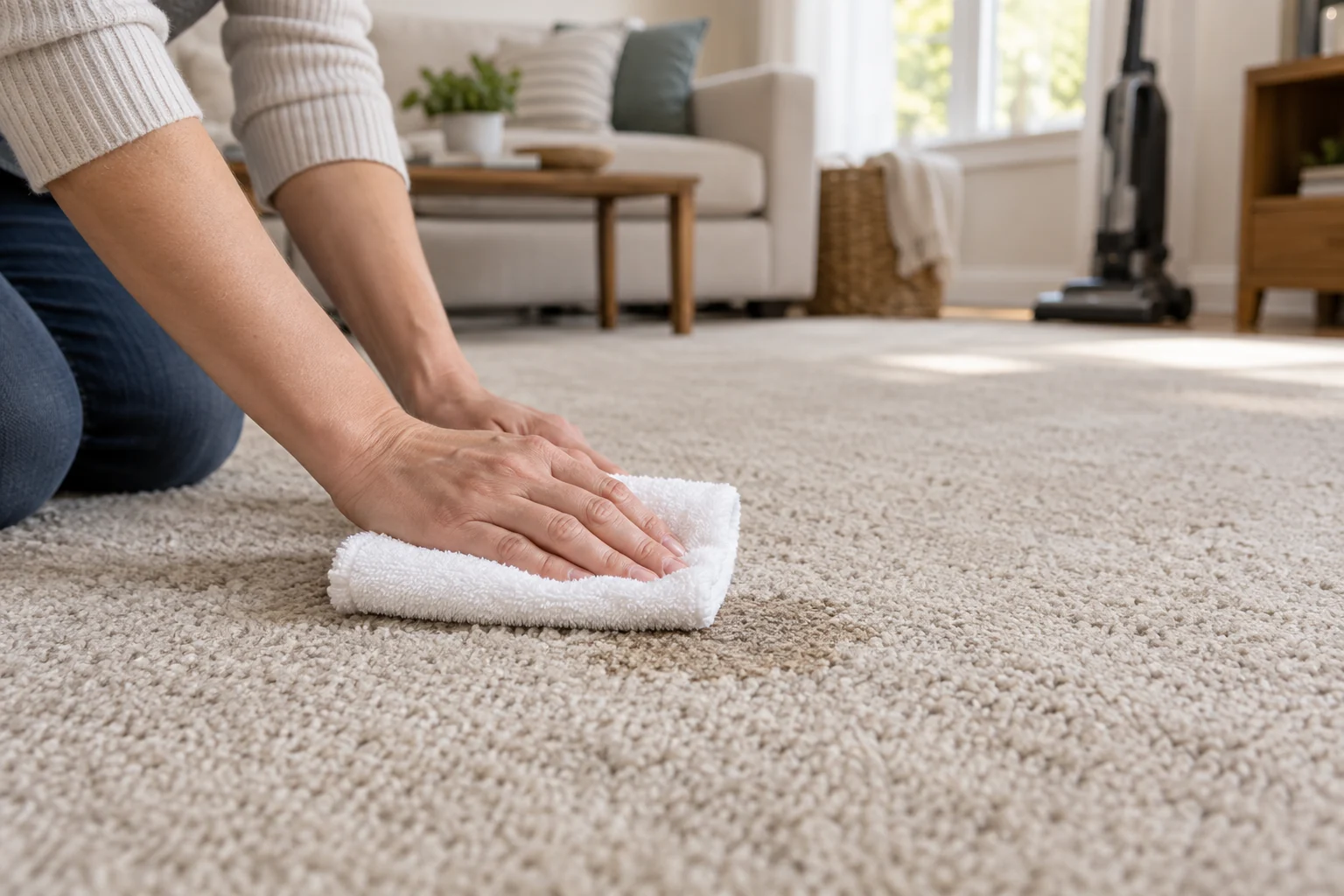
Lift semisolid material with a spoon or dull edge. Blot liquid with a clean white absorbent towel until transfer slows. Do not scrub. CRI warns that brushing and scrubbing can fray fibers and change texture.
Use a product only when the carpet instructions and the current product label support the fiber and stain. Pretest as directed. Apply a small amount to a white cloth rather than pouring it into the carpet, then work gently from the outside of the spot toward the center.
Is water and a towel enough for this spill?
For a fresh water-soluble spill on a compatible carpet, blotting and a small clear-water step may be part of the correct stain route. Water alone does not remove every soil, and excess water can move into the backing. Use the stain-specific and carpet instructions.
Remove treatment residue without flooding
Follow the product and carpet instructions. When a limited clear-water step is permitted, apply small amounts with a fresh cloth and blot them back out. Remaining detergent can attract soil and make the area look dirty again.
Do not rinse a room-size area by hand if you have no way to extract the water evenly. Do not pour water onto a spot to make it “reach” a deeper stain. If contamination is below the pile, extra surface moisture does not solve the depth problem.
Wick out moisture and allow complete drying
Press dry white towels over the treated area and replace them as they become damp. Keep people and pets off the spot. Use normal ventilation, a fan, or a dehumidifier only when the carpet and product instructions allow that drying setup.
There is no universal drying time. Pile density, backing, pad, room humidity, airflow, and the amount of liquid all matter. Judge the result only after the carpet is fully dry.
Read the dry result before adding more liquid
Run a clean dry hand lightly over the dry pile. Sticky or stiff fibers may indicate residue. A returning brown ring may be wicking from deeper material. Odor that returns after drying can mean the source remains below the surface.
Do not answer those clues with another full wet treatment. Stop adding moisture and have the cleaning depth assessed.
What about baking soda, vinegar, dish soap, or a scrub brush?
Do not treat any of them as a universal carpet-cleaning system.
- Baking soda: Powder can be difficult to remove from dense pile or backing. Check both the carpet and vacuum instructions before using a powder.
- Vinegar: An acid is not automatically compatible with every fiber, dye, backing, stain treatment, or previous cleaner. It also should never be added where bleach or unknown residue may be present.
- Dish soap: A product designed for dishes may leave residue in carpet. WoolSafe specifically warns that washing-up liquid can leave sticky residue and accelerate resoiling on fine fibers.
- A stiff brush: CRI says scrubbing and bristles can fray carpet and change its texture. Agitation belongs only in a method that the carpet and product instructions support.
- Steam from an iron or steam mop: Heat is not a universal cleaning step. It can affect fibers, dyes, adhesives, stain chemistry, and urine odor. Use heat only when a stain-specific guide and the carpet manufacturer explicitly permit it.
When dirty carpet is really an odor or moisture problem
A fragrance or surface refresh cannot remove a source held below the pile. If the room smells but the carpet looks clean, locate the source before adding deodorizer. Use the carpet deodorizing guide to separate dry surface odor from urine, smoke, dampness, and other sources.
Visible mold, a musty odor with dampness, or a spot that keeps returning needs moisture diagnosis. Use the mold-on-carpet guide and correct the water source before deciding whether the material can be cleaned or must be replaced.
Can you clean a whole carpet by hand?
You can improve appearance by removing dry soil and treating individual spots. You may also use a manufacturer-approved low-moisture interim system on a compatible carpet. That is not the same as deep cleaning a whole room.
A true room-wide cleaning method must control four things:
- how evenly the cleaning product is distributed;
- how soil is loosened without damaging the pile;
- how the product and suspended soil are removed;
- how much moisture remains in the pile, backing, and pad.
Hand shampooing cannot reliably control all four across a room. If the carpet is broadly gray, oily, sticky, heavily trafficked, or overdue for restorative cleaning, use a carpet-care method allowed by the manufacturer. CRI recommends periodic professional deep cleaning and notes that carpet warranties may specify products, equipment, or service intervals.
When to rent a machine or call a professional
Move beyond hand cleaning when:
- broad traffic lanes or a whole room need cleaning;
- soil is oily, sticky, or embedded rather than loose and dry;
- a spill reached a seam, edge, backing, pad, or subfloor;
- odor, a stain ring, or dampness returns after complete drying;
- the carpet is wool, viscose, sisal, seagrass, antique, hand-dyed, valuable, or unknown;
- dye transfers, the pile distorts, or texture changes during a test;
- the warranty requires a specific cleaning system or provider; or
- sewage, floodwater, mold, or an unknown hazardous material is involved.
Ask how the cleaner will identify the carpet, remove residues, control moisture, verify drying, and protect the warranty. No honest provider can promise that every stain or deeply contaminated pad can be restored.
Updated October 23, 2026: separated dry-soil care from optional spot treatment, moved wet-carpet and contamination limits before cleaning, and placed the no-vacuum, water-only, pad-condition, and disinfection answers beside the decisions they limit. Material, product, drying, and professional-care warnings are retained.