How to Remove Carpet Stains: Match the Spill, Fiber, and Depth
Choose the stain-specific route before choosing a carpet cleaner. Identify the surface, its fiber and care instructions, what caused the mark, and what has already been applied. Then use the matching guide below; this page is a route selector, not one cleaning recipe for every spill. Do not layer a new product over an unknown cleaner, and do not assume vinegar, peroxide, dish soap, solvent, or bleach is safe for every carpet.
When a stain is actually a moisture or contamination problem
Visible mold, sewage or floodwater, and persistent wetness are not ordinary spot-cleaning jobs. The EPA notes that mold can penetrate porous materials such as carpet and that moldy carpet may have to be discarded. The CDC advises discarding carpeting and padding that cannot be cleaned and dried quickly after floodwater exposure, which can include sewage and other contaminants.
For mold, first stop the moisture source and use the dedicated mold-on-carpet decision guide. For sewage, floodwater, or an unknown hazardous substance, isolate the area and use an appropriate restoration or remediation professional. Do not vacuum, scrub, or experiment with household cleaners on a contamination you cannot safely identify.
If the carpet is wool, viscose, sisal, seagrass, antique, hand-dyed, warranty-covered, or unknown, stop after dry blotting and use its care instructions or a qualified carpet or rug cleaner.
Match a known spill to its carpet guide
Use the first moves below only for an identified spill within the material and safety limits above. A matching stain name is not permission to treat a sensitive fiber, an unknown residue, or a wet-through carpet. If the spill or care instructions are uncertain, use the material and previous-product checks before adding anything.
| What you see or know | Safe first move | Use this route | Stop household treatment when |
|---|---|---|---|
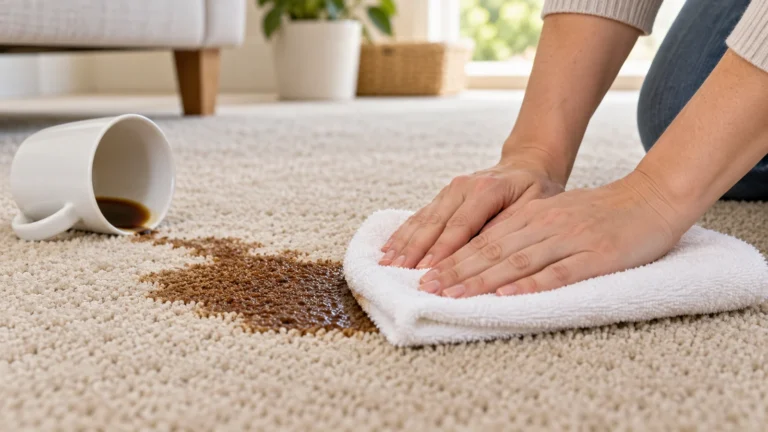
| Coffee or a brown drink mark | Blot fresh liquid with a dry white towel | Coffee stains on carpet | The drink reached the pad, contained unknown ingredients, or returns after drying |
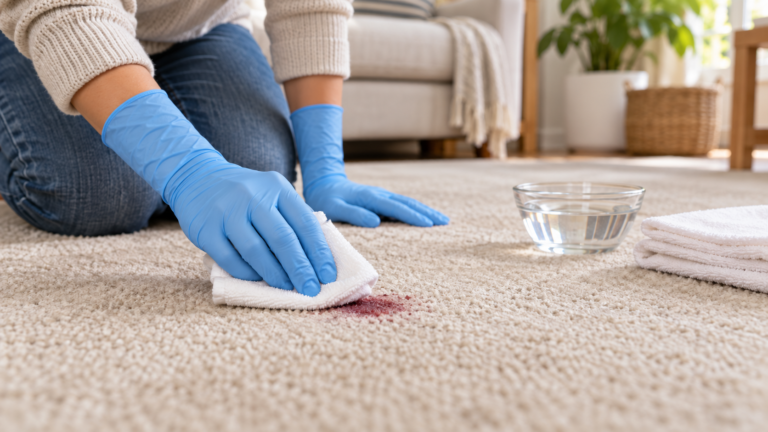
| Blood | Keep heat away; check the blood guide’s exposure limits before touching the spot | Blood on carpet | The source creates an exposure concern, the stain is large, or the carpet is sensitive or unknown |
| Pet urine or a returning urine odor | Absorb fresh liquid without flooding the area | Urine smell from carpet | Odor returns after drying or moisture reached the pad or subfloor |
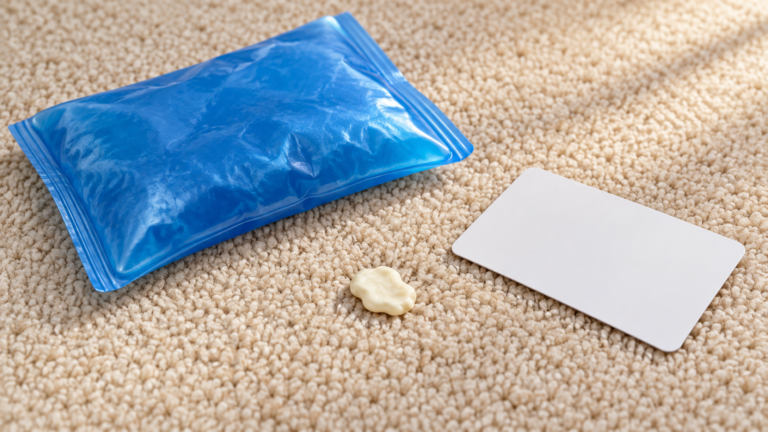
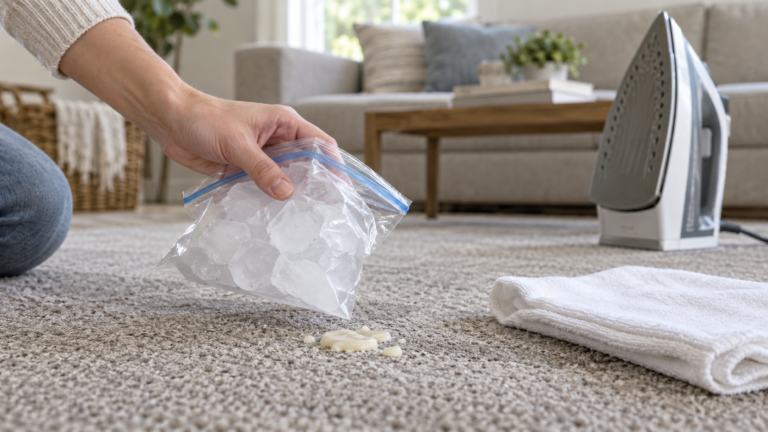
| Gum | Harden and lift it without pulling the pile | Gum in carpet | Fibers stretch, loosen, or begin to lift |
| Candle wax | Let hot wax cool; do not smear it deeper | Candle wax on carpet | The carpet is heat-sensitive, unknown, or color starts transferring |
| Nail polish or solvent-based cosmetic | Blot the edge and keep the spot small | Nail polish on carpet | A previous solvent is unknown or the backing may be affected |
| Visible mold, a damp patch, or mold returning in the same place | Stop the moisture source and avoid disturbing the area | Mold on carpet | Mold involves the backing or pad, the area is extensive, or the carpet cannot be dried fully |
| Odor with no clear visible stain | Locate the odor source before deodorizing | How to deodorize carpet | The odor is musty, sewage-like, chemical, or keeps returning |
| Unknown stain or several products already used | Do not add cleaner; record what was applied | Check the maker’s care instructions or a stain selector | You cannot identify the fiber, residue, or original spill |
The point of this table is not to diagnose every mark by color. Different substances can dry to a similar shade, and the same spill can need a different response on wool, nylon, polyester, viscose, or a blended rug. Use what you know about the spill and material; do not guess a stronger chemical from appearance alone. If there is no defined stain and the whole carpet needs routine soil removal, follow the carpet cleaning without a machine guide instead of spot-treating the room.
Resolve the material and treatment history before spot care
1. Is it installed carpet or a removable rug?
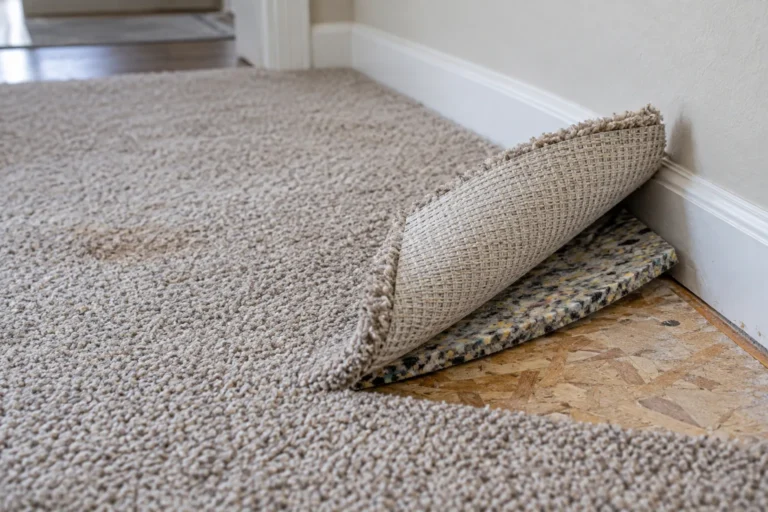
An installed carpet has backing and usually a pad below it. A large liquid spill can move past the visible pile while the top begins to look dry. A removable rug may have different fibers, dyes, backing, and care instructions—and its underside can sometimes be checked without disturbing installed flooring.
Do not pull up installed carpet simply to investigate a spot. A seam, stretched carpet, tack strip, glued installation, or wet pad may need a carpet professional or water-restoration service.
2. What is the fiber and what do its care instructions allow?
Check the purchase paperwork, manufacturer information, rug label, or warranty before using a spotter. A hidden-area test can reveal immediate color transfer or texture change, but it cannot prove that a product is safe for every dye, backing, adhesive, or long-term warranty condition.
Treat a blended carpet or rug according to its most sensitive fiber. WoolSafe groups sisal, seagrass, coir, viscose, Tencel, and bamboo among moisture-sensitive fine fibers and warns against spraying a water-based spot remover directly onto them. For an unknown or valuable rug, dry blotting and specialist advice are safer than trying a general household recipe.
3. What caused the mark, and what has already been applied?
The original material matters more than the stain’s final color. Food and drink, blood, urine, wax, gum, polish, paint, soil, and mold do not share one safe removal sequence.
Write down every product already used. If a cleaner is unknown, do not add another one. Poison Control advises never mixing household cleaning products because some combinations can produce dangerous fumes. Even when a dangerous reaction is not the issue, layering products makes fiber compatibility and residue harder to judge.
Decide whether spot cleaning is still the right scope
Carpet is layered. The visible yarn is the pile; below it are one or more backing layers, and installed carpet often sits over a pad and subfloor. The same brown ring can therefore represent a surface residue or material rising from a deeper layer as the carpet dries.
A small fresh mark that responds to blotting is not proof of a pile-only spill. A cool feel alone cannot locate moisture, and a dry-looking or dry-feeling top cannot establish that the backing or pad is dry. Do not lift installed carpet, pull a seam, press out liquid, or deliberately reproduce squishing to investigate the layers.
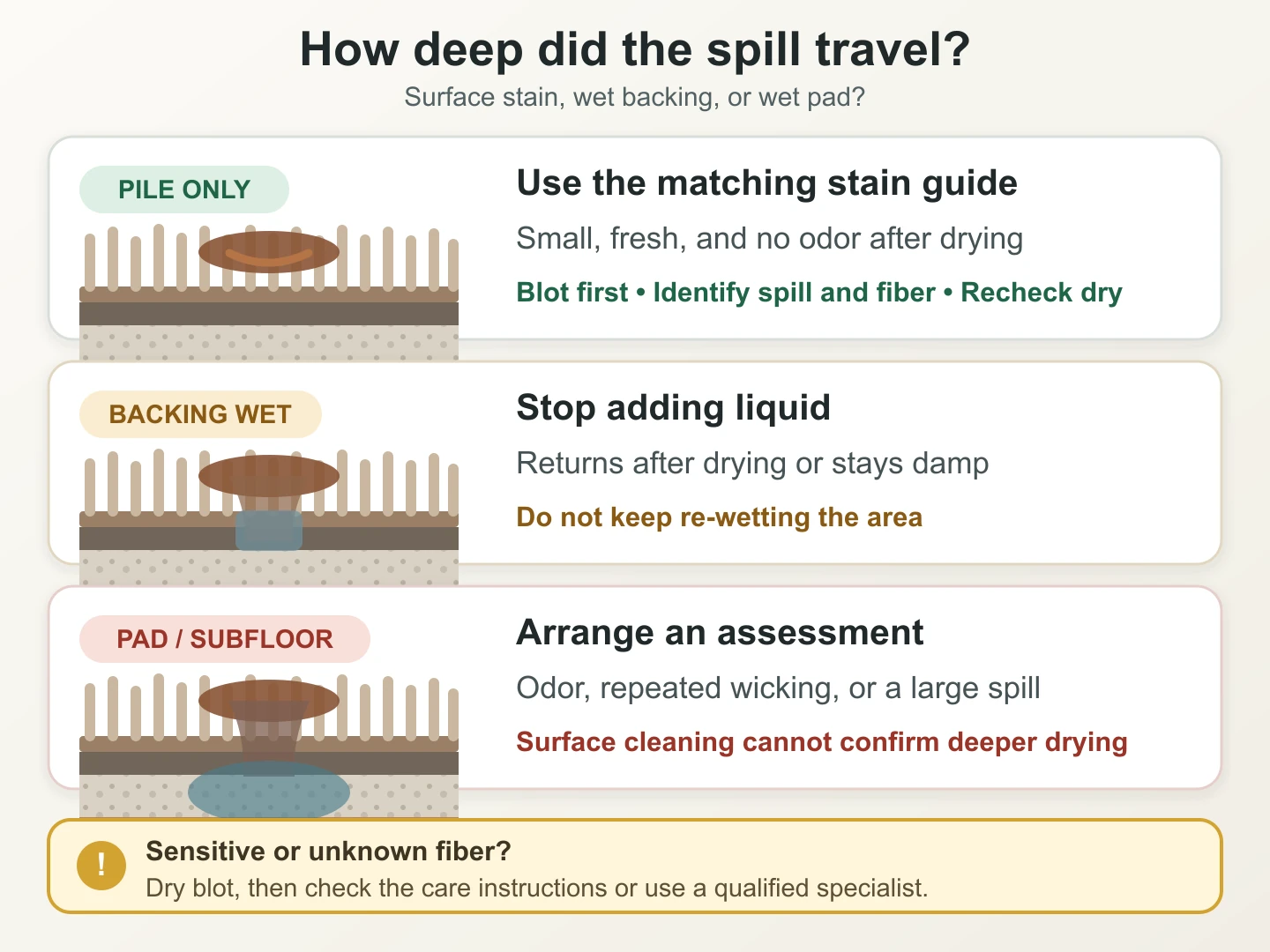
Use the observations you already have to decide whether to stop, not to name the wet layer:
- Limited spot care may be appropriate, not proven surface-only: a small fresh mark, little liquid, no seam involvement, no persistent dampness, no odor after drying, and no return after one compatible treatment. These observations do not establish that the backing or pad stayed dry.
- Possible backing involvement: a large spill, slow drying, a ring that returns, or liquid seen at an edge or seam.
- Possible pad or subfloor involvement: persistent odor, repeated wicking, previously noticed squishing or persistent dampness, or a spill large enough to soak through.
Those signs do not prove which lower layer is wet. They are reasons to stop adding liquid. Surface cleaning cannot reliably remove contamination held in padding or a subfloor.
Do not keep re-wetting a recurring stain. A professional can use controlled extraction and assess whether lower layers need drying, cleaning, or replacement.
Contain only an ordinary, identified spill while choosing the route
For a small, identified, nonhazardous spill, these steps limit spreading while you select a compatible stain-specific method. They do not override the contamination warning, material restrictions, or the blood guide’s exposure limits, and they are not a universal stain-removal formula.
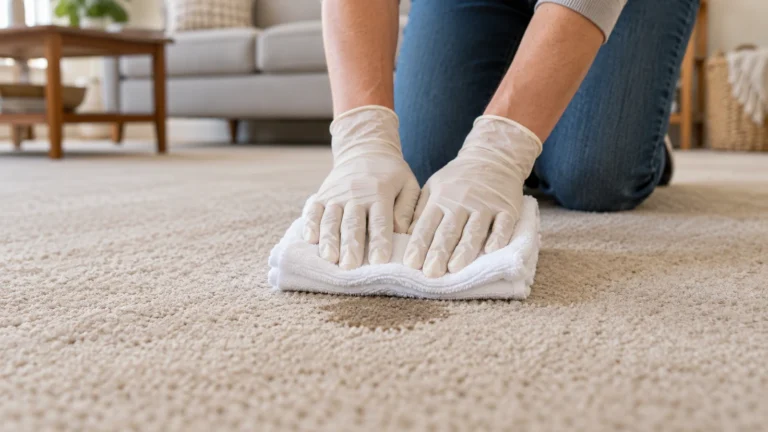
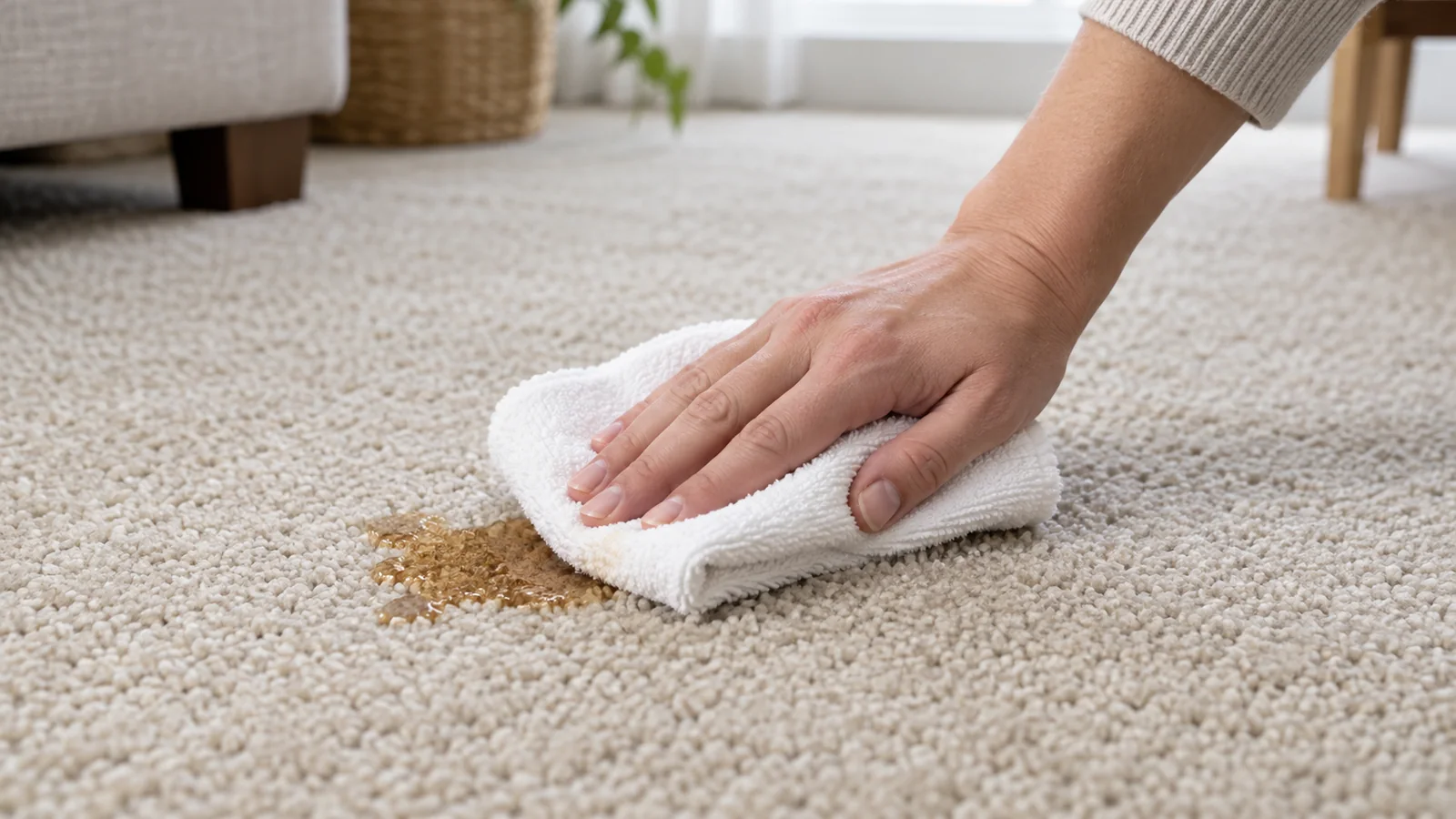
- Remove excess material without spreading it. Lift soft or solid material with a spoon or dull edge. Press a folded dry white towel onto liquid. Move to a clean section as transfer appears.
- Work from the outside toward the center. Keep the boundary from growing. Do not scrub; Shaw advises blotting because abrasive rubbing can fray carpet fibers.
- Keep the area controlled. Do not pour water or cleaner directly onto the spot. Avoid walking on it, and keep children and pets away while you identify the spill.
- Check the care route. Use the manufacturer’s instructions, the Carpet and Rug Institute Spot Solver, or the WoolSafe Stain Wizard for the identified stain and material.
- Stop if the carpet changes. Dye on the towel, fuzzing, stiffness, distortion, spreading color, stronger odor, or growing dampness means the next step should be professional assessment—not a stronger product.
Why a carpet stain can return after it dries
A returning mark usually needs diagnosis rather than another round of product.
- Residue-related resoiling: cleaner, sugar, oil, or another residue remains in the pile and attracts soil.
- Wicking: moisture or dissolved material travels upward from deeper pile, backing, or padding during drying.
- The source remains: urine, moisture, mold, or another odor-producing material persists below the visible surface.
- Fiber or dye changed: the “stain” is now fading, pile distortion, or texture damage rather than removable material.
After permitted small-spot care, let the area dry fully before judging the cosmetic result. Do not wait for drying to address hazardous contamination or persistent wetness. If the mark or odor returns, stop adding liquid and use the relevant guide or arrange an inspection.
What not to do while identifying a carpet stain
- Do not scrub a wet spill or use a stiff brush.
- Do not pour cleaner into the carpet or saturate the spot “to rinse it.”
- Do not mix cleaning products or place a new product over unknown residue.
- Do not use heat until the stain-specific guide and carpet instructions support it.
- Do not treat a hidden-area test as a guarantee of long-term compatibility.
- Do not assume a stain is removable after the fiber, dye, backing, or finish has changed.
- Do not use a method written for synthetic installed carpet on wool, viscose, sisal, seagrass, silk, antique, hand-dyed, or otherwise valuable rugs.
When to call a carpet or rug professional
Use a qualified cleaner, rug-care specialist, water-restoration company, or remediation professional when:
- the fiber, dye, backing, or previous cleaner is unknown;
- the carpet or rug is wool, a moisture-sensitive fine fiber, antique, hand-dyed, valuable, or warranty-covered;
- color transfers, pile distorts, or the spot grows during treatment;
- moisture, odor, or a ring returns after the area dries;
- the spill reached a seam, backing, pad, or subfloor;
- mold, sewage, floodwater, or another potentially hazardous material is involved; or
- the mark is no longer residue but appears to be permanent fiber or dye damage.
Ask what training applies to your carpet or rug material and whether the service can assess lower-layer moisture. A general promise to “remove any stain” is not a substitute for material-specific care.
Updated October 23, 2026: moved contamination and material limits ahead of the spill selector, grouped the material and previous-product checks, and combined the depth guidance. Clarified that a small mark, a cool feel, or a dry surface cannot confirm dry backing or padding. The stain-specific links, cleaning-product warnings, and specialist-care boundaries are retained.