How to Remove Coffee Stains From Carpet Without Spreading Them
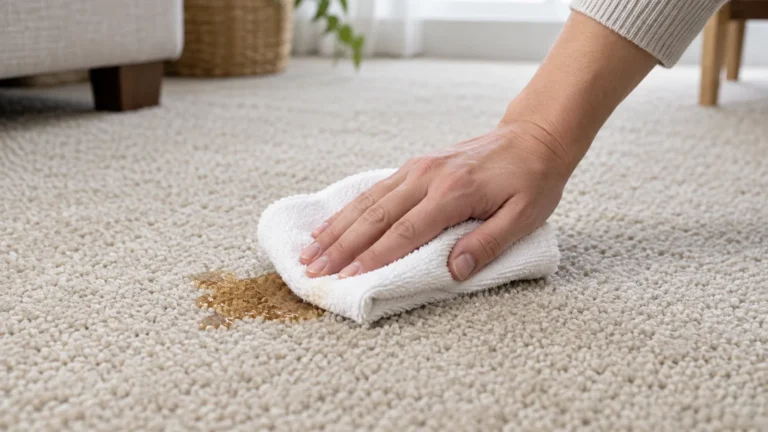
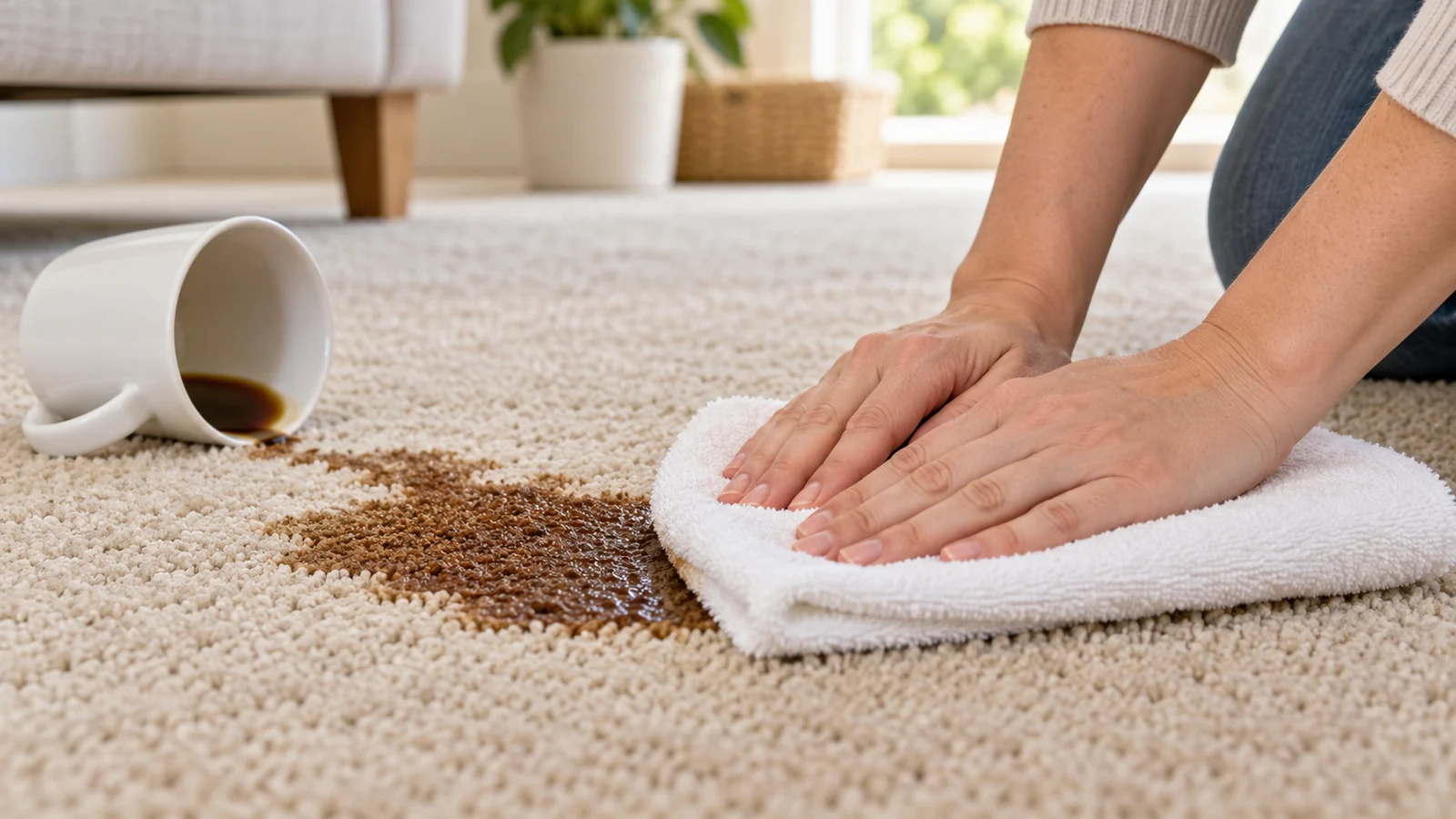
Blot a fresh coffee spill with a dry white towel—do not rub or pour cleaner onto it. For a known water-cleanable synthetic whose care instructions permit it, test clear water before using a lightly dampened cloth. If brown color remains, a manufacturer-permitted detergent route may help; the measured mixture and ingredient restrictions are in step 3. Complete the hidden test, controlled cleaning, rinse, and full drying. Do not add stronger chemicals just because a mark remains.
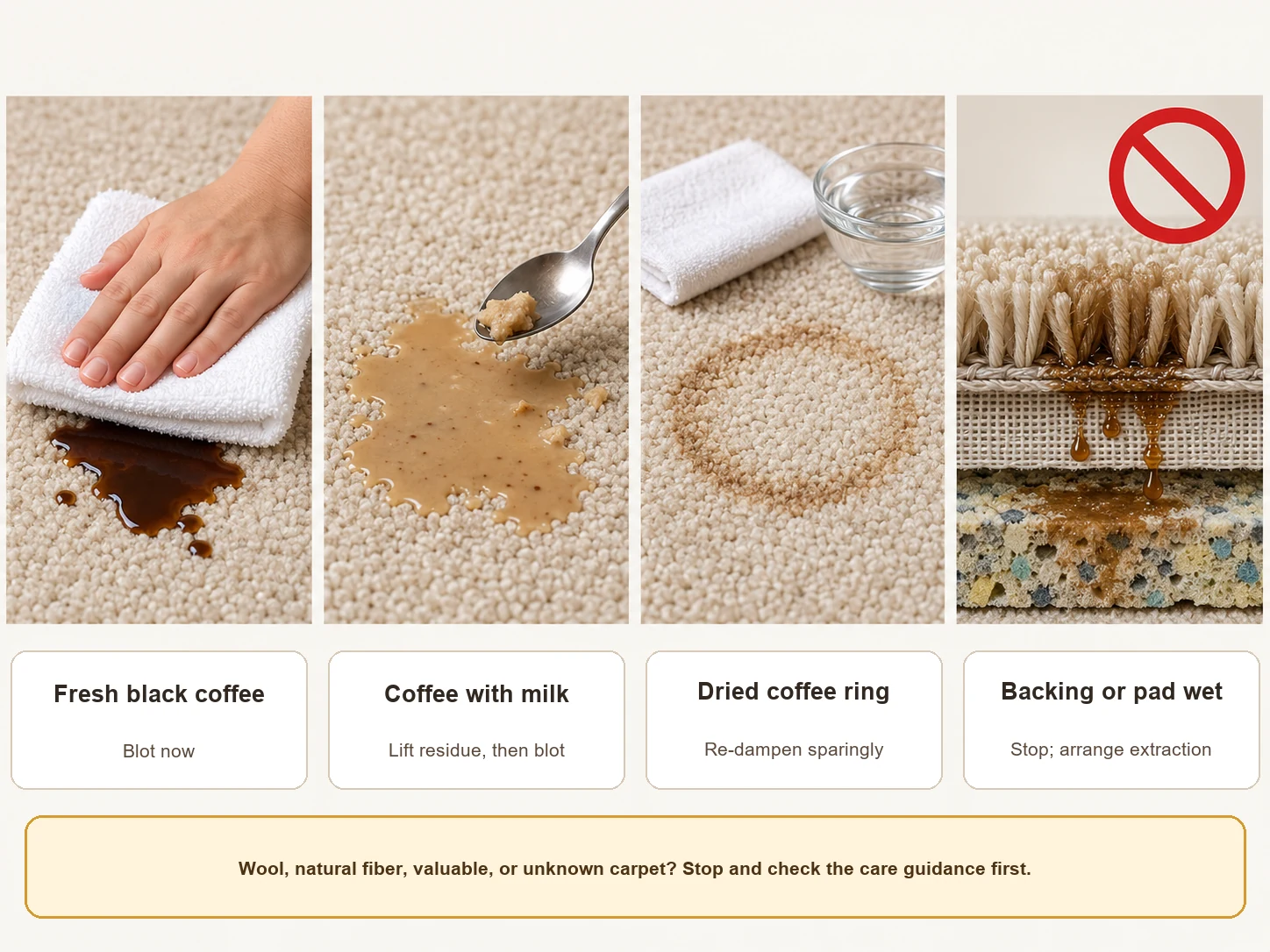
Stop before adding cleaner if the carpet is wool, another natural fiber, valuable, unknown, already treated with an unidentified product, or wet through to the backing. Those conditions need the care label, manufacturer guidance, or a qualified carpet cleaner.
Follow the small-spill steps · Check the detergent and test · Decide what to do after drying
Check the carpet, ingredients, and spill depth first
The first blotting step is similar for many spills, but the next step changes with the carpet and the coffee.
- Is the spill still wet? Remove free liquid before introducing water or detergent.
- Was it black coffee or did it contain milk, cream, sugar, syrup, or flavoring? Added ingredients can leave sticky or odor-causing residue even after the brown color fades.
- Do you know the carpet material and care instructions? Wool, natural fibers, specialty rugs, and some stain treatments need material-specific care.
- Could the spill extend below the surface? A large spill, returning ring, persistent dampness, or odor warrants caution. A cool feel alone does not locate the moisture, and a dry-feeling surface cannot prove the backing or pad is dry. Do not lift installed carpet or pull a seam to check.
- Has another cleaner already been used? Do not add a second product to an unknown residue. Mixing or layering cleaners can create a new compatibility problem and make the original stain harder to assess.
Use clean white cloths or plain white paper towels so you can see what transfers and avoid adding dye. Keep each pass small. CRI recommends pretesting a spot solution in an inconspicuous area and applying it to a white cloth rather than flooding the carpet.
Use this sequence only for a small, localized spill on a known water-cleanable synthetic carpet whose manufacturer permits the complete method. Find the carpet identity and care instructions first. If a maker requires a named spotter, extraction system, or different procedure, use that route instead of substituting the mixture below.
Match the coffee stain to the safer first move
| What you have | Safest first action | Conditional next step | Stop or escalate when |
|---|---|---|---|
| Fresh black coffee on known synthetic carpet | Press with dry white towels, then blot with a clear-water-dampened cloth | Check manufacturer permission and complete the detergent test, including rinse and full drying, if brown color remains | Dye transfers, texture changes, or dampness suggests the spill is beyond a small surface spot |
| Coffee with milk, cream, or sugar | Remove liquid and any soft solids; blot, then use the controlled water/detergent sequence | Rinse residue carefully and let the area dry fully | Sour odor, sticky return, or spill reached the pad |
| Dried brown mark | Lightly re-dampen with a clear-water cloth and blot | Use one compatible tested method; do not layer products | Previous cleaner is unknown, color lifts, or fibers change |
| Wool, natural-fiber rug, valuable rug, or unknown carpet | Dry blot only and check the care label or maker’s instructions | Use a qualified rug or carpet cleaner | Do not guess with vinegar, peroxide, solvent, or a stronger spotter |
| Ring returns after drying or the area stays damp | Stop adding cleaner and press with dry absorbent towels | Arrange professional extraction or inspection if the pad may be wet | Persistent moisture, odor, a large spill, or repeated wicking |
What changes before the shared procedure?
Milk, cream, or sugar: remove soft solids as well
Start with the same dry blotting and controlled mild-cleaning sequence. Remove any soft solids with a spoon rather than pushing them into the pile. The goal is to remove both visible coffee and the residue left by dairy, sugar, syrup, or flavoring.
Do not assume an enzyme product, solvent, vinegar mix, or oxygen cleaner is safe merely because the coffee contained milk or sugar. Follow the carpet maker’s instructions and the product label for the exact fiber and stain treatment.
Dried mark: remove loose debris, then use the same permitted route
A dried stain needs controlled rehydration, not aggressive scrubbing.
Vacuum loose dry debris around the spot without grinding it into the pile.
For the known compatible synthetic described above, use steps 2–6 below: complete the clear-water test, use the hidden-tested detergent method only if needed and permitted, then rinse, blot, and dry fully before deciding whether to repeat.
One small-spot procedure for permitted synthetic carpet
1. Blot out as much coffee as possible
Place a folded dry white towel over the spill and press straight down. Lift, move to a dry section, and repeat. Work from the outer edge toward the center so the wet boundary does not grow. Do not scrub; friction can spread the liquid and change the pile.
2. Lift more color with controlled clear water
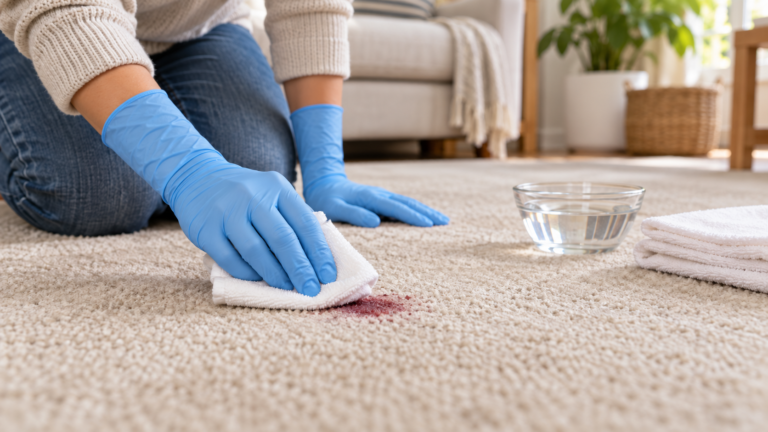
First test clear water on a hidden part of the same carpet: use a lightly dampened white cloth, blot dry, and compare after it fully dries. Stop for color transfer or a changed pile. If unchanged and water cleaning is permitted, blot the coffee with a second cloth dampened—not soaked—with clear water, followed by a dry towel. Continue only while color transfers and the wet boundary is not growing. Stop for spreading or persistent dampness; do not probe below the pile to claim the backing is dry. IICRC places this clear-water step before detergent.
3. Make and test the mild detergent solution
If the brown mark remains and your carpet maker permits this basic detergent method, use 1/4 teaspoon of clear hand-dishwashing liquid without bleach, lanolin, or optical brighteners in 1 cup of lukewarm water. This is the restricted mixture in the Carpet and Rug Institute’s care guide, not permission to use any dish product. Verify the ingredients or ask its supplier; appearance or “gentle” wording is not enough. If compatibility cannot be established, stop and ask the carpet maker for a suitable spotter. Do not make the mixture stronger. Do not use laundry detergent or automatic-dishwasher detergent.
Test the complete permitted method on a hidden area of the same carpet. Lightly dampen a white cloth with the measured solution, apply a small amount, and check the cloth and pile for dye transfer or change. Complete the rinse-and-blot removal in step 5 before allowing the test to dry; detergent left drying on the fibers is not a completed test. Then compare the fully dry test with untreated carpet for fading, stiffness, a ring, tackiness, or fuzzing. End the treatment immediately for dye or surface damage, rather than waiting for drying to decide whether to stop. Use the visible-spot method only if the test stays unchanged.
4. Blot from the edge toward the center
Lightly dampen a white cloth with the tested solution. Apply it in small passes from the outside edge toward the center, then blot with a dry section. Do not pour the solution directly onto the spot. Continue only while the stain transfers and the pile and color stay unchanged. Pause when transfer stops; more detergent or longer wetting is not the default next step.
5. Rinse out detergent residue
Use a fresh white cloth lightly dampened with clear water, followed by a clean dry towel. Rotate or replace cloths as they pick up residue and complete the carpet-approved rinse without pouring liquid into the pile. Stop adding water if the wet boundary expands or dampness persists; ask a cleaner about residue removal rather than soaking the spot to finish. A detergent-treated area is not finished just because brown color stops transferring. CRI and Shaw’s carpet-cleaning guidance warn that retained cleaning product can attract soil; milk and sugar add another residue concern.
6. Dry before judging the result
Press clean, dry white towels over the damp area without rubbing; replace them as they become damp. If the maker prescribes weighted towels, use only the weight and setup it allows. Keep children, pets, shoes, and furniture off the area until it is fully dry. Allow safe room ventilation and keep electrical equipment away from wet surfaces. Do not use a hair dryer or an iron to rush this check. A dry-feeling top does not establish dry backing or padding; persistent dampness or odor needs professional advice.
Read the fully dry spot before adding more product
| After full drying | What you can conclude | Next decision |
|---|---|---|
| No mark or tackiness remains; the pile is unchanged | No further stain treatment is needed if rinsing and drying are complete | Stop adding product. Keep observing rather than cleaning a normal-looking patch again. |
| The mark is smaller or lighter, with no changed dye or texture | The permitted method may be helping, but complete removal is not guaranteed | Repeat only if the maker permits it, the previous residue was removed, and each attempt makes progress. Do not enlarge the wet area. |
| The mark is unchanged, a ring returns, or tackiness remains | Appearance alone cannot distinguish fixed staining, remaining coffee, or retained cleaner | Stop the repeated household-treatment cycle. Save photos and product details for the maker or a qualified carpet cleaner. |
| Dye transfers or pile becomes rough, light, shiny, or distorted | The treatment may be changing the carpet | End treatment immediately and obtain advice; do not clean a larger patch to blend the change. |
| The spot is not drying, smells sour, or the original spill was large | The condition of the backing or pad is unresolved | Keep the area out of use and ask for professional assessment instead of more rinsing. |
Compare photographs in similar light after full drying, not only while the carpet is darkened by moisture. Record what was spilled, the approximate amount, products used, and whether the mark returned during drying or after traffic. These notes help a cleaner choose the next investigation; they do not diagnose the hidden layers.
Use the dry-result decisions before any repeat: another attempt needs manufacturer permission, completed residue removal, unchanged carpet, and visible improvement. An unchanged mark is a reason for advice, not indefinite rewashing of the pile. If you do not know what a previous owner or cleaner used, stop before adding another chemical.
If milk or sugar residue remains
Rinse in small passes after detergent and blot out as much moisture as possible. If the color disappears but the area becomes sticky, soils quickly, or develops a sour odor after drying, stop adding household products. Residue may remain below the surface, or the spill may have reached the pad. A carpet cleaner with extraction equipment can assess that without asking you to saturate the area again.
Why a ring can return after drying
Two different problems can look like a returning stain:
- Residue-related soiling: sugar or detergent left in the fibers attracts soil, so the area darkens again with foot traffic.
- Wicking from below: liquid that reached deeper pile, backing, or padding travels upward as the surface dries, leaving a ring or shadow.
A controlled clear-water rinse belongs only to a known, manufacturer-permitted residue-removal sequence—not an experiment to identify a returning ring. Repeated reappearance, a large original spill, persistent dampness, or odor warrants assessment because appearance alone cannot establish the depth or cause. Stop wetting the area and arrange professional advice or inspection.
What not to use as a universal coffee-stain remedy
- Do not scrub or use a stiff brush. It can spread the stain and alter the pile.
- Do not pour water or cleaner onto the carpet. Oversaturation can carry coffee and cleaner into the backing or pad.
- Do not use laundry detergent or automatic-dishwasher detergent. CRI identifies brightener and bleaching risks and stresses thorough residue removal.
- Do not mix cleaners or add a product over unknown residue. Use one supported method at a time.
- Do not treat vinegar as universally safe. Mohawk directs coffee to a vinegar step within its own published carpet procedure, but that does not make vinegar suitable for every carpet or rug.
- Do not make hydrogen peroxide the default next step. IICRC discusses 3% peroxide for residual color but warns that it is not recommended for wool or other natural fibers without extensive color-loss testing. The safer household boundary is to check the maker’s instructions or call a professional before that escalation.
- Do not scatter baking soda into the spot simply to add another step. BISSELL notes that fine baking-soda particles can be difficult to remove from carpet.
- Do not apply steam or extra heat unless the carpet manufacturer specifically allows it. Heat is not needed for the mild first route and can complicate material or residue questions.
Can vinegar remove coffee stains from carpet?
Some carpet makers include a diluted vinegar step in a product-specific procedure. Mohawk, for example, directs coffee past its ammonia procedure to the separate vinegar procedure. This is a stain-specific route, not an instruction to add vinegar to ammonia or another cleaner. Check your own carpet’s instructions; do not treat that procedure as universal permission for wool, natural-fiber, specialty, or unknown carpet.
When to call a carpet or rug professional
Stop household treatment when the carpet is wool, silk, another natural fiber, hand-dyed, valuable, antique, unknown, or under a warranty you cannot verify. Professional help is also appropriate when:
- carpet color transfers to a white cloth;
- pile becomes fuzzy, stiff, dull, shiny, or distorted;
- the spill is large or reached a seam, edge, backing, or pad;
- the spot stays damp, smells sour, or returns after a full dry cycle;
- an unknown cleaner was already applied; or
- repeated gentle treatment produces no useful improvement.
IICRC notes that complete coffee removal can be difficult on natural fibers and recommends an IICRC-certified cleaner when its basic procedure does not work.
Should I rent a carpet-cleaning machine?
Use a machine only when its instructions and your carpet maker allow it. IICRC places clear-water machine rinsing after visible stain removal in its coffee guidance. A large or pad-deep spill may be better handled by a professional who can control extraction and drying.
Related carpet guides
If you are not sure the mark is coffee, use the carpet-stain decision guide to match the spill, fiber, and possible backing depth before trying this coffee-specific route.
If the stain is gone but the fully dry carpet still smells, use the source-first steps in How to Deodorize Carpet instead of masking the odor.
Other spills need different methods. Use the dedicated guides for nail polish on carpet, candle wax on carpet, or blood on carpet rather than borrowing the coffee sequence.
Updated October 23, 2026: separated spill preparation from one shared small-spot procedure and grouped residue and returning-ring decisions beside the dry-result table. The detergent restrictions, complete hidden-test rinse/dry comparison, no-progress decisions and spill-specific safety boundaries added October 22 are retained.