How to Remove Rust Stains From Clothes Without Damaging the Fabric
Quick answer
To remove a rust stain from washable, colorfast clothing, use a rust remover whose label specifically permits use on that fabric. Test it on a hidden area, dampen and treat the stain exactly as the product label directs, rinse thoroughly, and wash according to the garment care label. Air-dry the item and check the spot before using a dryer.
Do not use chlorine bleach on rust. Do not mix the rust remover with bleach, vinegar, ammonia, detergent, or another cleaner. Take dry-clean-only, delicate, leather, suede, or non-colorfast garments to an appropriate professional cleaner.
First, make sure the orange mark is likely rust
Rust usually leaves an orange, reddish-brown, or brown mark. The location and timing of the stain are useful clues:
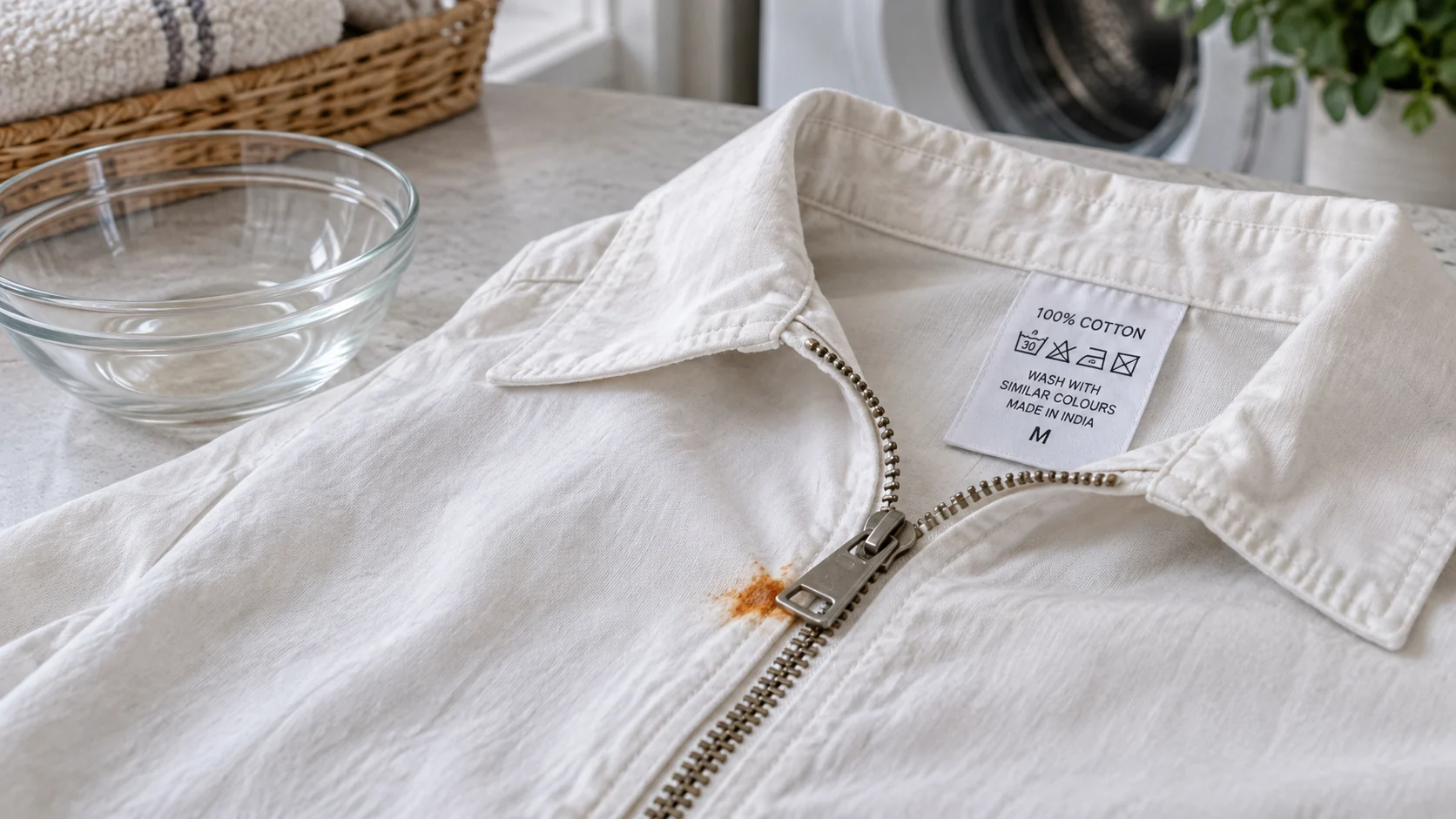
- A spot beside a metal zipper, snap, buckle, drying rack, tool, or outdoor chair may be rust transferred by direct contact.
- Orange marks that appear on several items after a wash may point to corrosion inside the washer or iron in the water.
- A greasy, waxy, yellow, or dye-like mark may be a different stain and needs a different treatment.
Do not keep applying stronger products to an unidentified mark. If you are not confident it is rust, start by checking when the mark appeared and what touched the fabric. For other possibilities, see our guides to detergent stains on clothes and paint on clothes.
Choose the safe route for the garment
| What you have | Best next step |
|---|---|
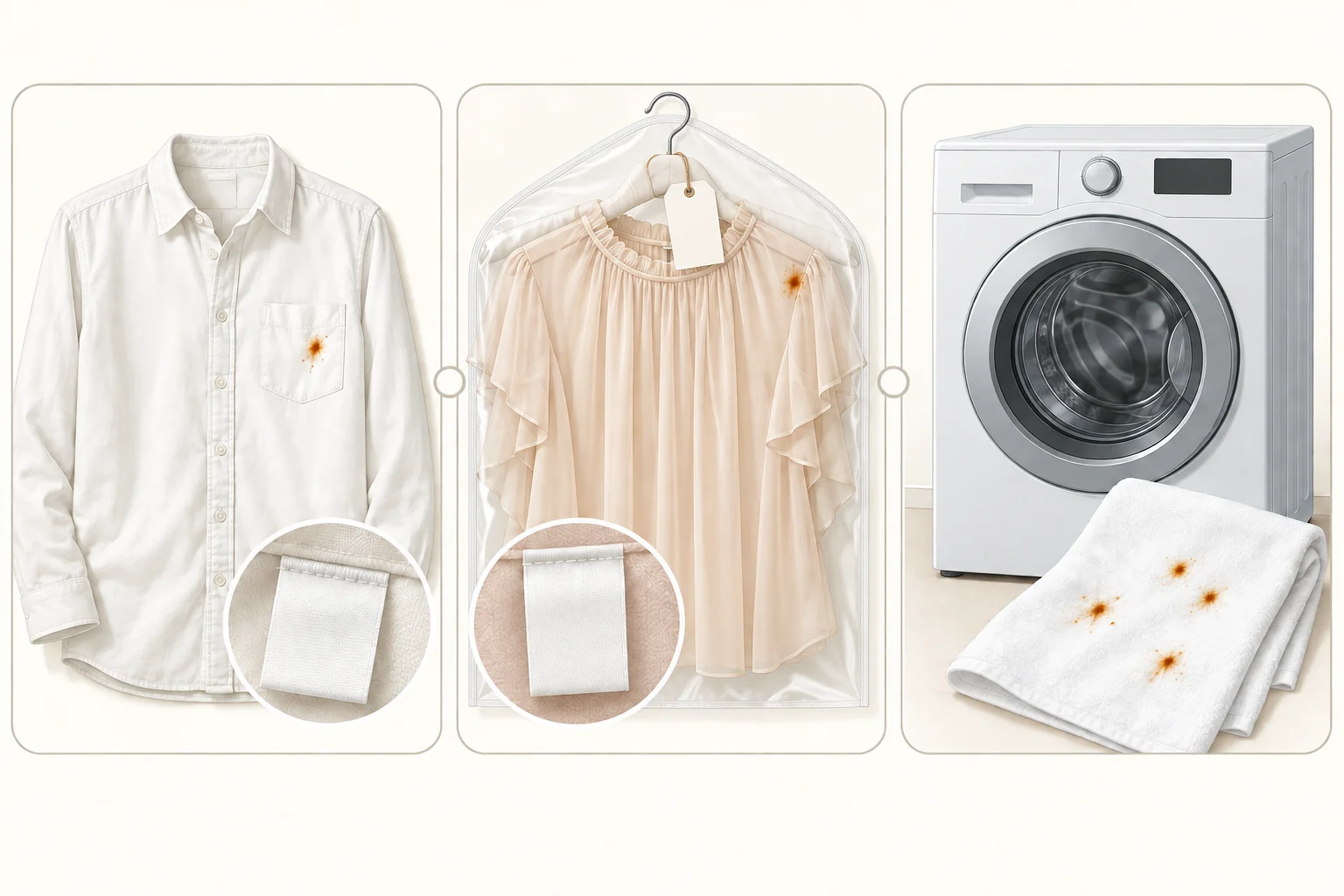
| Washable, colorfast cotton or another sturdy washable fabric | Use a rust remover that explicitly lists clothing or that fabric on its label. Patch-test first and follow the label exactly. |
| White clothing | Follow the same fabric and product checks. White does not make chlorine bleach suitable for rust. |
| Dry-clean-only garment | Do not spot-treat it at home. Show the stain to a professional dry cleaner before cleaning. |
| Silk, wool, embellished fabric, unstable dye, or a valuable garment | Use a professional cleaner unless both the garment and treatment labels clearly allow the method. |
| Leather, suede, or fur | Use a cleaner experienced with that material; do not apply a household fabric treatment. |
| Orange spots appearing across repeated wash loads | Stop treating individual spots long enough to investigate the washer and water source. |
If the care label is missing or unreadable, the safest choice for a valuable or delicate item is professional treatment.
What you need
- The garment care label
- A rust remover explicitly labeled for the garment’s fabric or for washable clothing
- Clean water for dampening and rinsing
- Heavy-duty rubber gloves or any other protection required by the product label
- Good ventilation if the label calls for it
Keep the original product container beside you so you can follow its contact time, rinsing instructions, first-aid information, and fabric restrictions. Do not substitute directions from a different brand or an online recipe.
How to remove a rust stain from washable clothes
1. Read both labels before opening the product
Confirm that the garment is washable. Then read the remover label from beginning to end. It should clearly permit use on clothing or the garment’s fiber. A product meant only for toilets, masonry, tools, or other hard surfaces is not automatically safe for fabric.
Follow every safety instruction on the container, including ventilation, gloves, eye protection, storage, and first aid. Keep children and pets away from the work area.
2. Test a hidden area
If the product label permits a colorfastness test, place the instructed amount on an inside seam, hem allowance, or another inconspicuous area. Wait and rinse for exactly the times on the label.
Stop if the dye changes, the finish dulls, the fibers weaken, or the fabric texture changes. A passed patch test lowers the risk; it does not override the garment or product label.
3. Isolate the stain
Work on the affected item by itself. If loose rust particles are sitting on the surface, gently lift them away without grinding them into the fibers. Do not scrub aggressively; friction can spread the mark or damage the weave.
Do not start this process if another cleaner is still on the fabric. Rinse out known residues as their labels direct. If you do not know what was previously applied, stop and seek professional advice rather than creating an accidental chemical mixture.
4. Apply the rust remover exactly as labeled
Dampen the stained area first if the product directs you to do so. Apply only the stated amount and keep it on the fabric only for the stated contact time. Rust removers may be strongly acidic, so more product or a longer wait is not necessarily safer or more effective.
Watch the fabric during treatment. Rinse immediately and stop if you notice color loss, surface damage, or another unexpected change.
5. Rinse thoroughly, then launder
Once the stain is no longer visible—or when the label’s maximum contact time is reached—rinse with clean water as directed. Launder the item according to both the remover instructions and the garment care label.
Do not add chlorine bleach or another stain remover to the treatment. If the two labels conflict, choose the more protective instruction or stop and use a professional cleaner.
6. Air-dry and inspect
Air-dry the garment after washing. Check the stained area in good light before using a machine dryer or iron. If a shadow remains, do not keep repeating an acid treatment beyond the product label’s limit. Reassess the stain and garment, or ask a professional cleaner whether another attempt is appropriate.
What not to use on a rust stain
Chlorine bleach
Skip chlorine bleach, including on white clothes. Clorox explains that sodium hypochlorite can oxidize iron and make a rust stain worse. A K-State Extension stain guide likewise warns that chlorine bleach can react with rust or iron in hard water and discolor clothing.
Mixed cleaners
Never combine a rust remover with bleach, vinegar, ammonia, detergent, or another cleaner. The CDC warns never to mix household bleach or disinfectants with other cleaners because dangerous vapors may be released. Its broader cleaning guidance also says to use a product suitable for the material, follow the label, and not mix chemicals.
If bleach or an unknown cleaner has already touched the garment, do not add an acid-based rust remover. Rinse only as the existing product’s label directs and contact the manufacturer, Poison Control, or emergency services if an exposure or fumes occur.
WD-40, toothpaste, and hard-surface rust products
These frequently appear in videos and forums, but they are not reliable universal fabric treatments. WD-40 may introduce an oily stain; toothpaste can contain abrasives, whiteners, or colorants; and hard-surface rust products may not be designed for textiles. Use only a treatment whose label covers the actual fabric.
Vinegar, lemon, salt, and baking soda combinations
Some older extension publications and many household-remedy pages describe lemon, salt, or vinegar methods. Other current guidance says these weak acids may not be strong enough for many rust stains. Because fabric dyes, finishes, fibers, concentrations, and exposure times differ, this article does not present a universal kitchen-ingredient recipe.
Do not combine these ingredients with another cleaner. Visible fizzing is not proof that a mixture is safe for the garment or effective on rust.
Can you remove old or dried rust stains?
An older stain may still respond, but there is no guaranteed home method. Previous washing, drying, ironing, repeated rubbing, or incompatible chemicals can make removal harder or damage the fabric around the stain.
Use the same label-controlled process for a washable, colorfast garment; do not increase the concentration or contact time on your own. Stop if the approved number of treatments fails. For a valuable item, professional treatment is usually less risky than escalating to an unlabeled chemical.
How to remove rust stains from white clothes
White fabric still needs a care-label check and a rust remover approved for that fiber. The absence of colored dye does not mean every chemical is safe: bleach can worsen an iron stain, and strong acids can damage fibers or finishes when used incorrectly.
Patch-test in a hidden area, follow the remover label, rinse, wash as allowed, and air-dry to inspect. Do not increase product strength just because the garment is white.
What if rust stains appear after washing?
One isolated mark may have come from a forgotten metal object or contact with rusty hardware. Repeated orange-brown spots across different items point to a source that needs investigation.
- Pause the affected loads. Repeatedly treating clothes will not correct the source.
- Check pockets and removable metal objects. Look for screws, clips, tools, coins, or other corroding items.
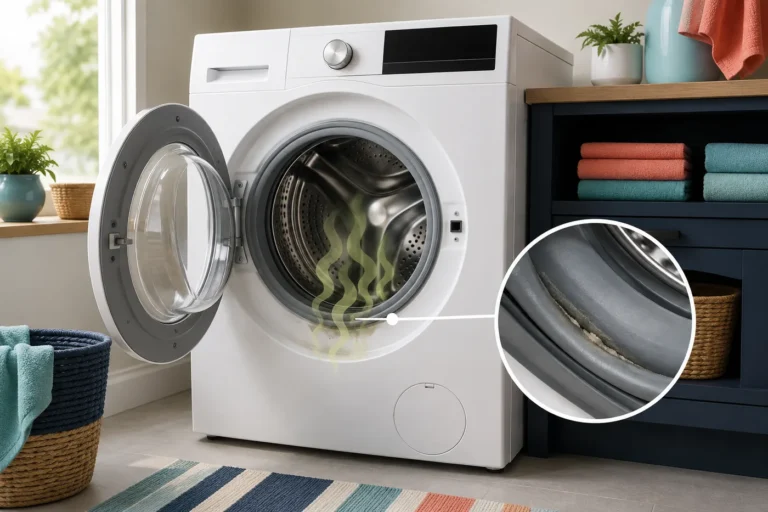
- Inspect the washer without disassembling it. With the machine off, look for visible corrosion around the drum or basket holes and other accessible metal parts. Do not reach into moving parts or remove panels.
- Compare other water fixtures. Reddish-orange staining or sediment at sinks and toilets can support a water-source explanation.
- Ask for appropriate testing. Public-water customers can contact their utility about monitoring results. Private-well users who suspect a problem can use a state-certified laboratory, as the EPA recommends.
- Use the right professional. An appliance technician can assess washer corrosion. A water-treatment professional or your local utility can help interpret an iron result and identify a suitable correction.
The EPA’s secondary drinking-water guidance lists 0.3 mg/L as the non-mandatory secondary standard for iron and associates higher levels with rusty color, sediment, metallic taste, and reddish or orange staining. This is an aesthetic and technical guideline, not a diagnosis of your water or a claim that every orange laundry mark comes from iron.
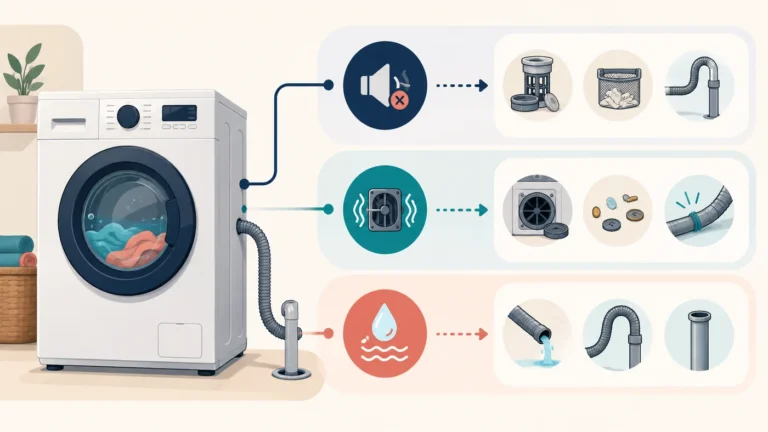
If the washer also has a draining problem, use our guide to safe washing-machine drain-hose checks for that separate issue.
When to stop and call a professional
Use a professional cleaner when:
- the care label says dry clean only;
- the garment is silk, wool, leather, suede, fur, embellished, vintage, or high-value;
- a hidden-area test changes the color, finish, or texture;
- you do not know which cleaner is already on the fabric;
- the stain is large, old, spreading, or still visible after the label’s allowed treatment;
- the garment has metal trim that may continue to corrode; or
- the treatment label does not explicitly cover the fabric.
Tell the cleaner what caused the mark, if known, and list every product already used. That information can prevent an incompatible follow-up treatment.
How to prevent rust marks on clothes
- Remove wet laundry promptly and keep it away from rusty racks, tools, fasteners, and outdoor furniture.
- Repair or replace corroded garment hardware rather than treating the same area repeatedly.
- Empty pockets before washing.
- Investigate repeated orange marks across multiple loads instead of assuming they are ordinary stains.
- Have visible washer corrosion evaluated by an appliance technician.
- Ask your utility about iron results or use a state-certified laboratory for a suspected private-well issue.
For another food-based laundry problem, see how to remove tomato sauce stains from clothes.
Frequently asked questions
Does bleach remove rust stains from clothes?
No. Chlorine bleach can make an iron-based rust stain worse. Use a rust remover labeled for the garment’s fabric, and never combine it with bleach.
Does vinegar remove rust from clothing?
Vinegar may lighten some marks, but it is not a dependable universal treatment for rust on every fiber, dye, or finish. A product whose label explicitly allows use on the garment provides clearer compatibility, timing, rinsing, and safety instructions. Never add vinegar after bleach or mix it with another cleaner.
Can baking soda remove rust stains from clothes?
Baking soda is not the evidence-backed first choice used in this guide. It may fail to remove iron staining, and mixing it with other cleaners adds uncertainty. Use a textile-approved rust treatment and follow its label.
Why did my clothes get rust stains in the washing machine?
Possible sources include a corroded object left in a pocket, rusty hardware inside the washer, or iron in the water. If marks appear on several items or return across loads, investigate the source before repeatedly treating the clothes.
Will a rust stain come out after it has been dried?
It may, but success is not guaranteed. Do not compensate by increasing product strength or contact time. Follow the treatment label and stop if the garment begins to change or the permitted attempts fail.
Related guides
- How to Remove Detergent Stains From Clothes
- How to Remove Paint From Clothes Without Setting the Stain
- How to Remove Tomato Sauce Stains From Clothes
- Washing Machine Drain Hose Problems: Kinks, Leaks, and Safe Checks